The Stuff:
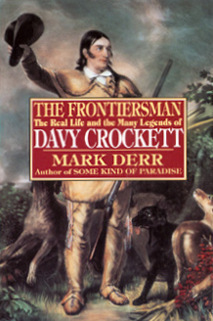
This is a non-sensationalized biography of early American Davy Crockett (1786-1836), frontiersman and congressman, written by a distant relative. Author Mark Derr seeks to wade through the many myths and find the person behind the stories. He adopts a more-or-less neutral tone, neither excoriating nor lionizing the book’s subject. He openly admits, for example, that the wealth of Crockett’s second wife allowed him to enter politics and that the family owned slaves, whom they sold when pressed for money—a little detail the folks at Disney didn’t mention.
Derr opens his book with a discussion of the Disney TV shows and movie, which took some factual and legendary elements and added some of their own fiction to create an American hero who won every fight except the last one at the Alamo. Disney’s portrayal set off a frenzy for coonskin caps in the mid-50s.
Thoughts:
Derr writes that as both a distant relative and an admirer of the (ghostwritten) autobiography A Narrative of the Life of David Crockett of the State of Tennessee, he set out to find the man behind all the legends. He relied on what documentary evidence he could find—marriage licenses, land deeds, sale of slaves, or summaries of court cases. He is careful to state what is known, what is probable, and when he is speculating.
Complicating matters is that the legends began in Crockett’s lifetime, sometimes with his approval or encouragement. For example, Crockett often exaggerated his illiteracy. In the days before spell-checkers and handy dictionaries, people tended to spell phonetically unless they’d had a formal education. Like many of the era and background, Crockett’s family found a formal education beyond their means and, frankly, unnecessary. David could read and write—quaintly—as demonstrated in a handful of letters he wrote to family members. Derr quotes from some of these.
In the 1830s, a play called The Lion of the West opened in New York, half-poking fun, half-celebrating Crockett with a character named “Nimrod* Wildfire.” (In England, the play was titled The Kentuckian.) Nimrod, a congressman, introduces himself to a New York uncle, saying, “I’m half horse, half alligator, a touch of the airthquake with a sprinkling of the steamboat.” He continues, “I’ve got the prettiest sister, fastest horse, and ugliest dog in the deestrict.”
The narrative gets into the weeds a bit when describing the legislation that Crockett unsuccessfully championed, but it also demonstrates how bitter he became. His rancor toward his political opponents, real and perceived, only increased with time. After losing his congressional seat, he is supposed to have told his constituents, “You can go to hell. I’ll go to Texas.”
It’s hard not to feel sadness after reading this. I sensed a lot of “almost.” Crockett sponsored needed land reform while in Congress that went nowhere. A version of his bill passed sometime after his death. He opposed the removal of Native Americans. He seems to have been a glib talker, always ready with a story or joke.
Perhaps because the author intended to remain as neutral as possible, the prose can get a little dry at times, but that is forgivable. The hero, the Davy Crockett of Disney, born on the mountaintop in Tennessee, is an easier sale than the fallible human. At the same time, the Davy who killed him a b’ar when he was only three is a cardboard cutout rather than a real person. The human is more interesting, IMHO.
As for recommending the book, I can’t say it’s a page-turner, but it is interesting.
* “Nimrod” is used now to denote a stupid or clumsy guy. My guess here is that it hearkens back to its older use, that is, speaking of a hunter.
Title: The Frontiersman: The Real Life and the Many Legends of Davy Crockett
Author: Mark Derr
First published: 1993
 Reviews of Old and New Stories. Mostly Old
Interesting. People love to create myths and legends out of ordinary people. My husband had a coonskin cap when he was a boy.
Your husband was not alone in that! Myths and legends are fun. While there may not have been too many surprises here, it gives an appreciation for a human as a human,
warts and all.
Thanks for stopping by and leaving a note.
I always say we’re all humans who have good and bad qualities and should be viewed as such, rather than creative infallible heroes of history.
Agreed. The myth may be fun, but it is also one-dimensional. The human is much more complex.