
For October 11
Plot:
Hester Ward is a happily married mother of two small children. Still young, she’s good-looking (and aware of it), healthy, and prosperous. Yet after a dream like those she had when she was younger, she senses catastrophe approaching. She sees no point in telling her husband, Dick, about anything so silly.
They go out for dinner and, after a lovely evening, return about midnight. Hester falls asleep instantly. Dick sleeps in her dressing room, which opens onto her bedroom, leaving the door open for air because of the heat.
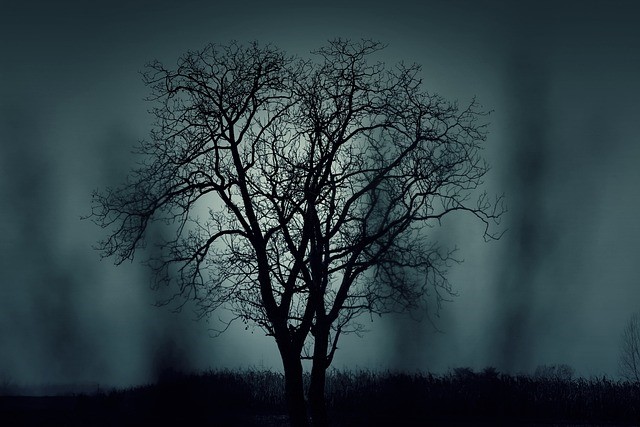
In her nightmare, Hester stands on a seashore, looking up at a church on a cliffside. The waves have worn away the earth under the church. Masonry and gravestones line the cliff bottom.
She has been here many times before, and although she tries to flee, she cannot. A pale oval light, the size of a man’s head, approaches her. It resolves into a face. Hester sees thin red hair. The lips form a cruel smile. “I shall soon come for you now,” a voice says.
Hester wakes up screaming.
At her husband’s insistence, Hester consults a doctor. The doctor finds her healthy and attributes her dreams to the unseasonable weather. He suggests a trip alone away from London to some quiet place she’s never been, where she’ll sleep better.
Thoughts:
This story is moody and atmospheric. Even by 1920s standards, Hester is not a hysterical woman. She tries to distract herself from her nightmares. They’re only dreams, and dreams don’t mean anything, right?
One thing I found interesting was a description that sounds a lot like sleep paralysis:
“…she tried to run away. But the catalepsy of nightmare was already on her; frantically, she strove to move, but her utmost endeavour could not raise a foot from the sand. Frantically, she tried to look away from the sand-cliffs close in front of her…”
The bad guy seems to have no connection to Hester. Why would he want to harm her in such a predatory way? Why single her out? Granted, it makes for irony that the place she goes away to for relief puts her in danger from the bad’un. Yet, the question remains—why her? Evil bad guy could have picked on a lot of people. IMseldomHO, this makes for a weakness in the story.
Nevertheless, overall, I liked this tale. The reader cares about Hester. She does her best in a world that doesn’t make sense. The few glimpses the reader gets of Hester and Dick’s married life show one of happiness. It would be nice to see them living happily ever after and playing with grandchildren.
Bio: E. F. (Edward Frederick) Benson (1867-1940) was a British author best known in his lifetime for his 1893 novel Dodo, satirizing British suffragist Ethel Smyth and his Mapp and Lucia series, which poked fun at the British upper middle class. These have been adapted for TV. In the 80s, British author Tom Holt wrote a couple of sequels. Benson is probably best known today for his short supernatural fiction.
The story can be read here:
The story can be listened to here: (36:10)
Title: “The Face”
Author: E. F. (Edward Frederick) Benson (1867-1940)
First published: Hutchinson’s Magazine, February 1924
 Reviews of Old and New Stories. Mostly Old
An intriguing story. It sounds like sleep paralysis to me but I wonder if back then that was just viewed as nightmare. I agree that the bad guy would pick on her without explanation seems like a weak point. However, I am not sure it would bother me that much. As usual you wrote a great review.
Thanks for your kind words. No, I don’t think sleep paralysis was known as such then. And, yes, the weakness was a minor point. I did enjoy the general creepiness of the story.