The Stuff:
Not all the cars take off when the light turns green. The man inside seems to be saying something, but it takes a while before anyone outside pays attention or stops to hear him. He cries, “I am blind.”
The blindness struck suddenly and without warning. The man cannot drive any further. Another man, a good Samaritan, offers to drive him home. He is grateful. The second man offers to wait with him until the newly blind man’s wife comes home. The blind man hesitates. What if this stranger steals from me? He declines. The stranger, offended, steals his car but doesn’t get far, for the blindness strikes him while he’s driving, and he wrecks.
When the wife of the first blind man gets home, she talks him into seeing an ophthalmologist. It’s difficult because they have no car, but they finally get to the office. The ophthalmologist can find nothing wrong with the man’s eyes. He says he sees nothing but white. After he leaves, the ophthalmologist also goes blind.
Before long, the authorities realize they have a plague, a “white sickness” on their hands. The only way to contain the plague is to round up those stricken with it and place them in a secure place—a disused mental facility. As the ophthalmologist is being loaded into the van that will take him away, his wife tells them to take her, too. She’s blind as well.
She’s not. She can’t bear to be parted from her husband. She will care for him—and many other blind people as well.
The internees (as they’re called) are supposed to be fed three times a day—but sometimes, the soldiers guarding them don’t bring the food. The blind don’t dare step outside, or they will be shot. They’re on their own.
Thoughts:
This book is brutal and sad. When you think it can’t get worse, it does. The internees are not able to take care of themselves. Their clothes become filthy, and their dormitories are like barns that never get cleaned. A simple wound gets infected and turns gangrenous; the soldiers will not provide antibiotics. If a few of the blind die off, well, less work for them, right?
The characters don’t have names but are designated by characteristics: the first blind man, the doctor, the doctor’s wife, etc. The prose itself makes reading confusing. According to the wisdom of the web, this is author Saramago’s style: no quotation marks, page-long paragraphs, no chapters, and comma splices to keep you reading without taking a breath. It takes a while to switch gears, but the reading is not difficult. You may have to stop occasionally and ask, “Now, who’s saying that again?”
Rather than revulsion—there is more than one reference to stepping on excrement on the floor as if blind people can’t find the bathroom facilities—the reader feels pity. These people don’t want to live like this. Later, sexual and physical violence occurs when the food runs short, making their plight all the more pitiful.
Like the people, the city and the country are never named. People who make pronouncements on these things say this is to give the story universality, but I thought it gave it anonymity, like people occasionally speaking on TV in shadow with their voice disguised.
No cause for the blindness is offered nor for the immunity of the doctor’s wife. This is just the way things are.
While the reading can be engrossing, it is also often something of a slog. It is not an enjoyable book, whatever insights it offers into human experience.
Bio: José Saramago (1922-2010) was a Portuguese writer and man of letters. He was awarded the Nobel Prize for literature in 1998. Among his notable works are Memorial do convento (1982; “Memoirs of the Convent”; Eng. trans. Baltasar and Blimunda) and O ano da morte de Ricardo Reis (1984; The Year of the Death of Ricardo Reis). The Encyclopedia Britannica describes Saramago’s writing as “setting whimsical parables against realistic historical backgrounds in order to comment ironically on human foibles.”
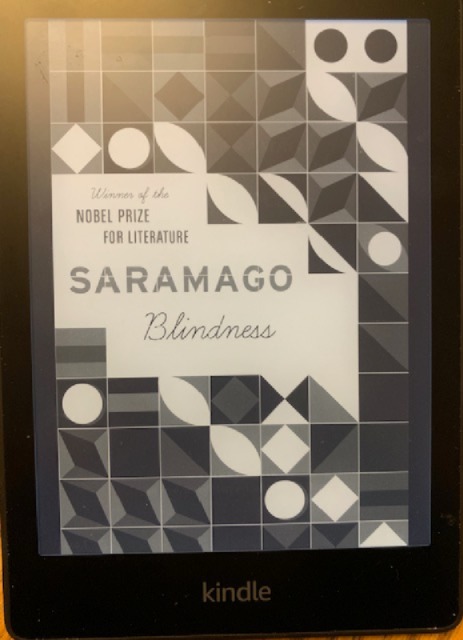
Title: Blindness (Originally: Portuguese: Ensaio sobre a cegueira, meaning Essay on Blindness)
Author: José Saramago (1922-2010)
First published: Portuguese 1995, English October 1997
Length: Novel
 Reviews of Old and New Stories. Mostly Old
This book sounds…unpleasant.
Yes. It’s engaging at times. but overall, just sad.
This book sounds depressing and scary. It sounds like a horror story. It also sounds like a metaphor for many of the evils in the world.
It is all that. It reminded me of “Day of the Triffids” and “Lord of the Flies” with page-long paragraphs.