A warning: This work, published posthumously, was written shortly before its author took his life in 1927 and reflects his long-standing despair. I wish to add that if you are dealing with issues like this, please call the Suicide Prevention and Crisis Hotline at 988.
The Stuff and Ramblings:
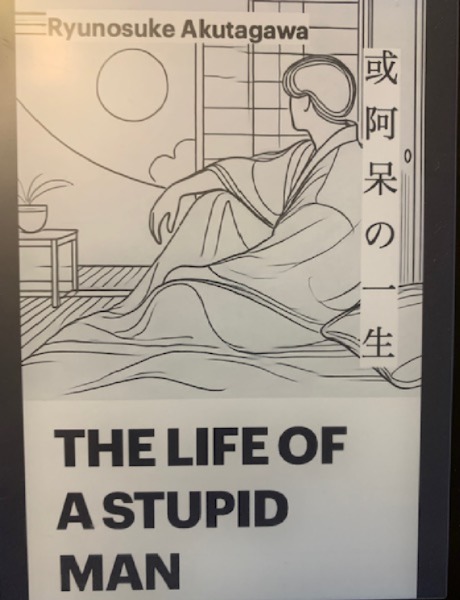
This extremely short semi-autobiographical book can be read in an afternoon, even if you have a helpful cat. It consists of fifty-one “chapters” or interconnected vignettes, offering the reader an impressionistic view rather than a consistent, chronological narrative.
Yet, there is a story here. The reader understands the author’s despair and pain. The main character is never named and is most often referred to simply as “he.” At the same time, the vignettes are not merely navel-gazing and never stoop to woe-is-me. Even in translation, there is genuine beauty that makes me wish I could read the original Japanese.
One example of the profound (?) in the mundane:
“Then, an overhead wire in front of him emitted a purple spark. He felt strangely moved. The pocket of his jacket concealed his manuscript to be published in the coterie magazine. As he walked in the rain, he looked up at the overhead wire behind him once more.
“The overhead wire continued to emit sharp sparks. Looking at life, there was nothing in particular he wanted. But just these purple sparks—just these fierce sparks in the sky—he wanted to catch even if it meant exchanging his life for them.”
I found the book beautiful and heart-rending, if obscure in some places. Above all, it is very human, making the reader (or at least this reader) wish to ask the author to stay—stay for just one more day.
None of which is to minimize or dismiss the agony the author must have been in toward the end of his life. He was experiencing insomnia and hallucinations, plus the terror of being convinced he would fall victim to the same mental illness that had struck his mother.
While I can understand that this book might not be for everyone, I found it poignant and a reminder of humanity at its barest.
This work is also known by the titles A Fool’s Life or The Life of a Fool.
Bio: Ryūnosuke Akutagawa (1892-1927) was a Japanese writer who is known as the “father of the Japanese short story.” Several of his works, such as “Rashomon” (1915), “The Nose” (1916), and “In the Grove” (1921), have become classics. The Akutagawa Prize, awarded to promising emerging authors, was established in his honor in 1935. The 1950 film, Rashomon, directed by Akira Kurosawa, was based on two of Akutagawa’s stories, “Rashomon” and “In the Grove.”
Title: The Life of a Stupid Man
Author: Ryūnosuke Akutagawa (1892-1927)
Translated by: Clayton Maris
First published: 1927
Length: short story
 Reviews of Old and New Stories. Mostly Old
What a touching review. I’m going to read one of his short stories because I loved the writing in the quote you included in your review.
Thanks for your kind words. I hope you enjoy whatever short story you find.
Thanks for stopping by and leaving a note.
I read “Rashomon” and I liked it very much. It’s a powerful story with great descriptions and a theme that is timeless. I’m going to read another one of his stories.
Wow. I’m glad you’re enjoying these. I haven’t read Rashomon. But from what I’ve read, he is a fantastic writer.
Wow
Yeah.
Seems like a very intense and sad but profound story. You presented it very well and honestly.
Thanks for your kind words. It is all that—and very moving.
wonderful review of a very sad book…
Thank you! What a lovely thing to say.