
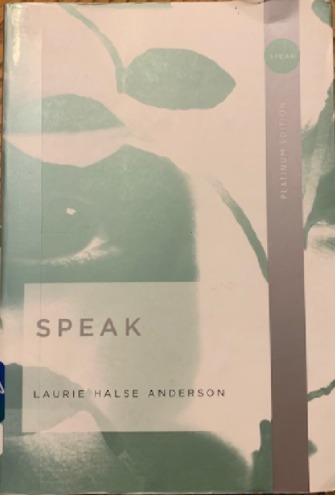
Warning: the book reviewed deals with sexual violence. The review mentions it but does not describe it.
Plot:
Melinda Sordino starts high school with everyone hating her. Her old friends from middle school aren’t talking to her. She really does eat her lunch all by herself.
Maybe if she could tell them about what happened, about why she did what she did, they’d understand. But Melinda can’t find the words.
Heather, a new girl from Ohio, becomes a friend. Heather has plans. Against her better judgment, Melinda lets Heather drag her to a pep rally. While Heather is talking to a sophomore she knows, a girl turns to Melinda and asks, “Aren’t you the one who called the cops on Kyle Rodger’s party at the end of summer?”
Melinda does not answer. Another girl says, “My brother got arrested at that party. He got fired because of the arrest. I can’t believe you did that. Asshole.”
Melinda might tell them why she called the cops, but she can’t. There are no words. She is an Outcast.
I don’t suppose I give much away if I say she finds her voice and there is, eventually, a reckoning.
Thoughts:
As one who’s been around the block, I heard what Melinda couldn’t say, but I’m not the book’s target audience. The author drops hints, involving writers like Maya Angelou and outcasts like Heather Prynne of that perennial high school favorite, The Scarlet Letter.
The book contains other nice touches. When Melinda is getting her feet, she begins doing some yardwork—without parental nagging—and cleaning out debris under the bushes in front of her house. In turn, her dad begins working on the yard, planting new flowers.
One weakness I found in the books is that many of the secondary characters lack depth, especially the antagonists. For example, the football coach/social studies teacher (that’s never happened), whom Melinda calls Mr. Neck. Not only does Mr. Neck have it out for Melinda, asking questions like “Where’s your hall pass?” but he also blames “immigrants” because his son can’t get a job as a firefighter. He tries to set a class debate topic in class: “America should have closed her borders in 1900.” When one student objects to the tone of the lesson as “racist, intolerant, and xenophobic,” he is sent to the principal’s office.
Not everything is depicted realistically, IMseldomHO, but Melinda’s internal world, where the reader spends most of their time, is authentic.
The YA novel’s awards are too numerous to list, but include being a 1999 National Book Award Finalist, 2000 Top Ten Best Books for Young Adults, and 2001 and 2005 New York Times Paperback Children’s Bestseller.
Because of the themes the book deals with, it has also been a frequent target for parental ire. The American Library Association lists it among the top ten most challenged books of 2020: “Banned, challenged, and restricted because it was thought to contain a political viewpoint and it was claimed to be biased against male students, and for the novel’s inclusion of rape and profanity.”
This is a good book for young people, especially girls, I believe, because it shows the importance of speaking up. There will be consequences because few people will want to hear what you have to say, but you have to say it anyway.
Title: Speak
Author: Laurie Halse Anderson (b. 1961)
First published: 1999
Length: novel
 Reviews of Old and New Stories. Mostly Old
I have seen this book around, but have never read it. Now, I’m thinking I might. I do sometimes read YA lit. There are a lot of good books in that genre.
I agree. There are a lot of good YA books out there. I hope you enjoy this one if you read it. I’ll be interested in knowing your thoughts on it (good or bad) if you do read it.