Many forms of Government have been tried, and will be tried in this world of sin and woe. No one pretends that democracy is perfect or all-wise. Indeed it has been said that democracy is the worst form of Government except for all those other forms that have been tried from time to time.…
Winston Churchill, 1947
The Stuff:
This book is an examination of American democracy, in theory and practice. It offers a variety of prescriptions to aid that ailing democracy, some of which are easier to administer than others. Ancient Athens may be the birthplace of Western democracy, but its current practice bears little resemblance to that of the ancients.
Author Nwanevu states that democracy offers us three valuable tools for governance: agency, dynamism, and procedure. Democracies can be designed and implemented in different ways, depending on need, balancing participation, representation, and deliberation.
That sounds rather abstract, but the author defines each term and takes the reader through a mini-essay on each. It’s still abstract, but coming into focus. It makes more sense when he discusses the detractors who bring up specific arguments for limiting democracy.
For example, in the view that democracy begins with voters (not a view shared by the author), many voters do not participate. They don’t even know their own representative’s names. Some will even go so far as to say that many of these non-participants and low-information voters tend to be younger voters, women, and minorities. It’s not that they’re stupid; they’re simply too distracted to sort through the information, so… should they be included in the franchise?
One detractor made an argument for the establishment of an epistocracy (p. 50), that is, rule by the most knowledgeable.
Yeah, no ethical problems there.
I’m sure this detractor would count himself among the worthy electorate in his epistrocracy.
Nwanevu is not just using the detractors as punching bags. He is using this to form his own definition of democracy:
“Democracy isn’t about the will of the people winning out in a given collective decision. It’s about the right of the people to govern themselves through collective decision-making in the first place.” (p.68)
But democracy is more than voting, according to Nwanevu. It must also provide a mechanism to secure basic rights, give means to ward off domination by more certain groups over others, an acceptance of division and conflict, and a recognition that economic conditions “shape our democratic agency.” (p. 101)
He further argues that the United States is not a democracy, according to this definition, nor was it founded as one.
Part II of the book looks at specific institutions of the United States—the Senate, the House of Representatives, the Supreme Court, among others—and points to undemocratic aspects of each. It then offers ways these institutions might be made more democratic.
Part II also contains a full (long) chapter on a “democratic economy,” dealing with empowering the American worker through labor unions and eliminating right-to-work laws, among other, less routine mechanisms.
He uses Amazon as a case study. Jeff Bezos thanking his workers has always brought the following clip to mind:
Thoughts:
Both as a retired union member and as one who has called for the abolition of the Electoral College since a civics teacher explained it to the class long ago and far away, I confess that reading this part of the book turned me into a kid with my nose pressed up against the window of a candy store. Oh—wouldn’t this be cool! And that! Yes, please, may I have some of that?
More soberly, while I find some of his proposals, such as ranked choice voting, quite doable, others, such as making the Senate more representative of the population rather than the states, hit constitutional roadblocks. But frankly, I’d worry if I agreed completely with any author on the subject.
Alas! Things in the country are the way they are because they serve the interests of those with a bit more sway (i.e., money) than I have. And there is the enemy of us all: inertia. Yet, a girl can dream. And maybe shout a little in the meantime.
The subject matter is perhaps a little abstract at points, and I don’t think the book is for everyone, but I think it is an important book, with respect to a view of American history and to the present. The author explains without talking down to the reader. The writing is clear, amusing at times, and never dry. If the topic interests you, you should find the book well worth your time.
Bio: Osita Nwanevu (b.1993) is a contributing editor at The New Republic and a columnist at The Guardian. He is a former staff writer at The New Republic, The New Yorker, and Slate. This is his first book. He lives in Baltimore.
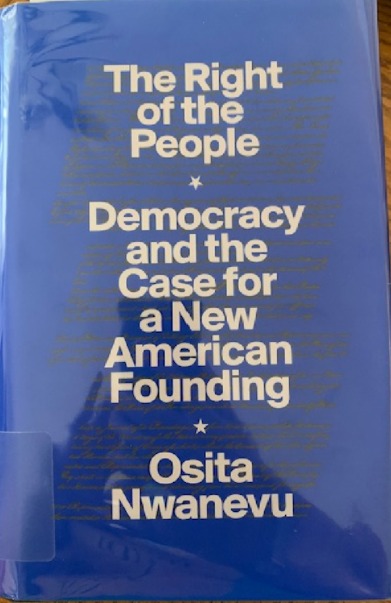
Title: The Right of the People: Democracy and the Case for a New American Founding
Author: Osita Nwanevu
First published: 2025
Length: nonfiction book
 Reviews of Old and New Stories. Mostly Old
That sounds like a very interesting book. At first, epistocracy, rule by the most knowledgeable sounded like a good idea to me until I realized the complexity and danger of deciding “the most knowledgeable”. There are some old fashioned things with American democracy which do not exist in other countries and that are not part of the constitution such gerrymandering, the filibuster, and the fact that when the two houses can’t agree on a budget related bill the government shut down. In other countires the old budget continues when houses can’t agree. These are things that hurt Americans, does not exist elsewhere, and are not required by the constitution. It seems this requires a rethink.
I agree that reform is necessary. I hope what one of things that will happen once Trump and his cronies are out of power is that sober people will institute reform including making the American government more modern. And help prevent authoritarian incursions in the future. There were reforms after Watergate. I could go on:
This is an interesting book. I’m glad I read it.
I hope you are right and it certainly sounds like a very good book.
Let us just look at what is happening all around us and forego any postulations about what might happen…America is in a state of being trashed…I believe there is a plan to redo the whole American concept into something that it has never been before…and whether that is good or bad is in the mind and experiences of the beholders.
While I agree there are concerted efforts to attack American institutions, there are also concerted efforts to not only preserve what is good and solid but also to improve and reform what didn’t work in American society. I don’t know what the end result will be, but I feel it’s worth the time and energy to work toward improvement.
Oppression will be the end result and the death of democracy barring some kind of Divine intervention.
This is an old story. You may have heard it. Old Smith was a believer. When the banks of the river by his house overran, he heard the Lord say he’d be delivered. His neighbors stopped by on their way to higher ground and offered him a ride. He declined; He was waiting on the deliverance of the Lord. The river kept rising.
Neighbors stopped by in a boat and offered to take him to higher ground. He declined. He was waiting on the deliverance of the Lord. The river kept rising.
Search-and-rescue stopped by with a helicopter. He declined. He was waiting on the deliverance of the Lord. The river kept rising.
Old Smith drowned. In heaven, he asked the Lord why he promised deliverance and let him drown.
The Lord said, “I sent you neighbors in their car. You sent them away. I sent your neighbors in their boat. You sent them a way. I sent the search and rescue in a helicopter. You sent them away. Son, you’re your own worst enemy.”
As has been said, the price of liberty is eternal vigilance. If we’re waiting on deliverance, it will never come. Does action guarantee success? No. But, in my opinion, inaction guarantees failure.
Great Wisdom…. but given the apparent intellectual deficiencies commonly demonstrated in the mass American paradigm, i.e, obsession with self-gratification above all things, do you actually believe there is a chance in peck’s Hell that this country will survive?
Here, sir, is where we will have to agree to disagree. I don’t believe people—American or otherwise—are perfect. There is plenty of room for improvement. But we are adults. Some of us can even conduct ourselves like adults. I say this not in blind faith, but with some evidence, such as the studied phenomena such as what’s known as the “wisdom of crowds.”
Again, I repeat, action may not lead to success, or at least success in all things. But inaction will definitely bring about failure.
I appreciate your wisdom.
Sounds like an interesting book. I just heard the Churchill quote repeated a couple of days ago. I enjoyed the clip. Is that from a movie? If so do you know the name of the movie?
It is interesting. The clip is from Mel Brooks’ History of the World Part One.
I’m sure the “very stable genius” currently occupying the Oval Office would consider himself “most knowledgeable.” Therein lies the rub with that issue. Defining that is hard because I know some very intelligent people who never graduated high school and some very ignorant people who have college degrees.
I don’t think we will ever have a perfect system of government. No matter how we try, there will always be failures and those who slip through the cracks. The idea, though, is to keep trying, not to destroy everything we’ve built.
Nice review!
Agreed; The author was not advocating this form of government. Obviously the “most knowledgeable people” are always going to be me and my friends.
If I ever find a perfect form of government, I’d run away from it because I wouldn’t want to ruin it.
At least democracy—if practiced honestly—has self-correcting devices built in. Which is not to say there isn’t always room for improvement. Like removing a certain stable genius and his friends. But I digress.