Plot:
This book is more of a character study than a narrative with a plot. Ifemelu is a young Nigerian woman who comes to the United States for a postgraduate education. The book begins as she is about to return to Nigeria and stops in a hair salon to have her hair braided. This is meaningful. One piece of advice she received upon arriving in the U.S. was that ditching her braids and straightening her hair would help her get a job.
In the meantime, the reader hears about her departure from Nigeria, her religious mother, and her bookish father. There is also her boyfriend, Obinze, back in Nigeria, who loves everything about America but cannot get a visa because of restrictions after the 9-11 attacks. For a while, he lives in Great Britain without papers.
Ifemelu writes a blog titled “Raceteenth or Various Observations About American Blacks (Those Formerly Known as Negroes) by a Non-American Black.” To her amazement, it becomes popular and lucrative enough to pay the bills. Her observations are sometimes amusing but often angry. They are accurate. For example, she became “black” when she moved to America without changing. Another observation is noting skinny white people at one train station and fat black people at the next. “Fat” in America is pejorative. In Africa, it’s simply a fact. One of her regrets about leaving the U.S. for Nigeria is closing the blog.
While Ifemelu is getting her hair braided, the reader learns about her time in the United States. The reader also learns about Obinze’s fortunes. After his deportation from the U.K. to Nigeria, he prospers. He marries and has a daughter.
Thoughts:
In one respect, the book reads like an extended version of Ifemelu’s blog. It is observations with some commentary. It is almost picaresque as Ifemulu moves through her adventures in America over the course of some fifteen years. A whole host of characters come and go. What does Ifemelu want? That’s a little hard to tease out, for she seems dissatisfied with everything and everybody. She’s embarrassed when her parents come to visit from Nigeria.
The term “Americanah” is a Nigerian term for a Nigerian who has newly returned to the home country after a stint in the United States.
Coming from a family with immigrants myself, I related to the immigrant stories. In America, a party means people sit around, talk, and drink, Ifemelu finds out. That there is no dancing is a disappointment.
Shortly after arriving in the U.S., Ifemelu stays with her Aunt Uju. She notices differences in her aunt’s behavior. She now pronounces her name “you-joo” instead of “oo-joo” because that’s what Americans call her. In the grocery store, Uju’s small son Dike grabs a cereal box after Uju has forbidden it:
“Hi, little guy!” The cashier was large and cheerful, her cheeks reddened and peeling from sunburn. “Helping Mummy out?”
“Dike put it back,” Aunty Uju said, with the nasal, sliding accent she put on when she spoke to white Americans, in the presence of white Americans, in the hearing of white Americans. Pooh-reet-back. And with the accent emerged a new persona, apologetic and self-abasing. (p. 109)
Dike gets his cereal, but in the car, he also has his ear grabbed and is threatened with a slap “before he can hear.” Aunty Uju complains about how spoiled kids are in this country.
Igbo language phrases appear untranslated throughout. Most can be understood in context. A common one is “ahn-ahn,” said when someone is surprised by or disagrees with something, often something said by another person:
“Ifem, [what?]” Aunty Uju asked. “I thought you would be in Nsukka. I just called Obinze’s house.”
“We’re on strike.”
“Ahn-ahn! The strike hasn’t ended?”
“No, that last one ended, we went back to school, and they started another one.”
(p. 100)
Google Translate renders “ahn” as “oh,” but there’s obviously a bit more behind the word.
I’ve read glowing reviews of this book, some of which make it sound like the best thing since sliced bread, which is one reason I read it. There are a lot of enjoyable elements to it. With humor, satire, and engaging and relatable parts, this work had a lot to recommend it. I chuckled while reading. I found the story to be more episodic than a plot, but it is enjoyable and insightful, so it depends on what the reader is expecting.
Bio: Chimamanda Ngozi Adichie (b. 1977) was born in Nigeria of Igbo parents. She holds a B.A. in political science from Eastern Connecticut State University, a Master’s in creative writing from Johns Hopkins University, and studied African history at Yale University. Her other books include Half a Yellow Sun, which deals with the Nigeria-Biafra War (1967-1970). Her writing often includes themes of anti-racism and feminism. She is regarded as one of the leading African writers.
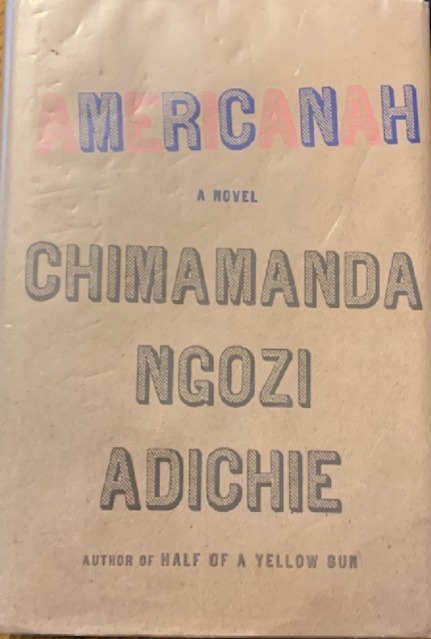
Title: Americanah
Author: Chimamanda Ngozi Adichie (b. 1977)
First published: 2013
Length: novel
 Reviews of Old and New Stories. Mostly Old