A word upfront: when I bought this book at a used bookstore and started reading it, I was unaware of allegations of plagiarism, fabrication, and misstatements of fact made against this author. Some of the oopsies include the following book, so I can’t in good conscience recommend it, even if it were a fantastic read.
I was also unaware that the author, writing in the 1970s, was such a proponent of Manifest Destiny (p. 323, see below), something that (caveat lector) provoked a bit of ranting and raving on my part. Out of habit, however, I have to give my opinion on the reading experience, just cuz.
The Stuff:
The subtitle names Crazy Horse, a 19th-century Oglala Sioux, as an American warrior. Without speaking for him, I can’t help wondering if he might find this designation a surprise, to say the least.
In his introduction, Ambrose points out that while both men had many things in common, they were also quite different. Crazy Horse was born around 1840, and George Armstrong Custer in 1839. Custer died in 1876 at the Battle of the Little Bighorn, which has come to be known as Custer’s Last Stand. Crazy Horse died in 1877. Both men won honors and were considered leaders; both were involved in career-endangering scandals.
The author promises the reader a story of how Custer and Crazy Horse found themselves at the Battle of the Little Bighorn.
Ambrose recounts what is known of both men from birth through childhood, into adolescence, and manhood. He describes their careers and the societies they grew up in.
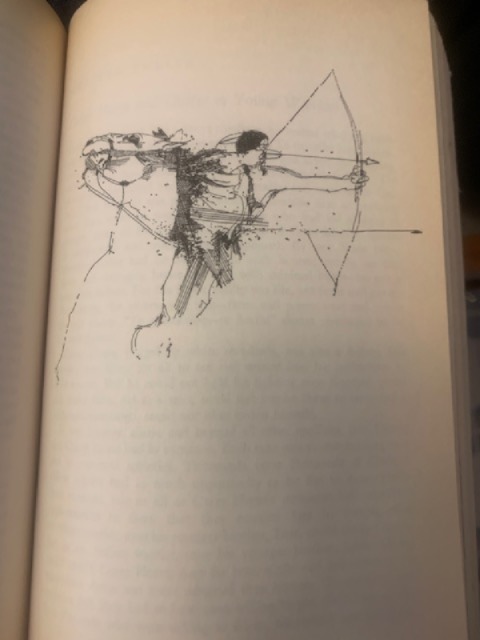
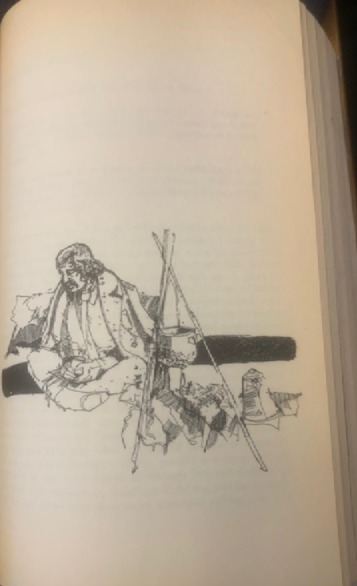
Each chapter opens with an unsigned line drawing. I could not find the artist’s name. If it was Ambrose himself, how modest of him.
Thoughts:
Ambrose is a storyteller in the best sense of the word. He recounts an 1854 incident involving Second Lieutenant John L. Grattan, who died with the rest of his detachment trying to arrest Miniconjou High Forehead for the alleged theft of a Mormon immigrant’s cow. Grattan was twenty-four years old and “fresh out of West Point.” He had never seen the Sioux in battle, “was certain that such an ill-organized, undisciplined bunch of savages could never stand up to a force of U.S. Infantry.” (pp. 60-61 ff)
He went in with thirty men and a howitzer. There were some negotiations, but High Forehead refused to surrender, and no one was going to compel him. Amid some complications (a drunken interpreter, whom the Sioux hated, provoking and jeering at the Indians, for one), someone shot first. Grattan and his thirty men all died and were mutilated by the Sioux. The lesson Ambrose is trying to depict is that inexperienced white men who underestimate the capabilities of the Indians, overestimate their own, rush into battle, and will die.
This tragedy foreshadows Custer’s death and disaster at the Little Bighorn.
Ambrose portrays both men as living and dying violently. The reader sees Custer as charming, playful, cheerful, but irresponsible. He is fearless in battle, but also careless with the lives of the men he leads. An indication of this is his claim to have had fifteen horses shot out from under him over time. Well, can’t make an omelet without breaking a few eggs, I guess. He would be the ultimate happy frat boy in current times, perhaps.
Crazy Horse, by contrast, was solemn and silent. He is violent but does not take the lives of the men with him for granted. His dream vision told him dress modestly and not to keep anything he won in battle for himself, but to take his responsibility to the defenseless. He was known as a great hunter in addition to being a warrior.
Of the two, Custer comes off as the jerk. He’s impetuous, and Crazy Horse is the more thoughtful and measured.
*WARNING: RANT TO FOLLOW*
Ambrose discusses not only the Grattan Massacre, but also the 1868 massacre of a Cheyenne winter camp led by Custer that killed perhaps 100 indigenous people, including the peacemaker, Black Kettle. He details the destruction of the village, the food stores, and, aside from ponies for the captives, the destruction of the herd of some nine hundred ponies. The author notes that, as a horse lover, killing so many healthy animals probably bothered Custer.
Unlike killing the healthy humans? The women and children…?
Pretty bleak. He doesn’t excuse Custer, but later, he says, you know, right and wrong are sort of malleable concepts, aren’t they?
“Well, [the destruction of such a ‘noble and romantic people’ as the indigenous] was regrettable, but who is to say [the expansionist Americans] were wrong? Who would be willing to tell the European immigrant that he can’t go to the Montana mines or to the Kansas prairie because the Indians need the land, so he had best go back to Prague or Dublin? Who wants to tell a hungry world that the United States cannot export wheat because the Cheyenne hold half of Kansas, the Sioux hold the Dakotas, and so on? Despite the hundreds of books by Indian lovers denouncing the government and making whites ashamed of their ancestors, and despite the equally prolific literary efforts on the part of the defenders of the Army, here if anywhere is a case where it is impossible to tell right from wrong.
“But we can tell truth from falsehood. It is, for example, totally irresponsible to state—as has so often been stated—that the United States pursued a policy of genocide toward Indians. …The United States did not follow a policy of genocide; it did try to find a just solution to the Indian problem. The consistent idea was to civilize the Indians.”
(p. 323)
… really, dude? You can’t tell if it was right or wrong to slaughter people and destroy their way of life so other people could control their land? Did you flush your moral compass down the crapper?
And how kind of the United States to “civilize” people at the point ot gun. He even admitted there were deliberate efforts to eliminate the buffalo so the “free Indians” would have nothing to hunt to sustain themselves. I believe Ambrose passed away before the abuses of the Indian boarding schools in the U.S and Canada came to light, but really, did those horrors surprise anyone?
And get the boy a dictionary—large print—so he knows genocide when he sees it.
*END MOST OF RANT*
Bottom line, no. I do not recommend this book for anything other than maybe skeet shooting. If the plagiarism accusations are accurate, it is sad that the author did not do his own homework and give proper credit. But his support for Manifest Destiny is fatal. So, avoid this book like the plague.
I generally give away most books once I’m done reading them, unless I intend to reread them or keep them for reference purposes. This one, however, I can’t let loose on an unsuspecting world. It stays in the darkest corner of the bookshelf.
Bio: Stephen E. Ambrose (1936-2002) was an American historian, writer, and academic. Most of his works concentrate on the Second World War. He also wrote biographies of Dwight D. Eisenhower and Richard Nixon. Among his most notable works are Band of Brothers (1992), D-Day (1994), Undaunted Courage (1996), and Citizen Soldiers (1997). In 2002, allegations arose that he’d plagiarized some of his works. Those charges and apparent misstatements of fact have cast a pall over his writing, sadly.
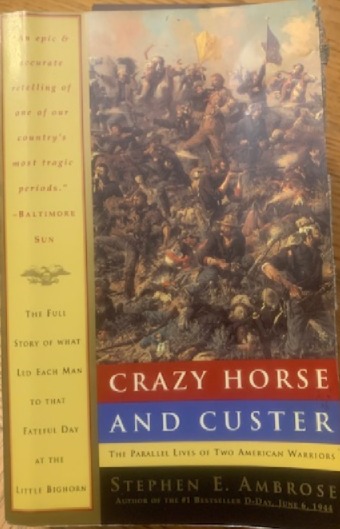
Title: Crazy Horse and Custer: The Parallel Lives of Two American Warriors
Author: Stephen E. Ambrose (1936-2002)
First published: January 1, 1975
Length: nonfiction book
 Reviews of Old and New Stories. Mostly Old
I visited the Crazy Horse monument/memorial in South Dakota this past summer. It was a powerful experience. So, so sad…
I’ve never been there, but I’ve seen pics. Yes, sad.
I’d rather read Son of the Morning Star.
I think I’ve had my fill of Custer for the time being. 🙁
Custer is not someone I admire. He was a proto-MacArthur, in many ways.
Sad part? I bought another book by Ambrose at the same time: Undaunted Courage about Lewis and Clark. I’ll get to it eventually. I hope it’s better.
I haven’t read “Undaunted Courage.” I have most of his WWII books, though.
I’ve never read any Ambrose, but I’ve recently heard about criticisms against him. I’m always leering when reading history books about people and events. I try to research about them. After reading your review and research, I won’t put any of his books on my list. This was a very interesting book review!
Thank you. Had I known when I was in the used bookstore what I know now, I would not have bought those two books. Live and learn.
What a shame! A man with his background, education, and resources taking without credit, but then buying into things like Manifest Destiny. No, he’s off my list as well.
I’m glad you found my rant helpful. 🙂
interesting book & what gorgeous artwork! thanks for sharing with us
Wow, thanks for bringing out Ambrose’s issues. I hadn’t heard this before, but I doubt I’ll read anything by him that I might have in my electronic TBR pile.
My work here is done. 🙂 Seriously, I’m glad to have been of service. I was unaware of the issues when I bought two Ambrose books at a used bookstore.
Thanks for your comment.