Plot:
This novel follows the fortunes of our hero, Okonkwo, in the 1890s in the (fictional) Ibo (modern spelling Igbo) village of Umuofia in what would become Nigeria. Okonkwo wants to be nothing like his father, Unoka, who is lazy and cannot support his family. Unoka likes to play his flute.
Okonkwo, on the other hand, becomes a fierce warrior and a renowned wrestler. After his father dies, Okonkwo pays off his debts. He works hard to build a prosperous farm and support three wives.
In recompense for the murder of a woman of Umuofia in a neighboring village, a 15-year-old boy named Ikemefuna, the son of the killer, comes to live in the village. The elders decide he should stay in Okonkwo’s compound. His son Nwoye is a few years younger than Ikemefuna. The two become good friends. Ikemefuna starts calling Okonkwo “father.”
After three years, the village Oracle decides that Ikemefuna must die. This news saddens Okonkwo. Nwoye is inconsolable. An elder warns Okonkwo not to take part in the killing (which must happen to appease the earth. The Oracle said so) because the boy calls him father.
Okonkwo ignores the elder’s advice and kills the unsuspecting Ikemefuna. From then, a series of mistakes and misfortunes plagues him. Eventually, British colonial authorities and missionaries arrive. To his chagrin, Okonkwo’s son becomes a Christian.
Thoughts:
Author Achebe draws his title from W. B. Yeats’ 1919 poem, “The Second Coming”:
Turning and turning in the widening gyre
The falcon cannot hear the falconer;
Things fall apart; the center cannot hold;
Mere anarchy is loosed upon the world.
This book came out in 1958, when most of what the Western world knew of Africa was depicted by Westerners. Achebe wrote, in part, to present an African world—or at least a little part of it—as Africans saw it. Achebe’s Africans were not saints or noble savages, but humans with their own complex society.
The main character, Okonkwo, is admired by his society, but the reader probably feels at best ambivalent toward him. He is a violent man living in a violent culture. He beats his wives and his children. It’s the only way he knows how to keep them in line. His greatest fear is appearing weak or lazy, like his father.
Yet, I think that’s part of the point. Okonkwo is not there to be admired, but rather to be sympathized with. The pre-colonial Igbo society, like Okonkwo, is depicted, warts and all, in simple prose to be shown as it is. Or was.
Achebe wrote an essay about his work as an answer to Joseph Conrad’s Heart of Darkness. Conrad’s novella had long been regarded as anti-colonial. Achebe points out that it is also racist. He notes the contrast between its depictions of the civilized people along the Thames and the not-quite-human people along the (putative) Congo. For example, while Conrad’s Africans generally are given to savage grunting rather than speaking, Achebe’s characters are eloquent and rely on storytelling and proverbs.
Conrad’s Africa is a set piece for Europeans to work out their problems or to fall apart. Achebe’s Umuofia is a place where people are born, grow up, fall in love, marry, fight, die, grow yams, die, etc.
That’s my take on it, anyway.
Is the book readable to the average person? I would say yes. Anyone interested in the topic should enjoy the book, even with foreknowledge that a happy ending is not coming. It is less than 200 pages long. The prose is straightforward and easy to read.
Bio: Chinua Achebe (1930-2013) was a Nigerian novelist, essayist, and poet, according to Britannica, “acclaimed for his unsentimental depictions of the social and psychological disorientation accompanying the imposition of Western customs and values upon traditional African society.”
He studied English and literature at University College (now the University of Ibadan), and he taught for a short time before joining the staff of the Nigerian Broadcasting Corporation in Lagos. A car accident left him partially paralyzed. He later taught at Bard College in Annandale-on-Hudson, New York, and then joined the faculty of Brown University in Providence, Rhode Island. Among his most noted works are Things Fall Apart (1958). Arrow of God (1964), A Man of the People (1966), and Anthills of the Savannah (1987).
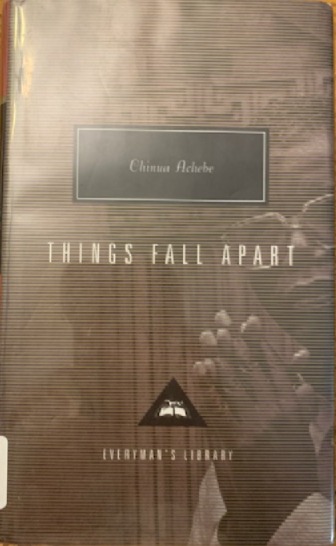
Title: Things Fall Apart
Author: Chinua Achebe (1930-2013)
First published: 1958
Length: novel
 Reviews of Old and New Stories. Mostly Old
I’ve read this book, and I feel your review of the book is very insightful and accurate. This book has many themes that make it a good book to talk about. On top of that, it is well written. The prose is simple, yet stunning.
Thanks for your kind words. Yes, I think you’re right about the righting—”simple, yet stunning.” The directness makes a greater impact in my eyes than a flowery style would have.