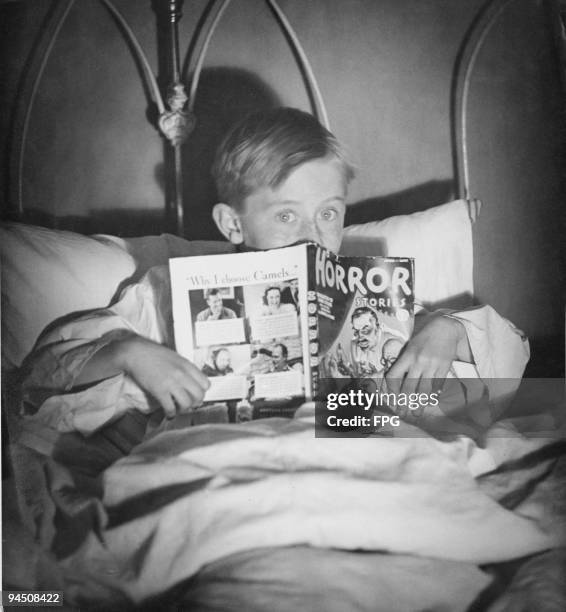
Review of “Master of Fallen Years” by Vincent O’Sullivan: Halloween Countdown

Getty Images and tip o’ the hat to Tracy

Plot:

Augustus Barber works in a paper-box manufacturing business in London. The narrator is at pains to tell the reader how ordinary, if commonplace, Augustus is. He doesn’t read anything outside of newspapers and shows no interest in anything spiritual or metaphysical.

After falling ill to the point that he was expected not to recover, Barber changes. He no longer laughs quite so quickly. He has fits of violence and begins to behave inappropriately in other ways. For example, once when the narrator is out with Barber and some friends, Barber “offered some freedom to a lady.” Her gentleman companion, who happens to be a member of Parliament, objects and raises his fist. Something makes him hesitate; it is not fear of Barber, who is a much smaller man. Something encompasses Barber, but then it is gone, and Barber gets decked before his friends can pull him away.

As the behavior grows more outrageous, the ability of the something to influence people increases. Barber frequently falls ill after an episode of angry or offensive conduct. Barber is aware of it and calls it the Other, but cannot control it.

Thoughts:

Poor Barber. The narrator (understandably) doesn’t want to have anything to do with Barber. Once an inoffensive if awkward guy—perhaps reminding the reader of an acquaintance who laughs too loudly at dinner—he becomes an outrageous guy who makes you want to run for fear of seeing flashing lights pull up out front.

The episodes appear to the modern reader like bouts of mental illness, especially because they are often followed by physical illness. Yet, O’Sullivan adds an element of the supernatural. During an episode, he seems to be able to influence people. At first, this is only to not interfere with what he’s doing, as if a toddler has managed to enchant those around him to let him continue with his antics. However, the antics become increasingly dangerous, and their influence grows. What began as annoying (at worst) becomes sinister and perhaps deadly.

This is a weird, sad little story.


Bio: Vincent O’Sullivan (1868-1940) was an American poet, critic, and writer of weird fiction, most notably in the turn-of-the-century Decadent* movement. He spent most of his life in Europe, living quite comfortably until the family coffee business went bust.


This story can be read here:


I could not immediately find an audio version of this story.


*The Encyclopedia of Fantasy describes the Decadent movement thus: “Decadent writers were interested in all things abnormal, artificial, morbid, perverse, and exotic and were much given to symbolism; they were inevitably drawn to fantastic themes and bizarre stylistic embellishments, and their best work dramatically expanded the range, the bizarrerie, and the grandiloquence of fantasy.”

Title: “Master of Fallen Years”
Author: Vincent O’Sullivan (1868-1940)
First published: The Smart Set, 1921
Length: short story

Review of “The Marble Hands” by Bernard Capes: Halloween Countdwon

Getty Images and tip o’ the hat to Tracy


Plot:

Our hero rides his bike with his friend Heriot to the churchyard. Heriot wants him to check something out but doesn’t want to see it himself. Our hero soon finds what he’s looking for—a grave with no headstone or inscription. A beveled marble curb encloses a graveled area. In the graveled area stand two marble hands as if projecting from the grave. A sculptor friend of the interred made them. The woman insisted that they be her only epitaph.

The woman beneath them was a friend of Heriot’s Aunt Caddie, who disliked her. Heriot, however, liked her. He was only seven.

When the husband of the deceased remarried, the new wife insisted that the hands go. Heriot went to see what the grave looked like without them—but they were still there, looking as lifelike as ever.

Thoughts:

This story is a short-short that can be easily read in one sitting, unless you have a cat who wishes to help you with your reading.

This is a brief, creepy story. The narrator feels the eeriness of the place but doesn’t understand it. His friend tells him the backstory as the two ride their bikes away. He does not, however, settle the crucial question of whether the hands are “real” or not. While she was alive, the owner of the hands was friendly to Heriot. He liked her in return. Now, he’s not so sure…

If this little gothic tale is something less than a masterpiece, it makes for a nice little creepy read.


Bio: Bernard Capes (1854-1918) was a prolific Victorian English author and journalist who mainly wrote ghost and supernatural stories but also romances, mysteries, poetry, and history. His popularity waned after his death during the 1918 flu epidemic. Anthologist Hugh Lamb published a selection of Capes’ stories as The Black Reaper in 1989 (expanded 1998).

This story can be read here:

This story can be listened to here: (8:35)


Title: “The Marble Hands”
Author: Bernard Capes (1854-1918)
First published: The Fabulists, 1915
Length: short story

Review of “The Wolf-Man” by Erckmann-Chatrian: Halloween Countdown

Getty Images and tip o’ the hat to Tracy

Plot:

Around Christmas time in the year 18—, our hero Fritz lies fast asleep at the Cygne in Fribourg in the Black Forest when someone awakens him, telling him:

“I have good news for you; I am going to take you to Nideck, two leagues from this place. You know Nideck, the finest baronial castle in the country, a grand monument of the glory of our forefathers?”

At first, Fritz does not recognize his caller, which hurts the other man’s feelings.

“Was it not I who taught you to set a trap, to lay wait for the foxes along the skirts of the woods, to start the dogs after the wild birds? Do you remember me now? Look at my left ear, with a frost-bite.”

“Now I know you,” Fritz says. “That left ear of yours has done it; Shake hands.”

The visitor is Gideon Sperver, Fritz’s friend and foster father. Fritz hasn’t seen him for sixteen years.

Gideon, the old poacher, has honest work now. He’s a huntsman for the Count of Nideck at Nideck Castle. The old count has taken ill. The malady is a strange one, coming and going. No doctor has been able to help him, but Gideon is convinced Dr. Fritz can cure him.

They set off immediately despite the miserable weather. Gideon insists they arrive before nightfall.

On the way to Nideck Castle, they notice an old woman in a black, tattered dress crouching on a hillside some distance from them. She gives Fritz the creeps. Gideon calls her “The Black Plague” and wants to be clear of the sight of her. He calls her a witch and claims that she is “killing the count by inches.”

This makes no sense to Fritz.

When they get to the castle, various servants meet them before Fritz meets his patient and his daughter, Countess Odile. Although confined to his bed, the count seems cheerful and friendly. The count’s appearance rattles Fritz:

“A grey head, covered with short, close hair, strangely full behind the ears, and drawn out in the face to a portentous length, the narrowness of his forehead up to its summit widening over the eyebrows…”

He calls the older man an old wolf.

Word comes that a traveler, Baron of Zimmer-Bluderich, lost in the mountains, wishes to shelter at the castle. The countess agrees but tells the servant to let the baron know the count is ill and cannot receive him.

The count starts an old fight with his daughter. He wants her to marry. Then all his troubles would be over, knowing his line would continue. She demurs, having decided to dedicate herself to God.

Dr. Fritz stays out of the family argument. Once he sees his patient resting comfortably, he leaves. He assures the countess that her father is not in imminent danger and that he may, in fact, recover.

Gideon then leads Fritz to the old Hugh Lupus (hmmm… interesting nickname) Tower, where he’ll stay the night. Nideck greatⁿ granddaddy, for whom the tower was named, built the edifice in the time of Charlemagne.

Gideon and Fritz drink and eat a lot—but that’s probably not what gives Fritz those oddball dreams after he retires to sleep under the bearskins in the alcove.

Thoughts:

This story was originally serialized, so there are many little cliffhangers and colorful characters that serve as red herrings. Some of these may not wear well with the modern reader; the castle porter is a dwarf named Knapwurst. He’s described as ugly, but he’s also learned. He and Fritz become friends. The head butler is Tobias Offenloch, an old soldier from the Nideck regiment. He lost a leg in a battle and has grown fat. His wife is French, Marie Lagoutte. Rounding out the servants is Sébalt Kraft, master of the hounds, a dismal fellow. The servants don’t do much—the master is laid up, after all—and they like to party in the kitchen.

In true gothic fashion, Fritz witnesses the count’s grotesque transformation as a “fit.” He recovers but remains in danger of death. Fritz is a doctor. He should know.

And it is long, making it a nice winter read to enjoy with a cup or three of fortified hot chocolate.

What is the connection between the count and the “Black Plague”? Is she human, or something more? Why has this baron appeared out of nowhere, and why is he so determined to go into the mountains during the snowstorm?

While not all the mysteries are solved, the reader sees a centuries-old family curse unravel amid derring-do, tragedy, and loss. However, this is a nineteenth-century work that includes melodrama and flowery language. The foreshadowing is about as subtle as a kick in the shins. It is in no hurry to get where it’s going. All that said, I rather liked this, more for the company of the characters than the plot.


Bio: Émile Erckmann (1822-1899) and Alexandre Chatrian (1826-1890) were French writers and playwrights who collaborated on much of their work. However, it is now believed that Erckmann wrote the novels and Chatrian largely wrote the plays.

Among their best-known supernatural works are “L’Oeil Invisible” (“The Invisible Eye”), “L’Araignee Crabe” (“The Spider Crab”), “Le Blanc et le Noir” (“The White and Black”), and “La Maison Forestière” (The Forest House).


This story can be read here:

This story can be listened to here:(4:19:36)


Title: “The Wolf-Man”
Author: Erckmann-Chatrian (a pen name used by Émile Erckmann (1822-1899) and Alexandre Chatrian (1826-1890))
First published: in French “Hugues-le-loup,” Le Constitutionnel, (1859); in English 1876
Length: novella

Review of “Luella Miller” by Mary E. Wilkins Freeman: Halloween Countdown

Getty Images and tip o’ the hat to Tracy

Plot:

The only person alive who remembers Luella Miller is Lydia Anderson, now eighty years old. She never thought Luella was pretty, though her husband Erastus worshipped the ground she walked on. Luella came to teach school but didn’t do much of the teaching. The work was left to one of the older girls, Lottie Henderson, who was happy to teach while Luella sat and embroidered a pocket handkerchief.

Lottie began to fade, but she kept coming to school right to the end. No one ever knew what she died of.

Luella quit teaching when she and Erastus married. Erastus did all the cooking and cleaning; he was happy to do it for his Luella. No one saw the consumption coming on nor realized how quickly it would take such a young man.

Thoughts:

Lydia compares Luella to a willow; she’s pliant and weak but unbreakable. People happily rush to care for her, as if she can’t care for herself, even at their own expense. Luella flourishes as her caretaker of the moment fades away.

How much of this does she realize? It’s hard to say. When Lydia tells her to shift for herself, she insists she can’t. Some commentators online refer to her as a “Marxist vampire.” She seems to suck the vitality out of people.

I confess I’m the first to pick up a torch or a pitchfork for the proletariat, but what strikes me about Luella is that she is a child, a dependent toddler in an adult’s body. She has never faced or overcome challenges, nor has anyone taught her practical skills. She misses the people who die, of course. But more importantly, who will take care of her now? Could she even brew herself a cup of coffee? Left to her own devices, she would starve.

Lydia tells her that Maria, the caretaker of the moment, should “stay home and do her washin’ instead of comin’ over here and doin’ YOUR work, when you are just as well able, and enough sight more so, than she is to do it?”.

Luella regards Lydia like “a baby who has a rattle shook at it. She sort of laughed as innocent as you please. ‘Oh, I can’t do the work myself, Miss Anderson,’ says she. ‘I never did. Maria HAS to do it.’”

Why Luella has been kept a child, the reader is never told. She is not wealthy—she was a schoolteacher who married a man who chopped wood for a living.

An air of the supernatural hangs on in that even after Luella dies, her menace remains.

This is a sad little horror tale.


This story can be read here:

This story can be listened to and read here: (41:07)


Bio: Mary E. Wilkins Freeman (1852-1930) began writing children’s literature as a teenager. Most of her two hundred stories for adults are realistic, such as “A New England Nun.” She also wrote ghost and supernatural stories.

Title: “Luella Miller”
Author: Mary E. Wilkins Freeman (1852-1930)
First published: Everybody’s Magazine, December 1902
Length: short story

Review of “Lot No. 249” by Arthur Conan Doyle: Halloween Countdown

getty images and tip o’ the hat to Tracy

Plot:

Jephro Hastie, a student at “Old College” at Oxford, is visiting with his friend, medical student Abercrombie Smith, in the latter’s third-floor turret room. Hastie warns him about the student in the room below his, Edward Bellingham.

“There’s something damnable about him. My gorge always rises around him. I should put him down as a man with secret vices.”

He continues, saying Bellingham is a “demon” at “Eastern languages,” speaking (among others) Coptic, Hebrew, and Arabic. The “demon” Bellingham is also a good friend of William Monkhouse Lee, who lives below him on the ground floor and is a friend of a mutual friend of Hastie.

“You can’t know [Lee] without knowing Bellingham,” Hastie says. Bellingham is engaged to Lee’s younger sister. Hastie describes the match as a “toad and a dove.”

Okay, Jephro, how do you really feel about him?

One night, a scream arises from Bellingham’s room. Medical student Smith runs down to see if he can be of help. He finds Bellingham in a faint. Odd Egyptian artifacts, including a mummified crocodile and a newly acquired human mummy, fill the room. It’s designated by the auctioneer’s mark, Lot 249.

Lee is with Bellingham and explains that he’s obsessed with such things.

Smith revives Bellingham (brandy is apparently useful for such revivals), who seems nervous and embarrassed, locking a yellowed scroll in a drawer.

Over the next few days, Smith hears shuffling and footsteps in Bellingham’s room when he knows his downstairs neighbor has gone out.

Someone or something jumps out of a tree and attacks a student with whom Bellingham has had a long-standing feud. The student doesn’t see the assailant.

Hmmm… could it be…?

Thoughts:

The suspense builds nicely in this story. The oddball downstairs neighbor who studies suspicious things (not medicine or classics, like the normal red-blooded undergrad), the cries, the embarrassed behavior—what is he covering up?—the charm offensive that alternates with naked aggression. Only people who had a beef with Bellingham get attacked or end up in the river.

Although it begins a bit slowly with some interminable scene-setting, this is an enjoyable little tale. Our hero may be a little slow on the uptake, but once he’s clued in, he’s all in a righteous lather. It’s fun to watch.

The reader sees the mummy in its case in Bellingham’s room (ICK), but when it’s out wreaking havoc (…perhaps…), it seems camera-shy. The opening lines set a tone of uncertainty regarding what actually happened and provide the reader with a date of May 1884, some twelve years before the story was published.

The slang places the reader in an informal college setting. When Bellingham tells Smith he’ll soon leave his rooms and let him study, he says, “Three whiffs of baccy, and I am off.”

Come on, guy. That stuff will kill you, ya know.

Another idiom I had to look up. Smith, in an attempt to avoid visits from Bellingham, “sported his oak.” Apparently, it was common for college rooms in those hoary days of yore to have an inner and an outer door. The outer was often oak. If you wanted to be left alone to study, sleep, or avoid your crazy downstairs neighbor, you closed the outside door or “sported the oak.”

One can’t help wondering if Doyle weren’t remembering his own college days, studying for his medical degree—minus the downstairs neighbor reanimating mummies, of course.

I would be remiss if I didn’t note that the story is written with young men in mind. There are no women in it. Only Lee’s sister Eveline, the “dove,” is mentioned, but she never appears.

The story is one of the first to feature an evil, reanimated mummy, thus spawning a whole army of wrapped critters of the night. Forty years later, Boris Karloff would thump and strangle his way to a lot of startled faces and bloodshed.

While this might be a little slow to start and hold more surprises for the MC than for the reader, I liked it.


Bio: Arthur Conan Doyle (1859-1930) was a British author and physician. He is best known for creating the detective Sherlock Holmes, whose deductive reasoning solved many otherwise unsolvable cases. Holmes remains one of the most popular detectives and has become the subject of many books, plays, and movies. Doyle’s first Sherlock Holmes book, A Study in Scarlet, was published in 1887. Unlike Holmes, Doyle was a believer in the supernatural. He also wrote some fantasy, such as The Lost World.


This story can be read here:


This story can be listened to here: (1:26:26)


Title: “Lot No. 249”
Author: Arthur Conan Doyle (1859-1930)
First published: Harper’s New Monthly Magazine, September 1892
Length: novelette

Review of “The Kit-Bag” by Algernon Blackwood: Halloween Countdown

Getty Images and tip o’ the hat to Tracy

Plot:

The successful defense of John Turk, a client of the great Arthur Wilbraham, KC, brings the barrister no joy. His private secretary, Johnson, is glad to be rid of the case. Despite the verdict of not guilty by reason of insanity, he agrees with the general sentiment that few men were more deserving of the gallows. He tells his boss that he’s happy to see the last of John Turk’s dreadful face.

“It positively haunted me. That white skin, with black hair brushed low over the forehead, is a thing I shall never forget, and that description of the way the dismembered body was crammed and packed with lime into that—”

Wilbraham advises him not to dwell on the case but to enjoy his planned vacation to the Alps.

Johnson then asks to borrow one of Wilbraham’s kit bags (duffel bag). The latter agrees. His servant will bring it around to the secretary’s lodgings later.

When Johnson receives it, he notices that it looks a little worse for wear, but doesn’t think much about it. He begins packing, looking forward to the fresh mountain air, away from the sleet storm London is presently enduring.

It’s a little hard to tell, but he thinks he hears footsteps in the unoccupied rooms below his. Nah—just the storm. The trial must have really gotten to his nerves.

Thoughts:

Poor Johnson keeps hearing things. The top of the half-filled kit bag collapses to look like a human face—John Turk’s face! No, no. It’s just the light in here. And Johnson’s a bit on edge. Surely, he hears the landlady, who might have had a bit too much to drink tonight.

Does he see someone on the landing? In any event, that someone disappears.

Johnson is not one to panic, but sumptin’s goin’ on.

The moodiness of the piece is what makes it. Johnson hears and sees things that don’t quite add up. He at first attributes them to the storm and the nerves from the horrendous trial he’s just witnessed. After all, he’s busy packing for a trip—he needs to shake this all off. But wait! What was that?

While the ending may be a bit of a letdown, it is also unsettling. This story is one to read late at night, wrapped in a warm blanket and sipping a cup of tea.


Bio: Algernon Blackwood (1869-1951) was a prolific British writer and broadcaster of mystery, horror, and supernatural tales. Before he turned to writing, he spent time in Canada and the US farming, running a hotel, and gold mining in Alaska. He also worked as a newspaper reporter in New York City. He wrote of this time in a memoir, Episodes Before Thirty (1923/1934).

Many of his writings are atmospheric, heavy with unknown or poorly understood menace, such as “The Willows.”


This story can be read here. Thanks, Tracy!


This story can be listened to here: (35:13)


Title: “The Kit-Bag”
Author: Algernon Blackwood (1869-1951)
First published: Pall Mall Magazine, December 1908
Length: short story

Review of “The Haunted Chair” by Richard Marsh: Halloween Countdown

Plot:

As Mr. Philpotts walks into the smoking room of the club, he hears, “Well, that’s the most staggering thing I’ve ever known!” The narrator hints that the actual comment was not quite so tame.

The speaker, Mr. Bloxom, stands in front of his chair, looking around. He asks Mr. Philpotts, “Did you see him?”

“I heard you,” the other replies and points out that Mr. Bloxom’s cigar is on the floor, burning the new carpet the committee has just had installed.

Mr. Bloxom ignores him and demands, “Did Geoff Fleming pass you as you came in?”

This confuses Mr. Philpotts. “Geoff Fleming!–Why, surely he’s in Ceylon [present day Sri Lanka—my note] by now.”

Mr. Bloxom insists he was just in the room. A few moments later, he discovers his wallet is missing. Geoff Fleming, who should be on his way halfway around the world, must have taken it.

Thoughts:

I found it obvious what was happening from the moment poor, flummoxed Mr. Bloxom began looking for someone who was just there—and couldn’t be there. This is a cute little tale. Mr. Bloxom is not the only club member to have a similar adventure and be relieved of something of value.

The members argue with one another. Surely Bloxom, then the next person is losing their marbles. Fleming can’t be here. Even if he were, he couldn’t have gotten out of the room without someone seeing him, right?

This little tale pokes fun at the various club members and the high opinions they have of themselves. Nevertheless, it is sad, demonstrating the lengths one member will go to measure up, at least in his own mind. Yes, he screwed up, but he must keep his word under any circumstances—then all will be forgiven, right?

One drawback is the use of dialect and slang that rely on the particular time and place. For example, when Bloxom realizes his wallet is gone after his brief encounter with Fleming, he complains that Fleming has “boned his purse.”


Bio: Richard Marsh (legal name: Richard Bernard Heldmann) (1857-1915) was a prolific British writer and novelist. His best-known work is the 1897 novel The Beetle. He began writing boys’ fiction. For a brief time, he served as a co-editor at one of the periodicals he’d been publishing regularly in, but then was let go. After serving time for forging checks, he adopted the pseudonym Richard Marsh and began publishing crime, detection, thriller, popular romance, and humor fiction for adults. All told, he published about seventy-six short stories.


This story can be read here:

I could not find an audio version of this story.


Title: “The Haunted Chair”
Author: Richard Marsh (legal name: Richard Bernard Heldmann) (1857-1915)
First published: Between the Dark and the Daylight, April 1902
Length: short story

Review of “A Ghost Story” by Mark Twain: Halloween Countdown

Getty Images and tip o’ the hat to Tracy

Plot:

The narrator recounts that he took a large room in a huge old building. The upper stories, where his room is, have been unoccupied for years and have long given up to cobwebs, solitude, and silence. He feels he’s invading the privacy of the dead. For the first time in his life, a superstitious dread overcomes him.

He locks the door. While a cheery fire burns, he sits and thinks of bygone times, faces of friends he’ll never see again, voices fallen forever silent, and once familiar songs no one sings anymore. Outside, it begins to rain. He turns in for the night and sleeps profoundly.

He wakes suddenly with the feeling of someone or something tugging the covers toward the foot of the bed. He hears noises of someone walking—no, stomping like an elephant—around the bedroom and the building. He sees disembodied faces floating above the bed…

Cardiff Giant from Wikipedia

Thoughts:

While this story begins in traditional gothic ghost story form—the long-unused room, the cobwebs, the rain, the narrator’s ruminations on lost friends and loved ones, and the appearance of the ghost, which terrifies him—it turns on a dime. After all, Mark Twain wrote this tale.

After a second look, he realizes his visitor is a little out of sorts. And stark naked. One can’t be at his best when he’s knocking around a stranger’s room in the middle of the night in the all-in-all.

It ends in farce. Good for Twain. He brings in one of the day’s great hoaxes, the so-called Cardiff (New York) Giant. According to Wikipedia, the Cardiff Giant was created by New York tobacco retailer George Hull after an argument at a Methodist revival meeting about biblical references to giants in the earth. Showman P. T. Barnum then created a replica. It had already been exposed as a hoax when Twain wrote the story.

This is a cute little tale.


Bio
: Mark Twain (legal name: Samuel Langhorne Clemens) (1835-1910) was an American writer, novelist, and journalist. He was known primarily as a humorist. As a young man, he worked as a boat captain on the Mississippi River until the Civil War disrupted river trade. He recounted the time in Life on the Mississippi. Among his most well-known books are The Adventures of Tom Sawyer (1876) and The Adventures of Huckleberry Finn (1884), which have lately had their share of controversy.


This story can be read here:


The story can be listened to here: (14:38)


Title: “A Ghost Story”
Author: Mark Twain (legal name: Samuel Langhorne Clemens) (1835-1910)
First published: Mark Twain’s sketches, new and old, 1875
Length: short story


Review of “The Furnished Room” by O. Henry: Halloween Countdown

Getty Images and tip o’ the hat to Tracy


Plot:

In the turn of the century New York’s Lower West Side, a young man seeks to rent a room. After confirming with the prospective landlady that she rents to a lot of “theatrical people,” he asks if she has recently rented to Miss Eloise Vashner.

“[D]o you remember such a one among your lodgers? She would be singing on the stage, most likely. A fair girl, of medium height and slender, with reddish, gold hair and a dark mole near her left eyebrow.”

The young man has been looking for her for five months.

The landlady denies this.

The young man takes the room, which has the marks of many of its former tenants. As he settles in, the strong, sweet odor of mignonette* fills the room. He cries aloud, “What, dear?” as if she called to him.

He decides that Eloise has been in that room and searches for some token of her. He runs down the hall and asks the landlady about former tenants. She recites a laundry list, none of which sounds like Eloise. When he returns to the room, the scent of mignonette has gone.

Thoughts:

I do wish to warn sensitive readers that the story deals with suicide.

The writing is nicely atmospheric. The young man is never named, but the reader knows the name of the young lady he is searching for. The landlady is quick with useless information, telling him twice that the former lodgers hung their marriage certificate on the wall. They were respectable, after all. So is she—not renting rooms to women of questionable character.

The unnamed young man doesn’t care. He’s looking for his beloved.

The rooms-to-let speak of a transient population, always coming and going. The “theatrical people” are always on the move. Just the same, the places they stay leave traces of their passing, ghosts of their actions, so to speak:

“A splattered stain, raying like the shadow of a bursting bomb, witnessed where a hurled glass or bottle had splintered with its contents against the wall.”

Why shouldn’t the young man expect to find a trace of Eloise there?

The surprise O. Henry ending follows.

This is a sad little tale about a young man who has searched and perhaps found the woman he loves.


Bio: O. Henry (legal name: William Sidney Porter) (1862-1910) was a prolific American short story writer with some 600 short stories to his name. His stories were known for the surprise twist endings. He was born in Greensboro, NC, but settled in New York City. While he was working as a bookkeeper in a bank in Austin, some money went missing. In 1896, on the day before he was to stand trial for embezzlement, he fled to New Orleans and later to Honduras, which had no extradition treaty with the U.S.

He returned on hearing that his wife was gravely ill and was later convicted of embezzlement in 1898, despite some doubts about his guilt. He served three of the five years he was sentenced to, changed his name to O. Henry, and moved to New York City to continue his writing career.

He found success during his lifetime but drank heavily and died of cirrhosis of the liver. He was deeply in debt.

Among his most famous stories are “The Gift of the Magi” (1905) and “The Ransom of Red Chief” (1907).


This story can be read and listened to here: (14:18)


* mignonette 1) a plant, Reseda odorata, common in gardens, having racemes of small, fragrant, greenish-white flowers with prominent orange anthers 2) a grayish green resembling the color of a reseda plant.

Title: “The Furnished Room”
Author: O. Henry (legal name: William Sidney Porter) (1862-1910)
First published: New York Sunday World Magazine, August 14, 1904
Length: short story

Review of “Fishhead” by Irvin S. Cobb: Halloween Countdown

Getty images and tip o’ the hat to Tracy

Plot:

“Fishhead” is the unkind name given to the mixed-race main character who lived by swampy Reelfoot Lake in Tennessee. The lake was created by an 1811 series of earthquakes, which caused an area of land to subside and the Mississippi to flood in.

Fishhead’s “half-breed Indian” mother—so the story goes—was frightened by one of the monstrous fish that lived in the lake shortly before Fishhead was born, thus bringing about her offspring’s physical deformities.

He grew up and stayed in a slough by the swampy lake, keeping to himself, “a piece with this setting,” the author tells the reader. “He fitted into it as an acorn fits into its cup.” People told stories about Fishhead: At dusk, some heard a cry “skittering across the darkened waters.” It was Fishhead, calling to the huge, ugly catfish in the lake. They would come, and he’d swim with them and eat with them…

The Baxter brothers, Jake and Joel, come across Fishhead at the skiff landing at Walnut Log one day. Jake and Joel accuse Fishhead of stripping hooked fish off their trot line. They have no evidence of this, but they are drunk. Fishhead answers their accusation in silence. One of them slaps his face. They both receive a fair beatdown for their efforts.

The Baxter brothers find such treatment beneath their dignity and plot revenge.

Thoughts:

The setting of Reelfoot Lake in this short tale is a character in itself. The author takes pains to describe it long before introducing Fishhead, who is part of the land and lake. It sustains those wise enough to understand its ways, but there are also dangers—the skeletons of submerged cypress trees, for example. In some spots, it appears bottomless. In others, it is shallow. And there are always strange creatures and mud—endless mud.

Fishhead’s deformities are not the result of his mixed heritage but the result of the shock his mother experienced shortly before he was born—an old and long-discredited idea. His appearance may be a little hard on the eyes, but he’s well-adapted to his environment and doesn’t bother anyone.

The white Baxter brothers drink, make false accusations, and abuse Fishhead. If their appearance isn’t as ugly as Fishhead’s, their actions are far uglier. They get their collective rear end handed to them—deservedly so—and they can’t accept that a black guy bested them. The story is one of tragedy and unnecessary death brought about by drunk and foolish people who hate without reason someone different from them.

I found this story primarily sad and difficult to read on an emotional level.


Bio: Irvin S. Cobb (1876-1944) was an American journalist, humorist, and author. Originally from Paducah, Kentucky, he began writing at the local paper but settled in New York. He wrote for the Saturday Evening Post (among other papers) and covered Americans serving in France during the Great War, particularly the Harlem Hellfighters. Among his most popular series were the stories of Judge Priest. He also worked in film, both in silent and sound productions. “Fishhead” remains one of his most frequently anthologized stories and served as an inspiration for H. P Lovecraft’s “The Shadow Over Innsmouth.”


This story can be read and listened to here: (29:08)


Title: “Fishhead”
Author: Irvin S. Cobb (1876-1944)
First Published: The Cavalier, January 11, 1913
Length: short story: