The Stuff:
Author Mary Beth Norton, Professor Emerita at Cornell University, writes that the Salem witch crisis took place in the midst of another crisis—the devastation of the First and Second Indian Wars (King Philip’s War) of the late seventeenth century, which wreaked havoc. Traumatized refugees fled south.
While the “afflicted” people spoke of the devil as a “black man,” (a designation that did not mean the same thing in the seventeenth century that it does in the twenty first), they also described him as “tawny,” and looking like an “Indian.”
Because of the religious outlook of the colonists, they viewed the setbacks, losses of family, homes, and attacks as punishment from God. It was not a great leap to see God allowing the devil to torment them.
Thoughts:
Norton uses trial records (when available) and other public documents, and lays out the whole say, tragic business chronologically. It makes for some thick reading, particularly because she retains the original spelling and syntax when quoting the documents. Seventeenth-century spelling was variable and depended a lot on the degree of education of the writer.
A lot of the sensationalism the topic often falls prey to is avoided. However, it is also dry and does take a lot of effort to get through. One has to wonder, nevertheless, if the colonists and the special court (“Oyer and Terminer”) drawn up to try the witchcraft cases didn’t begin to wonder sooner about the “afflicted” who would go into fits when a particular person was being examined.
A hotly debated issue was “spectral evidence,” that is, that the specter of a witch appeared to torment a person often by pinch or sticking pins into their body. Could this really be the devil, taking on a form? Could he disguise himself as an innocent person? What about people who had bad reputations beforehand—those who squabbled with relatives? If a witch confessed (often under torture) to have seen Goody So-and-So and the witch’s sabbath, could anyone believe her?—but why would she lie?
To twenty-first-century readers, these questions sound arcane, if not nonsensical, but people died while the colonists sorted out this stuff.
The book follows a lot of people, some of whom have the same name, and it can get difficult to keep everyone straight. Norton is usually clear about which Ann Putnum she is talking about, for example.
A few colorful people stand out, not for signing the devil’s book or anything like that, but for being all too human. For example, Captain John Alden, who, it was said, was an “Old Indian trader.” “The Indians have a saying that Mr Alden is a good Man, & loves Indian very well for Beavers,” one man said.
When he brought the Wabanaki and French goods to trade, Captain Alden found a fellow Englishman being held prisoner. The prisoner asked Alden to ransom him. The prison later related Alden said, “he came to Trade & not to redeem Captives.”
Pretty cold. The good people of Salem (not the ex-prisoner) accused him of being a witch.
The ex-prisoner probably just thought he was a miserable SOB.
While the book is definitely worth a read, I have to warn that it will take time and dedication.
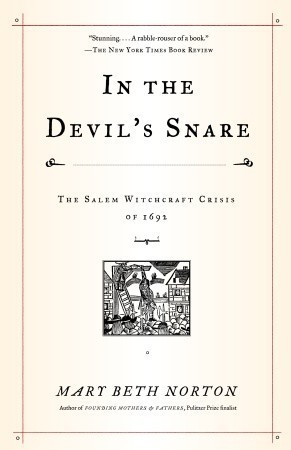
Title: In the Devil’s Snare
Author: Mary Beth Norton
First published: 2002
 Reviews of Old and New Stories. Mostly Old
It sounds similar to a book I read in college. The Devil in the Shape of a Wonan about the Salem witch trials.
It is very similar to that. She has a different thesis, but it’s very much like that one—even with maps and charts at the back.