The Stuff and Ramblings:
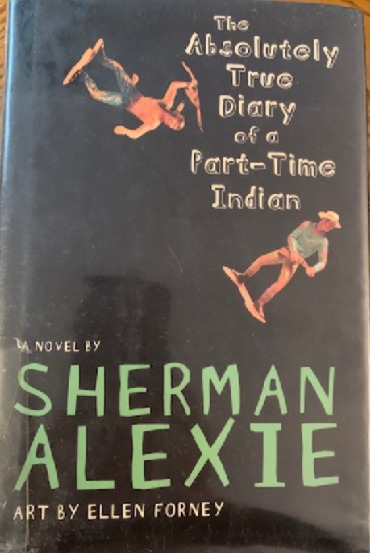
This semi-autobiographical YA novel centers on an adolescent young man called Junior growing up on the Spokane Reservation. Like the author, he was born with hydrocephalus and underwent surgery as an infant. Both also suffered seizures as children. Because he is not athletic, he is easy prey for bullies. He has one friend, however, Rowdy, who is both fearless and willing to knock the daylights out of most bullies.
Rowdy’s father is a mean drunk. Junior’s father also drinks but isn’t mean. Junior’s family, with its shortcomings, is loving. After a teacher advises him to leave the reservation, Junior tells his parents he wants to go to school in Reardon, an all-white school off the reservation, twenty-two miles away. They readily agree, though transportation remains an issue.
This draws immediate backlash. Others on the reservation see him as a white-lover and call him an apple, meaning someone red on the outside and white on the inside. Rowdy, Junior’s best friend, is especially hard on him, even though Junior tries to talk Rowdy into coming with him.

Early in the book, before he leaves for the off-reservation school, Junior talks about the effects of poverty. He had a dog named Oscar, who was the only being he could trust—more than any human. Oscar got sick. His mother finally had to tell him there was no money to take Oscar to the vet.
When his father got home from wherever, his parents had a talk. Junior’s dad got his gun and bullets and told Junior to bring Oscar outside.
“So, poor and small and weak, I picked up Oscar. He licked my face because he loved and trusted me. And I carried him out to the lawn, and I laid him down beneath our green apple tree. “(p. 13)
In describing this terrible loss, the author says:
“Poverty doesn’t give you strength or teach you lessons about perseverance. No, poverty only teaches you how to be poor.” (p. 13)
Another notable theme is alcoholism. After a series of tragic losses, Junior notes how many of them had to do with alcohol. One can be killed by drink without even imbibing if someone else gets behind the wheel drunk.
But I think by far the greatest underlying theme is the dual nature of Junior. He is an Indian, a self-designated “reservation boy,” but he also wants to build a life outside the reservation. This is indicated in the title “part-time Indian.” It also follows the relationship between Junior and Rowdy, where he concludes that Rowdy is his best friend, even if he hates him. The book is dedicated to Reardon and Wellpinit, the author’s “two hometowns.”
I did go on a bit…
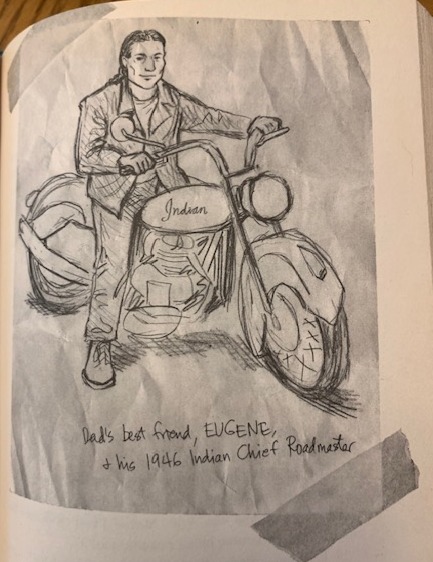
One nice thing about the book is the many drawings by Ellen Forney, executed to look like sketches taped to walls or comic-book panels. Some give the impression of kid drawings, but there are also beautiful pencil portraits.
This book was the most banned and/or challenged from 2010 to 2019, according to the American Library Association. Really? I might have to re-read it in case I missed something. Okay, there were a couple of naughty words, and it mentioned that people gamble. It also discussed people drinking and doing stupid, sometimes hurtful and deadly things. But it advocates none of the above.
I have mixed feelings about the book. I enjoyed reading it, yet I hesitate to recommend it because of the allegations of sexual harassment made against the author, which I was unaware of when I chose this book at the library. Banning the book, however, would be pointless. It is a story worth reading.
Bio: Sherman Alexie (b. 1966) is a US writer, poet, and filmmaker who was raised on the Spokane Indian Reservation. Among his works are The Lone Ranger and Tonto Fistfight in Heaven (1993), which received a Hemingway Foundation/PEN Award and was adapted into the movie Smoke Signals (1998), for which he wrote the screenplay. Among his books of poetry are The Man Who Loves Salmon (1998), One Stick Song (2000), and Face (2009).
Several women have come forward with allegations of sexual harassment against Alexie.
He has apologized.
It is a sad business throughout.
 Reviews of Old and New Stories. Mostly Old
It is sad all around. I tend to give men a break on their behavior in the more distant past. Working in an office in the 80s and 90s there was a lot of what would now be considered sexual harassment going on. Sometimes it crossed the line and nothing was done. Other times it was just good-natured fun and no one meant anything by it. It wouldn’t fly now, though. I look at my Dad’s generation where they thought giving a girl a tap on the butt or a pinch was a compliment. Times change, thankfully. This sounds like it was within the last 20 years, which he should have known better, especially if he was married while it was going on.
There are always two sides to a story, of course, But some of the allegations sounds downright predatory, for example, promising to review a young native poet’s work and inviting her to his hotel room.
And yes, he was married and carrying consensual extra-marital affairs. That I would view between him and his wife.
A tap or a pinch on the butt I would view as tacky and worth a scold but not worth ending a career.
This is another book I’ve always wanted to read.
I wanted to read it for a long time as well. It is a fun but sad read.