
Nicias:
But can we? Oh, no, no,
I’m frightened. Better go and cling somewhere
To a holy image.
Demosthenes:
Holy grandmother!
You don’t believe in the gods!
Nicias:
Of course I do.
Demosthenes:
What reason have you?
Nicias:
Reason? Why, I know
I’m a God-help-us failure. That enough?
–from The Knights by Aristophanes (c. 424 BCE), trans. Gilbert Murray
The Stuff:
This nonfiction book grew out of a study published in 2010 as an Evolutionary Psychology article, “Preachers Who Are Not Believers,” examining preachers who do not believe in God. The study focused on five Protestant ministers who lost their faith. The book expands the number of people interviewed to about thirty-five and includes a Roman Catholic priest and an Orthodox rabbi, among others.
Unless the subjects have permitted their real name to be used, the authors have understandably assigned the people in the study pseudonyms.
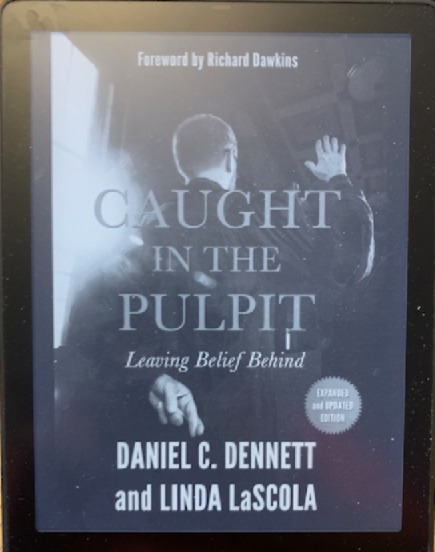
The cover depicts a black-robed (white) guy with his right hand raised, perhaps in blessing, to an unseen congregation. His back is turned toward the viewer. His left hand, behind his back, shows his fingers crossed. This is perhaps a little unfair; most of the clergy who stayed in their positions saw their loss of faith as a struggle.
The book begins with a discussion of qualitative research, author Linda LaScola’s specialty. Author Dennett discusses The Clergy Project, an online forum for present and former clergy people who no longer hold supernatural beliefs. Dennett himself is not involved as the forum is for clergy only. It is private and closed, intended only for its users.
The authors make a distinction between the “literals,” those who take the Bible literally, and the liberals, those who see more metaphor in the Bible. The more education one receives, the more one leans toward metaphor, the authors seem to hint. Of course, it is possible to educate oneself into non-belief.
A few examples: “Bill” is an Episcopal priest in a college town in a conservative state. He began doubting in seminary and now considers himself an atheist, but does not press anyone into disbelief. Instead, he views his position as one of service. He sees it as a privilege to be “invited into the most intimate aspects of a person’s life—birth, dying, divorce, losing a child.” (pp. 131-132)
Similar to his experience is the Humanist rabbi, “Jacob,” who speaks of humanist Jews: “They’re certainly not theistic. But they like being Jewish. They love the holidays. They love that affect component. And when I teach—and I do very clearly and accurately and forcefully teach about this history—they like it.” (p. 132)
A dilemma of sorts opens up between the pastor and the congregation. The pastor knows more about the Scripture, the history, and church history than the congregation does. S/he has been to seminary. Does the congregation want to know the difficult stuff or stick with the comforting stuff, the Jesus-loves-you stuff?
Interestingly enough, most people began losing their belief in seminary. Many believe the phenomenon is widespread but seldom discussed. Some said preachers have a coded vocabulary when seeking other non-believers out, even comparing it to gay people seeking other gay people out in the days when homosexuality was not discussed.
Thoughts:
Some anecdotes and excerpts from some interviews are moving and reflect the deep conflicts of the person involved. Others are puzzling. This is understandable. Participation in a religious community is more than a belief in God or the supernatural. It is also a community and can involve the observation of rites of passage (First Communion, bar mitzvah, and so on). If you’re a preacher, it’s also a job. How do you feed your family if you walk away from that?
However, there is a lot of data—tables and lists—so the book also reads like a sociology study. Small wonder that it does so, because that’s what it primarily is. Nevertheless, some very human and very poignant stories emerge. The reader sees a lot of people forever caught between two worlds.
While this was interesting and at times moving, mostly it was sad. The idea of a clergy person keeping their job despite not believing conjures up all sorts of cynical ideas. No doubt a few Elmer Gantrys exist, and are in no hurry to unburden their consciences to such a project, but the portrait that emerges from Dennett and LaScola’s study is more complex.
My dearly beloved told me he received advice on meeting women (before we met) from the father of a friend many years ago: “Go to church.”
“But I hate religion,” the dearly beloved said.
“Doesn’t matter,” the friend’s father said. “Just smile and nod your head.”
I long imagined there was a lot of smiling and nodding of heads, particularly back in the day when there was more social pressure to go to Sunday meetin’, but I didn’t expect a lot of preachers to be doing the same.
Like so many books, this is not for everyone. If the topic is of interest to you, the book should be a worthwhile read.
Bios:
Richard Dawkins (foreword) (b. 1941 is a British evolutionary biologist, ethologist, and popular-science writer born in Kenya, where his father was stationed. He earned Bachelor’s and Master’s degrees in zoology. His first book, The Selfish Gene (1976), argued that natural selection takes place at the genetic rather than the individual level. Other books include The Blind Watchmaker (1986), Climbing Mount Improbable (1996), and The Ancestor’s Tale (2004). He is a fierce advocate for evolution and atheism.
Daniel C. Dennett (1942-2024) was an American naturalist philosopher specializing in the philosophy of mind. He was also active in the atheist movement. Among his books are Consciousness Explained (1991) and Darwin’s Dangerous Idea (1995).
Linda LaScola (b. 1945) is a qualitative researcher, clinical social worker, and Clergy Project co-founder. She holds a Master’s in Social Work. This is her first book.
Title: Caught in The Pulpit: Leaving Belief Behind
Author: Daniel C. Dennett, Linda LaScola; foreword by Richard Dawkins
First published: 2013
Length: nonfiction book
 Reviews of Old and New Stories. Mostly Old
It sounds like a very interesting book. A priest or other clergy losing their faith certainly puts them in a difficult position. The “you must believe this…” requirement in many, if not most denominations leads to a need to defend what is often indefensible. Belief in anything cannot be forced and is not a virtue and yet that is the foundation. The more you understand and the more honest you are, the worse for you. I feel sorry for this clergy being put in this position. You wrote a very interesting and very helpful review.
It is an untenable position for sure, but there are liberal Protestant denominations that don’t really care all that much. The Unitarians, as I understand it, aren’t that picky about beliefs but more about actions.
Thanks for your kind words.
Yes you are right. Thank you Denise.
This sounds really interesting. I still believe in a higher power, but I believe the world’s religions have it wrong. There are elements of truth in many of them, but I tell people it’s like an ant trying to understand human beings – we just don’t have the capability of understanding it so we try to frame it in human terms and mess it up completely. I wonder if some of the clergy feel the same, or if it’s just a complete disbelief in anything like that. I have to say my problems with religion mirror their experience. It was once I started working in a church and with members of our local Synod that I began to feel this way.
I found it interesting. I think most people go into the ministry with good intentions. Losing faith complicates things, though there are dozens of ways to deal with it. IMseldomHO, it doesn’t matter what creed you can recite. Decency, honesty, and compassion work far more than statements of faith.
Sounds fascinating! Maybe I could borrow this book from you sometime?
At your leisure!