Warning: This is longer than usual.
The Stuff:
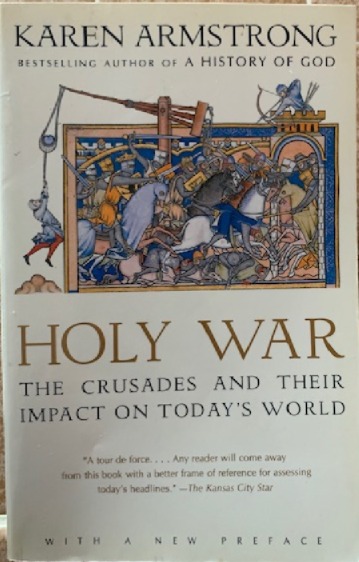
Author Karen Armstrong informs the reader: “The central thesis of this book is that there is a strong connection between the medieval Crusades in the Holy Land and the conflict between the Arabs and Jews in the Middle East today.” (p. 373)
Armstrong seeks to view history through what she terms “triple vision,” that is, seeing the events through the eyes of the Christians, Jews, and Muslims in turn.
According to Armstrong, at the time of the First Crusade, Christians, Muslims, and Jews had been living in acceptance of one another in the Middle East. In Europe, they also tolerated one another, if to a lesser degree. The Church taught against killing Jews. Indeed, there were no anti-Semitic pogroms in Europe until the First Crusade.
(This last statement is not entirely accurate, but certainly crusaders indulged in trashing Jewish places and killing Jewish people on their way to and back from the Holy Land. “Deus vult,” you know.)
The author claims that the idea of crusading grew out of the Cluniac monastic reforms that began in Cluny, France, in the mid-10th century (p. 54 ff). These led to several significant changes, not only regarding the property of the monastic houses but also with a return to prayer and liturgy, among many other things.
While she mentions the reforms often, the only aspect of them she dwells on for any length of time is the idea that the orders no longer report to secular authorities but to the pope alone. This “liberation” from secular authorities made the church more interested in expanding, tying violence, including anti-Semitic pogroms, to Christian piety. Pope Urban II (in office 1088-1099), who had been the grand prior at Cluny, called for the First Crusade beginning in 1095. Crusading would continue into the 13th century.
Exploitation, colonization, and invasion of the Middle East by several parties continued for centuries—something Armstrong refers to as “the crusader spirit”—building ill will that persists to this day.
With 540 pages of text, there is more to her arguments, of course, but this is the crux of the matter.
Thoughts:
I have to preface the following rant remarks with a note that I am not a professionally trained—or even amateur—historian. Nor is the author. Her degrees are in literature, and I concede that she may know a thing or two I don’t. My degree is in damnit I ran out of money.
The book’s narration is not chronological, though it begins around the time of the First Crusade and ends with a summary of events after the last Crusade (13th century) through the late 20th century.
The book was originally written in 1988 with a new preface added after the September 11 attacks in 2001, in which Armstrong points to George Bush’s unfortunate use of the term “crusade.” She notes that it has more specific meanings in the Middle East and conjures up bitter memories of invasion and oppression.
She writes:
…Arab historians have developed an entirely new interest in crusading and…they see the Crusaders as the first Western Imperialists and the Zionists as either new Crusaders or tools of Western imperialism. Similarly, crusader studies flourish at the Hebrew University at Jerusalem; whenever Israelis travel in their small country, they see the great castles, churches, and cities built by the Crusaders some nine hundred years ago. These ruins are eloquent reminders of another colonizing movement which has powerful Western backing and which tried to establish itself in the hostile Muslim world of the Near East. (p. 373)
While I have no wish to minimize the destructiveness of the Crusades, I cannot accept that there is only a single root cause of the present violence and hatred in the Middle East. On the contrary, there seems to be an infinite progression of causes, which makes it all the sadder and more tragic. The Crusaders were not alone in cruelty, but their excesses stand out in a cruel place and time.
One of the pleasant surprises was the author’s turn to literature, particularly 20th-century novels, to reflect the Zeitgeist. No doubt, this reflects her specialty in literature, something not often seen in historical accounts.
An exception to that is her examination of Salman Rushdie’s The Satanic Verses. She admits Rushdie couldn’t have foreseen the backlash and the Ayatollah Khomeini’s death sentence, and understands that Khomeini had non-religious reasons for issuing the fatwa, but she also states that Rushdie’s book appears among Muslims to be “only the latest in a long line of books written in the West, supported and, even promoted by the establishment, which have presented Islam and its Prophet in a distorted light.” (p. 537)
The “long line of books” she talks about were xenophobic tomes claiming “scientific” reasons why Arabs were inferior to Europeans, and Islam was an inferior religion to good ol’ Christianity. Rushdie’s work of fiction speaks to human nature. He writes: “From the beginning, men used God to justify the unjustifiable.”
To understand this, one would, you know, have to read the book, something that doesn’t involve the satisfying righteous indignation of screaming, “She’s a witch!”
But I digress.
If Armstrong is guilty of any sin, it is perhaps the old idea of post hoc ergo propter hoc, that is, the present-day troubles follow—at a distance—the Crusades; therefore, the Crusades must have caused—or at least contributed to—the present-day troubles.
I remain unconvinced. The Crusades are more of a stepping stone on a long road. What caused them, other than greed and delusion? Perhaps a need to ensure safe passage for pilgrims to the Holy Land? A self-interested desire to answer a call from fellow Christians in Constantinople to help fend off an invasion of Seljuk Turks? Worry that Europe’s doorstep wasn’t safe from invasion by Muslims in occupied Spain? How far back does one have to go? My guess (and it is only that) is that there are enough threads in the weave that blaming one is to distort the work.
The Crusades were bloody, cruel, and destructive, but there was a lot of that going around.
There remains a lot of that going around, sadly.
One more brief complaint. The book is densely written, with few breaks. A random page below:
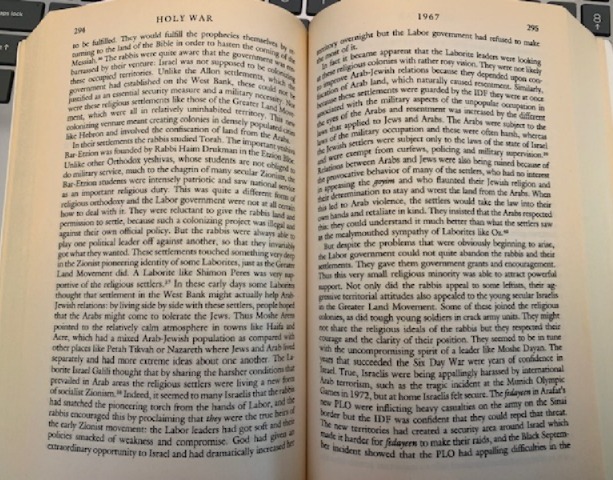
All this to say that Armstrong’s book is worth reading, but it takes effort. She is a thoughtful writer. Not all readers will find themselves arguing with her as forcefully or as often as I did.
Bio: Karen Armstrong (b. 1944) is a British author and commentator. She is a former Roman Catholic nun, an experience she wrote about in Through the Narrow Gate (1982) and The Spiral Staircase (2004). She writes mostly about comparative religion. Among her most well-known books are A History of God (1993), Islam: A Short History (2000), and The Case for God (2009). She has also written documentaries for the BBC
Title: Holy War: The Crusades and Their Impact on Today’s World
Author: Karen Armstrong (b. 1944)
First published: 1988
Length: nonfiction book
 Reviews of Old and New Stories. Mostly Old
I think that this is good “Armstrong seeks to view history through what she terms “triple vision,” that is, seeing the events through the eyes of the Christians, Jews, and Muslims in turn.” but she seems to be overstating her case and it would have been better if she was a professional historian. The book seems to be really dense and I agree that is very difficult to read (your page example). However, it seems like an interesting book. You wrote a great and very helpful review.
Thanks for your kind words. Yes, it is an interesting book. It takes a bit of effort to get through it. I think (but what do I know?) she pays more attention to what wants to and neglects other areas. But the whole picture is complicated and I’m hardly an expert.
That’s not going to keep me from asking questions. 🙂
Yes you certainly should ask questions