The Stuff:
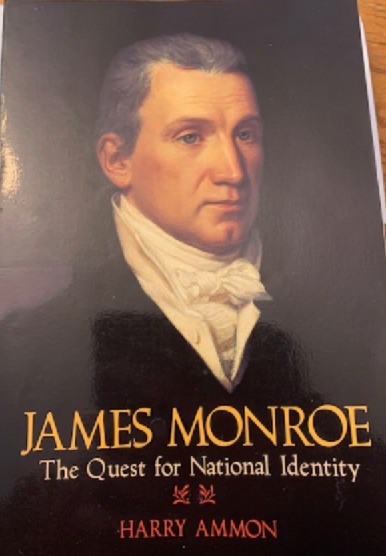
This book is a biography of the fifth U.S. President, James Monroe (1758-1831; in office 1817-1825). He’s probably best known to those of us who went to school in the US for the Monroe Doctrine, which grew out of a State of the Union address he delivered in 1823 and warned European powers to keep their colonizing paws off the Americas. Many Latin American countries were declaring independence at the time.
I remember a high school social studies teacher in the days of yore describing the Monroe Doctrine as the United States declaring, “The Caribbean is our lake!”
Monroe is also regarded as the last of the generation of Founding Fathers to serve in high political office. Like Thomas Jefferson and John Adams, he died on July 4th. (Jefferson and Adams in 1826, Monroe in 1831). He was good friends with Jefferson and James Madison, and lived near Jefferson.
All that aside, the book describes Monroe’s early years—what little is known of them—his dropping out of William and Mary College to serve in the Continental Army in the Revolution, during which he received a serious wound. He later practiced law, served in the Congress of Confederation (the Articles of Confederation), and served various terms as a diplomat in France, England, and Spain. He also served as the Governor of Virginia and Secretary of State.
He was a busy boy, but the book reveals little about his inner life and thoughts, probably because he was not in the habit of committing much of the same to paper. Only one letter to his wife survives. Author Ammon draws a lot of his material for what transpired during Monroe’s presidency from the journals of his secretary of state and successor, John Quincy Adams.
Thoughts:
This seems to be a historian’s rather than a general reader’s book. The reader will hear in exquisite detail all the minutiae of the diplomatic back and forth of Monroe’s career, whether instructions from Washington (the human) while Monroe was in France, or whether he’s debating the ethical concerns with his cabinet about spending federal taxpayers’ money on the Cumberland Road (“internal improvements”).
He regarded himself as a republican, which at the time meant concern for individual rights, states’ rights, and agrarian rights. He seems to have been a true believer in that respect and did not want too much power concentrated in the federal government.
However, he was also a man of his time. The franchise belonged only to certain people, namely, white landowning men who could pay the poll tax. He worked against the smuggling of slaves in the US (importing slaves was officially banned in 1807). In 1820, an act was passed that designated smuggling slaves as piracy and a capital crime, but enforcement…?
He showed ambivalence toward the idea of slavery. He owned slaves himself, but envisioned an end to slavery not by emancipation but by sending black people to set up their own country in Africa. His view was similar with respect to native Americans, though he thought they should be civilized for their own good.
And that is how long ago 200 years was.
There are some indications that the author assumes knowledge among his readers such as comments like, “Although many regretted the unhappy fate of [Gilbert du Motier, Marquis de La Fayette] and the execution of the [French] King…” (p. 98)
This note confused me because I seemed to recall Lafayette living a long time. What “unhappy fate” was he talking about? What did it have to do with the execution of the French king?
Whatever did we do without the internet?
Lafayette was imprisoned along with his wife for five years during the French Revolution, something the author doesn’t mention for another forty pages or so when Monroe is in France as a “minister.” Lafayette lived long enough to tour the United States during the 50th anniversary celebrations of the American Revolution.
Speaking of the French Revolution, the author also casually drops terms like “Jacobin” and “Thermidorian” without further explanation. Again, what would we do without the internet?
While I have to confess there were interesting things in this book, overall it was a slog. Those, like myself, who are not terribly well-informed about the era (even if history class was a lot closer in time to the American Revolution), will certainly learn something about it, but only after wading through a lot of detail to get there. And it is lo-o-ong.
Bio: Harry Ammon (1917-2016) was Professor of History at Southern Illinois University, Carbondale. He attended Georgetown University and received his doctorate from the University of Virginia in 1948. He retired from Carbondale in 1984. He is also the author of The Genet Mission (1973
Title: James Monroe: The Quest for National Identity
Author: Harry Ammon (1917-2016)
First published: 1971
Length: nonfiction book
 Reviews of Old and New Stories. Mostly Old
I enjoy Presidential bios, but missed this one. Thanks for the summary.
Thanks for your comment. It’s a little older and a bit heavy.
That sounds like an interesting but heavy book. I knew what “Jacobin” was but I had to look up “Thermidorian”. You wrote a great review.
Thanks for your kind words. It was an interesting book, but oh, did it take a bit of time and effort.
Yes I can imagine that