The Stuff:
In this nonfiction work, British teacher Carol Atherton mulls over fourteen books and plays, and one poem she has taught English students over the years. A single chapter, titled with a tagline, is devoted to each work. An afterword discusses additional modern works that could be added to the reading lists.
Some works, like Charles Dickens’s Great Expectations (“On loyalty, empathy, and social mobility”) and Robert Browning’s “My Last Duchess” (“On gender, power and control”), were expected and brought back memories of the days of yore, otherwise known as high school. Others, such as A Kestrel for a Knave (“On learning”) by Barry Hines and Noughts & Crosses (“On seeing things differently”) by Malorie Blackman, I’d never heard of. The last two struck me as more British-centric and less likely to show up in an American curriculum, which, of course, in no way diminishes their value for reading on this side of the Atlantic.
This book is also about being a teacher, particularly an English teacher, and about being a student. Atherton sees the humanities as vulnerable to budget cuts with the current emphasis on STEM subjects. It’s easy to see how important STEM fields are and how training in them will lead to lucrative careers. Her own career is challenging and rewarding.
Thoughts:
I am not now nor have I ever been an English and/or reading teacher. However, I am an inveterate book nerd. And I love conversations with other book nerds. I will read just about anything, even stodgy old English texts. But seriously, this was a lot of fun. An added plus was that the author was open and vulnerable about her own experiences, not only in teaching but in applying to university, for example. It’s almost like you’re talking to a person.
For example, in discussing Macbeth, a play I read in both high school and college and have seen performed several times, Atherton provides an additional dimension by viewing it from Lady Macbeth’s perspective through the lens of childlessness. She is frank about her own struggles with infertility (which, one can safely assume, didn’t involve regicide). This discussion demonstrates the best of what literature can do, IMHO. Even with a play that is so old, so dated, and that I am so familiar with, there is still more to be learned. It can still speak to human experience beyond what its author could have imagined.
I had a lot of fun with this book. I didn’t agree with everything, of course. I will worry when I find someone with whom I do agree on every point. The book A Kestrel for a Knave sounds as depressing as watching Old Yeller or Bambi’s mother get shot or reading Where the Red Fern Grows. Man, just hang a sign that says, “Abandon all hope, ye who love animals.”
This book is not everyone’s cup of tea. By its nature, it tends to center on British works—not that there’s anything wrong with that—and shouldn’t stop anyone outside Great Britain interested in an examination of English-language literature from reading it.
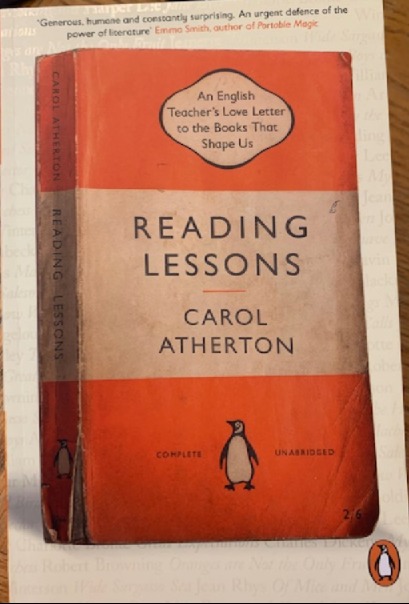
Title: Reading Lessons: An English Teacher’s Love Letter to the Books that Shape Us
Author: Carol Atherton
First published: 2024
Length: nonfiction book


It sounds like a very good book and you wrote a great and very helpful review. Considering that I’ve never taken an English class (other than as a second language), or read much classic English literature (Swedish was my langauge and focus), I am not sure it is for me though.
Thanks for your kind words. This probably would score high on the nostalgia meter with you (other than maybe the Shakespeare), so no, I can see where you might not find this much of a fun read. In saying so, I have to admit, that I can’t think of any classic Swedish literature off the top of my head. I’m sure there’s enough to keep young Swedes occupied in school, but I can’t think of any at the moment. They can’t be reading something like the Elder Edda (in translation) for twelve years. 🙂
UGH.. .. would NOT score high…
“NOT” ha ha I skip that word often. It changes the meaning of the sentence quite a bit.
It does, doesn’t? I imagined you’d be scratching your head at my statement or in awe of my fantastic (HA!) typing skills. 🙂
No I easily understood
🙂
Some authors and poets we studied were Carl Michael Bellman, Olof von Dalin, Emanuel Swedenborg, August Strindberg, Viktor Rydberg, Selma Lagerlöf, Hjalmar Söderberg, Harry Martinson, Vilhelm Moberg, Karin Boye, Pär Lagerkvist. My favorite poet (in the world) is Viktor Rydberg. My favorite Swedish children’s author is Astrid Lindgren (Pippi Longstocking, Emil, Karlson pa taket, etc). We also studied Norwegian, Finnish and Danish literature, as well as some French, German, Russian and English, where I came across Shakespeare. The thing is that Swedish is a small language so people part of other cultures do not know much about Swedish literature but Swedes know more.
How could I have forgotten Pippi Longstocking? I loved those books as a kid. The only other writer I’ve heard of that you mention is Emanuel Swedenborg. I haven’t read his works, but he’s been quoted in other stuff I’ve read. I’ll have to give your favorite poet a try, though I imagine some stuff is lost in translation. Thanks!
Yes, unfortunately, when it is about poems, a lot is lost in translation, especially when the beauty and rhytm of the poem depends on rhymes. This is an example of poem by Viktor Rydberg that I love but unfortunately a lot is lost in translation.
Thanks, Thomas! I remember reading this! Stumbling (and I do mean stumbling) over a few lines of the I can see the rhythm. It would be very hard to carry that over to another language. But what a lovely poem!
Thank you so much Denise
What an interesting book! I love Great Expectations. I listen to it at least once a year. I think it’s Dicken’s best novel. It’s a story that is Shakespearean in scope, characters, themes, and literary language.
Yes! I remember we read different endings back in the day. I’m not sure which on is standard or which one worked better. But it went quite the distance. Dickens, I always thought, did better with characters than plot, though he was no slouch with plot.
Dang. Book nerd mode again. 🙂
In the original ending Pip and Estella don’t end up together. But some people in Dickens’ circle wanted him to change the ending. In the second ending, Pip and Estella do end up together. Over the years I’ve waffled over which ending I liked the best. Right now, I like the ending where they end up together. Perhaps it’s because the world needs all the happiness it can get.
Thanks. I’ll vote for happiness