
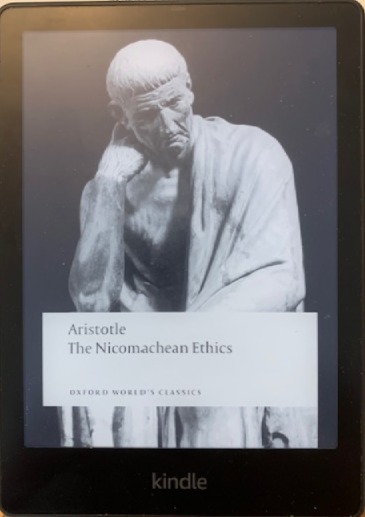
And now for something completely different.
The Stuff:
Aristotle poses the question, “What does it mean to be happy as a human?” Rather, because he was a member and sustainer of a patriarchal society, “happy as a man?”
(Aristotle doesn’t say much about women in this work, but in general, at the time, women were considered a different subspecies, dontcha know—useful for cooking, cleaning, sex, and perpetuating the species. Hesiod advised marrying a slave so that if times get rough, you can make her walk behind a plow.)
Aristotle differentiates between momentary joy or happiness and long-term flourishing, eudaimonia, by living up to one’s potential. This involves practicing virtue, something more complicated than being a Goody-Two-Shoes but living what various translators call “in the means” or “in moderation,” that is, between two extremes of a behavior.
For example, the man who has perfected the habits of Self-Mastery understands courage and will practice it. A man with a deficit in courage will flee a confrontation out of fear; one with an excess of courage will behave rashly. The virtue of courage is the “mean,” between the two extremes, and (so Aristotle tells us) will help a man lead a life of eudaimonia, flourishing, happiness.
The same can be said for many other attributes.
He also covers topics such as justice and fairness, friendship (yes, and male friends with benefits), and pleasure—ascribing a type, function, and qualities to each.
Thoughts:
Perhaps the first question is why on earth would anyone willingly read this stodgy old book? Good question.
I have no better answer than that some BookTube channel recommended it. I’d heard of the work for years and got curious. It is foundational in Western philosophy. I really will read just about anything.
Aristotle must have had a lot of time on his hands.
But seriously: this is traditionally considered to be drawn from lectures at his Lyceum. This book is a slog. He seems to want to examine every aspect of his topic but is only able to deal in abstracts. While people understood human psychology in an empirical fashion, they did not have the access to (obviously) the modern controlled studies we do now. The result is detailed summaries of perhaps idealized situations and opaque conclusions.
Reading it is rather like constructing a geometry proof, but without visual aids like drawing triangles, bisecting any angles, or worrying about a circumference.
For example, in Book VI, discussing intellectual virtue, Aristotle tells us:
“What affirmation and negation are in thinking, pursuit and avoidance are in desire; so that since moral virtue is a state of character concerned with choice, and choice is deliberate desire, therefore both the reasoning must be true and the desire right, if the choice is to be good, and the latter must pursue just what the former asserts.” (p. 103)
And there are nine more books like this to go through.
On the bright side, there were a few happy surprises. When talking about his “Chief Good,” Aristotle says, “it is not one swallow or one fine day that makes a spring.” I’ve heard for years a variant of this: “One swallow does not a spring make.” I knew it was an old expression. I didn’t realize how old.
Unless the reader is an expert in the history of the classical and ancient worlds, keeping an internet connection open to look things up while reading this is a good idea.
Aristotle mentions people that the reader may not be immediately familiar with. In one case, he butchers a name and mischaracterizes a person and events so thoroughly that scholars have offered an explanation as to who he had in mind: Sardanapalus
A final caveat: Different translations have different chapter divisions. I could not find an explanation for this, other than, well, they could.
My guess is that not many people are going to run out and get a copy of this work. Those who were forced to read it in college figure they’ve already put in their time. And that’s all right.
This book can be read here, but a copy from the library is a lot easier to read.
Bio: Aristotle (384-322 BCE) was born in the Macedonian region of northeastern Greece. He studied at Plato’s Academy in Athens and left at Plato’s death in 347. He stayed in Assos, with a fellow Academy student, then at Lesbos, with another fellow student, continuing his philosophical and scientific studies. He later tutored the son of King Philip of Macedonia, who would become Alexander the Great. He established a school of philosophy in Athens dedicated to Apollo Lykeios, which became known as the Lyceum.
It is believed he wrote about two hundred works, but only thirty-one are extant. His writings cover subjects such as logic, metaphysics, ethics, political theory, aesthetics, rhetoric, and biology. Debates continue regarding how many exist and which works are authentic.
Title: Nicomachean Ethics
Author: Aristotle 384-322 BCE
First published: 340-334 BCE
Length: nonfiction book


Thanks for reading it, so I didn’t have to! LOL. I admire your willingness to read a wide range of books!
LOL! Glad to be of service. Curiosity and the cat, I guess. 🙂