
A note: The book reviewed below deals with clergy sexual abuse.
The Stuff:
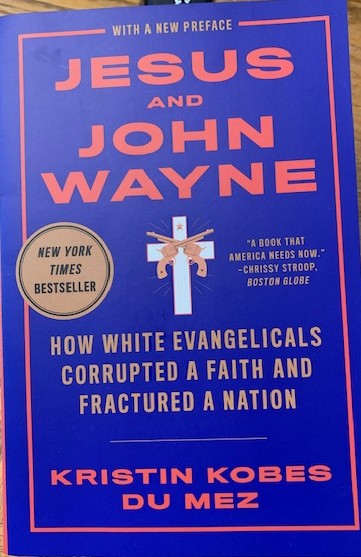
Written by historian Kristin Kobes Du Mez, this book examines Christian nationalism as an alien influence that first invaded and corrupted American evangelical Christianity and now threatens American society and government.
Du Mez points to fear in an uncertain world—the threat of godless Communists and nuclear attack or the dread of god turning away from America because of sexual immorality*—driving conservatives toward a more defensive, warrior stance. The same conservatives saw John Wayne as a hero of masculinity in the post-WWII years. Du Mez quotes Baptist scholar Alan Bean: “The mantra of post-war evangelicalism was simple: Jesus can save your soul; but John Wayne will save your ass.” (p. 59)
I must admit this confused me. John Wayne was an actor. He never served in the military, though he dearly wished to enlist during WWII. No image on a movie screen is going to save anyone’s ass. The best he could do was encourage you to buy war bonds, and that time is long gone.
A journalism instructor I had long ago and far away once told a class that he did a stint for one of the scandal sheets. One of this particular scandal sheet’s favorite things was printing fabricated stories about John Wayne being thrown out of bars. Once in a while, they’d get their wires crossed and print stories of him being thrown out of a bar in, say, Tokyo at the same time he was supposedly thrown out of a bar in, say, Munich. So, John Wayne was a paragon of Christian manly virtues? Hmmmm…
Nevertheless, conservative Christians used the image of cowboy/soldier John Wayne to create an ideal for men to aspire to, even (especially?) if they’d never seen a John Wayne movie. Didn’t anyone stop to think it was all celluloid and mirrors?
Du Mez traces the absorption of these “warrior” and hypermasculine ideas into the evangelical communities, which caused a greater dichotomy between men and women and the marginalization of LGBTQ + communities. She goes further and shows the damage teaching corporal punishment can cause.
In her final chapters, she examines the sexual abuse of young parishioners by clergy and how the church elders are quick to reconcile with the abuser and ostracize the victim. They “rehabilitate” the clergy without requiring the slightest bit of work, change in venue, retreat, or even treatment. And for goodness’ sake, let’s not get the police involved. In one chilling passage, she writes:
Since 1998, around 380 perpetrators [of sexual misconduct, assault, rape, molestation, etc.] within the [Southern Baptist Convention] had left a trail of more than 700 victims. In the wake of these allegations, the leadership of the SBC denied collective culpability, drawing attention to the autonomy afforded local churches within the SBC. Yet the SBC has a record of “removing from fellowship” churches that hired female pastors, even as they appeared unable to discipline known sex offenders. Many victims had been urged to forgive their abusers, and it was victims, rather than predators, who ended up frequently shunned by their churches. (p. 291)
Thoughts:
I found this book difficult to read not because the author’s writing style was unclear or convoluted. On the contrary, the writing is easy to follow and clear throughout. Du Mez seems to like a story with a beginning, middle, and an end. I don’t know if that’s because she’s a historian, but it works. She puts events into context nicely.
However, the events she relates made me so angry I had to take frequent breaks. She does not use inflammatory language. This is definitely not clickbait. The hypermasculine creed produces only conquerors and conquered. A few bastards get rich, but do any learn to treat our fellow humans better?
Salman Rushdie said it best: “Fundamentalism isn’t about religion. It’s about power.”
Du Mez shows this power exercising itself in political forums, in churches that will not discipline or report predatory clergy, and in interpersonal relationships. Men are the head of the family. Much of the literature encourages women to remain dependent first on their fathers, then their husbands.
There is opposition within the Christian and evangelical communities, but these guys are aiming high. I’d like to see at least some of them handed their metaphorical culus come this November.
My fellow Americans, please vote.
*Isn’t that what happened to Sodom and Gomorrah? Not exactly.
Bio: Kristin Kobes Du Mez is an American author and Professor of History at Calvin University in Grand Rapids, Michigan. Her research focuses on the intersection of gender, religion, and politics. She has written for The New York Times, The Washington Post, NBC News, Religion News Service, and Christianity Today. Among her works is A New Gospel for Women: Katharine Bushnell and the Challenge of Christian Feminism (2015). A new book, Live Laugh Love: The Secret History of White Christian Women and the World They Made is forthcoming in September 2026.
A short film dealing with clergy abuse, For Our Daughters (2024), based on the last chapters of Jesus and John Wayne is available on YouTube.
Title: Jesus and John Wayne: How White Evangelicals Corrupted a Faith and Fractured a Nation
Author: Kristin Kobes Du Mez
First published: 2020
Length: nonfiction book


This sounds like a good book. I can understand why reading it would make you angry about the church covering up the crimes of clergy and church elders. Religion is too often about power and money. Thanks for reviewing this book.
Thanks for your note. This sort of abuse is not limited to Roman Catholic priests. It’s scary because these bastards are making inroads into government.
Part two:
making inroads into government in ways the Founding Fathers tried to prevent.
That seems like a very interesting book, but I can understand if it is a difficult read. I’ve come across so many Christian fundamentalists who were extremely arrogant, cruel and delusional. They don’t tolerate other opinions nor science they feel is threating.
Thanks for your note. Yes to all of the above, sadly.