
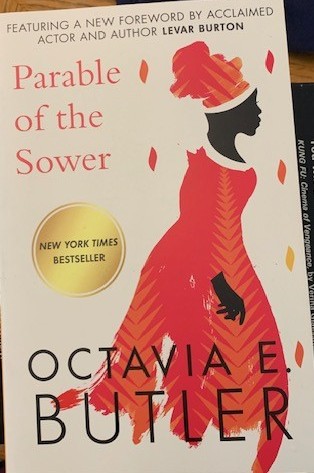
Note: The novel is set in a dystopian world where the social order has broken down. Violence, including murder, is common. It discusses rape and depicts acts of attempted rape and cannibalism. While the author does not glorify any of this, it can be hard to read.
Plot:
Fifteen-year-old Lauren Olamina lives with her Baptist preacher father, stepmother, and younger brothers in a walled community near Los Angeles in the 2020s. Many people grow their own food.
Things have changed. The walls keep out not only the wild dogs that attack humans but the thieves and drug addicts that loot and burn. A new drug, referred to as “pyro” or “’ro” makes addicts enjoy watching fire.
Lauren was born with hyperempathy, a condition that makes her feel the physical and emotional pain she witnesses in another person, even if she inflicted that pain. Her father sees this as a handicap and tries to talk her out of it. She doesn’t really feel that pain.
But she does.
Lauren thinks. She wonders. She begins to see things as they are. She writes:
All that you touch
You change.
All that you change
Changes you.
The only lasting truth
is change.
God
Is Change.
She knows a time will come to leave the walled enclave. She doesn’t foresee how the departure comes, or the devastating loss. But she dreams of humanity leaving Earth for another planet.
Thoughts:
Written in the 1990s, this book looks about thirty years into the future, when the fabric of society has broken down. Fire and police services exist but are unreliable and as likely to rob citizens as to assist them, provided they show up. There is a President Donner. He loosens labor protections, giving rise to old-fashioned company towns and debt-servitude. (“St. Peter doncha call me…”)
And yet, the space program still exists. Go figure.
The work has a dark but not a hopeless outlook. Everyone involved has lost someone dear to them, as well as their home. Because few cars exist, people walk along the freeways, migrating north in search of a better life. The reader sympathizes with Lauren and those she meets along the way, knowing that so much good stuff is going to hit the fan before they get where they’re going. Do they know where they’re going? Crossing the border into Oregon is not like crossing into a foreign country.
Lauren might not have a grand plan, but she understands change is inevitable and constant. Her design it to control that change.
This book is the first of a planned six-volume series which Butler did not live to complete. The second volume, The Parable of the Talents, was published in 1998. Butler began work on the third.
I liked this book, though not without reservations. I’d like to read the second book, though I imagine it will have little in common with this one.
But it really is time for a cheerier read.
Bio: Octavia E. Butler (1947-2006) was an African-American science fiction and speculative fiction writer who grew up in poverty. Her most notable works include the time-traveling novel Kindred and the Xenogenesis Trilogy. Among her awards are Hugo Awards for Best Short Story and Best Novelette, and Nebula Awards for Best Novelette and Best Novel. She is the only science fiction writer to win a John D. and Catherine T. MacArthur Foundation “Genius” Grant.
Title: Parable of the Sower
Author: Octavia E. Butler (1947-2006)
First published: 1993
Length: novel
Series: Parable of the Sower/Earthseed #1


I haven’t read these books but they are always recommended by people. I read Kindred a couple of years ago and was blown away, so I will eventually get to this series if I don’t die first.
I haven’t read Kindred and will probably get around to it. I read Xenogensis. It goes by another name now. It was unusual,
A dark dystopian novel but the people in Haiti are experiencing this
You are right. This did not occur to me as I was reading the novel, but how sad. And now, Temporary Protected Status in the U.S. has been cancelled for Haitians in the U.S., and politicians knowingly spread false vicious rumors about Haitians eating dogs and cats. Those poor people can’t catch a break.
Yes it is a very sad situation
I started reading it for a book club several years ago, but had to give up. it was too depressing!
I can see that. It’s not an easy read.
PS – Ms. Butler left her portfolio of papers to the Huntington Library, where my daughter Emily works. She says they get LOTS of scholars coming to the library reading room to review her documents, drafts, etc… Quite the popular subject for academic research!
Cool. Several bios made mention of this. She was born in or around Pasadena.