
Our Saturday pizza and bad movie night featured a flick we’d seen before, a spoof on horror flicks. It plays with tropes familiar in both horror and comedy.
Plot:
Waldo Trumbull (Vincent Price) and his assistant Felix Gillie (Peter Lorre) run a funeral business in late 19th century New England, cutting corners by reusing the same casket—for years. The opening scene shows them waiting for the mourners to leave a funeral, dumping the deceased into the open grave, loading the casket into their horse-drawn hearse, and quickly throwing dirt over the poor man.
Waldo drinks. Felix is a convicted bank robber and a picklock, the latter an ability that seems to have helped him escape from prison. They’re not above drumming up business by murdering by smothering (wealthy) sleeping victims with a pillow.
At home, Waldo verbally abuses his wife, Amaryllis (Joyce Jameson), who complains she gave up an opera career to marry him. Her singing—suffice to say it has to be heard to be appreciated.
Felix thinks she sings like a nightingale. He’s in love with her.
Amaryllis’ elderly father, Hinchley (Boris Karloff), who founded the funeral business his son-in-law now runs, is ill and deaf. Waldo threatens to add “medicine” from a bottle marked “POISON” to his food. Amaryllis always intervenes, much to the dismay of her clueless father.
And now, threatening to bring all that domestic harmony to a screeching halt, Waldo’s landlord, Mr. Black (Basil Rathbone), demands Waldo pay his back rent—one year’s worth—within twenty-four hours—or he will evict the lot of them.
Waldo snarls at Mr. Black as he walks off, but as he later tells Mr. Gillie, he has an idea how he might kill two birds with one pillow.
Thoughts:
The viewer has to accept the absurdity of the various situations before enjoying this movie. Waldo is nasty to his wife. He repeatedly threatens to kill his father-in-law. His wife acts like this is a simple annoyance, as if he left the toilet seat up. Despite Felix’s fumbling attempts at romancing her, she remains faithful to him—until she doesn’t.
Much to the delight of Waldo and Mr. Gilles, the doctor pronounces Mr. Black dead before they get a chance to suffocate him.
“Are you sure?” Mr. Black’s servant asks. “He had cataleptic* fits.”
The doctor has no doubts.
The viewer sees Mr. Black’s nose twitch. Apparently, he’s allergic to Amaryllis’s cat, Cleopatra.
The title is a play on Shakespeare’s A Comedy of Errors. In an homage to reciting bad Shakespeare, before things go south for him, Mr. Black is sitting in bed with a book that looks like a dinner menu, reading from the bard aloud in a deep, sonorous voice. He gets out of bed, picks up a sword, and slices several candles before jabbing it through a screen where Mr. Gillie is hiding, missing him by a hair. It is amusing and quite silly.
In another slapstick scene, Waldo and Mr. Gillie creep up a staircase lined with plaster busts on pedestals. They’re looking for a “client.” The viewer knows what’s going to happen.
Toward the end of the movie, many people who seem dead make a comeback.
I could not find this available for free. According to Justwatch, it can be rented on YouTube or GooglePlay or watched on AppleTV, however.
I had a lot of fun with this, but I wouldn’t want to invite any of these characters over for dinner.
* A state of immobility. In literature, it’s often used to mimic death.
Title: Comedy of Terrors (1963)
Directed by
Jacques Tourneur
Writing Credits
Richard Matheson…(screenplay)
Richard Matheson…(novel) (uncredited)
Elsie Lee…(novel)(uncredited)
Cast (in credits order)
Vincent Price…Waldo Trumbull
Peter Lorre…Felix Gillie
Boris Karloff…Hinchley
Joyce Jameson…Amaryllis
Joe E. Brown…Cemetery Keeper
Beverly Powers…Mrs. Phipps (as Beverly Hills)
Basil Rathbone…Mr. Black
Released: 1963
Length: 1 hour, 24 minutes
Review of “Five Million Years to Earth” (1967)
I doubt this is going to happen in your lifetime.
This was a bit different for our Saturday night pizza and bad movie, a flick my dearly beloved and I had seen on TV some time ago. We both remembered it in black and white because of the sets our families had back in the day. I must have been a munchkin, but I remember it scared the bejesus out of me. That was a while ago.
Plot:
A construction crew working on a London subway/underground extension comes across human remains, bringing in paleontologists and the curious public. Doctor Roney (James Donald) believes the fossils prove that essentially human-like creatures walked the earth five million years ago.*
While Roney is giving an unofficial press conference, one of the diggers (Bee Duffell) comes across what initially appears to be a pipe. A consultation with blueprints confirms no plumbing works are there. Another possibility, of course, is a bomb left over from the war.
The site is closed down, and the bomb squad is brought in. Roney objects to the conclusions of Captain Potter (Bryan Marshall), the man in charge of the bomb squad, as too young to have had any wartime experience. Potter sends a message to Colonel Breen (Julian Glover), who was once involved in enemy missiles.
Busy at the moment arguing with Quatermass (Andrew Keir) over the use of the rocket program, which is Quatermass’s expertise, Breen is too busy to take Potter’s call. Quatermass insists on peaceful use. Breen is looking forward to armed bases on the moon. Ouch. Breen’s been assigned to the rocket program with Quatermass.
Once Breen reads Potter’s message about a possible unexploded V-2 or something like it in the underground, he’s off the races and brings Quatermass with him.
By the time they get to the location, workmen have uncovered most of the item. They find another skull in a mud-filled pocket. It’s intact. So, how did a V-2 land with an intact fossil skull inside it…?
The crew exchanges looks.
Thoughts:
In the US, this was released as Five Million Years to Earth. In the UK, it was titled Quatermass and the Pit. Quatermass was a figure in British media, a fictional member of the space program who went about righting wrong and doing good, and so on and so forth.
When I first saw this movie on a black-and-white set, probably on a Saturday afternoon, it scared the bejesus out of me. It is creepy.
In checking the Civil Defense records, they find only a few incendiary bombs were dropped in the area. Nothing like a V-2. The houses were empty. Breen concludes they’d been evacuated.
On the way out of the underground, Police Sergeant Ellis (Grant Taylor) tells Quatermass that wasn’t the case. The houses had been deserted years before the war. People wouldn’t live there. He takes a flashlight and shows him and Roney’s assistant, Miss Judd (Barbara Shelley), inside the wrecked houses. People left because of noises, bumps, and seeing things, he tells them.
“A lot of nonsense,” he says.
When Quatermass points to scratches on the walls and asks what might have made them, an already agitated Ellis says, “Kids. Kids playing around.” He beats a hasty retreat outside. It was—warm in there. He wipes his face with a handkerchief.
Miss Judd notices an older spelling of the street name, one she says was an old nickname for the devil.
When she later shows Quatermass newspaper clippings of strange occurrences that coincided with digging for the underground in the 1920s, he pooh-poohs it all. They’re both scientists, don’t you know. Later, Quatermass listens when an abbey librarian (Noel Howlett ) translates from Latin a medieval account of similar things happening when people dug a well. Hmmm… is it the Latin or the guy that makes this credible? Or is Miss Judd just another hard-working assistant with an answer who goes ignored and, if one watches the ending closely, abused?
The special effects are so-so. You can see the strings. And the explanation is far-fetched. But again, this is creepy. Quatermass, the genius righter of wrongs and doer of good is just as vulnerable to mass hypnosis as the average Joe.
I liked watching this movie in color after all these years. It’s fun.
The only place I could find this movie online was here, at the Internet Archive. It’s probably best watched with headphones. The audio is a little murky, and the actors have funny accents.
*Early modern humans are believed to have emerged about 300,000 years ago.
Title: Quatermass and the Pit, aka Five Million Years to Earth (1967) (US title)
Directed by
Roy Ward Baker
Writing Credits
Nigel Kneale…(original story)
Nigel Kneale…(screenplay)
Cast (in credits order)
James Donald…Doctor Roney
Andrew Keir…Quatermass
Barbara Shelley…Barbara Judd
Julian Glover…Colonel Breen
Duncan Lamont…Sladden
Released: 1967
Length: 1 hour, 37 minutes
Review of “The Invisible Man’s Revenge” (1944)
Really this is the best and only trailer I could find.
Our latest Saturday pizza and bad movie offering has a put-upon dog for a hero. That journalist guy wasn’t half-bad, but the dog got the job done, even after humans hadn’t been all that good to him.
Plot:
Robert Griffin (Jon Hall) returns to London by cutting himself out of a cargo bale dropped off on a pier. Couldn’t have been a comfortable trip. He immediately buys himself some respectable clothes.
At the shop, the salesman (Cyril Delevanti) asks if he’d come in the ship now in port. Griffin seizes the man by the lapels and demands, “Who told you? Who’s been spying on me?”
The poor man says that he just thought with the ship in port—
Griffin lets the man go. He leaves his old clothes behind. In one of the pockets, the shopkeeper finds a newspaper clipping from South Africa about an escaped inmate from what was then referred to as a lunatic asylum who stabbed three men on his way out.
We next see Robert Griffin lurking outside a mansion, watching a young lady (Evelyn Ankers) drive off with her beau (Alan Curtis). “Julie,” he mutters.
Inside the house are his old friends and business partners, Sir Jasper Herrick (Lester Matthews) and Irene, Lady Herrick (Gale Sondergaard). Griffin remembers being ill and receiving a blow on the head about five years earlier. The Herricks thought he was done for.
Griffin has a copy of their agreement drawn up in Mozambique. He wants his half of all properties—a diamond field—discovered in Tanganyika (roughly present-day Tanzania). There must be a million from that diamond field!
Well, there was quite a bit, but Herrick lost it all in bad investments. He offers Griffin half of their own (inherited) money.
Griffin says that’s not enough. He’ll take even their inherited house. He has his proof.
Irene makes him a drink, slips him a Mickey Finn, and relieves him of the paper the agreement is written, over Jasper’s objections. Griffin wakes up in a ditch and ends up in the river, only to be rescued by cobbler Herbert Higgins (Leon Errol), “an honest man.”
Griffin is eventually asked to leave town. On his way out, he meets Doctor Peter Drury (John Carradine), who has been experimenting with an invisibility serum. Everyone needs a hobby. He has an invisible parrot. Brutus, his dog, is also invisible. He realizes Griffin is a fugitive. Say, don’t suppose Griffin would like to become invisible and make Drury famous, would he…?
Thoughts:
Unlike in the earlier “Invisible Man” movies, the serum doesn’t make its subject a psycho. This time around, he’s a psycho to begin with.
A couple of questions are never settled—did the Herricks knowingly leave him for dead for his stake in the diamond field? Did they merely high-tail it out of there when things got hot with the locals, and devil take the hindmost?
Griffin accuses them of murder. Jasper Herrick wishes to make some sort of amends. Irene, however, has no qualms about drugging their old friend and partner and talks her husband into abandoning his scruples after Griffin threatens to take their home as compensation for his share of the diamond field. Griffin also wants to marry their daughter Julie, who happens to be engaged to the reporter Mark Foster. Maybe he thinks that after he kills Mark and sends her parents packing, she’ll turn to him and say, “You know, you’re kinda cute”?
Despite the heaviness of many plot elements—murder, blackmail, and so on—there is also silliness. While trying to raise money for the honest man, the cobbler Herbert Higgins, who is behind on his rent, Griffin suggests he challenge the dart champions to a game at the pub. Since he’s invisible, he grabs the darts from Herbert’s hand and embeds them in the bull’s eye.
Griffin learns he can become visible again. It will take the death of a man. He’s okay with that. He figures his chances with Julie are better if he’s visible. (Uh, no, dude. They’re not.) He takes another name and coerces Jasper into letting him join the household. One morning at breakfast, he begins to fade.
Oh, yeah. Karma’s about to come to bite you where it hurts.
While I enjoyed a lot of this movie, I felt some things went unanswered. Any movie that has a dog as an unexpected hero—even if his humans don’t treat him especially well—is worth the watch in my book.
The Invisible Man’s Revenge was nominated for a 1945 Hugo Award for Best Dramatic Presentation—Short Form— for writer Bertram Millhauser and director Ford Beebe.
The movie can be watched here with iffy sound at the Internet Archine.
Title: The Invisible Man’s Revenge (1944)
Directed by
Ford Beebe
Writing Credits
Bertram Millhauser…(original screenplay)
Jane MacDonald…(adaptation)
H.G. Wells…(suggested by “The Invisible Man”)
Cast (in credits order)
Jon Hall…Robert Griffin
Evelyn Ankers…Julie Herrick
Alan Curtis…Mark Foster
Leon Errol…Herbert Higgins
John Carradine…Doctor Peter Drury
Gale Sondergaard…Irene, Lady Herrick
Lester Matthews…Sir Jasper Herrick
Released: 1944
Length: 1 hour, 18 minutes
Review of “The Name of the Rose” 1986
Struck with a bit of nostalgia, the dearly beloved and I chose a movie we’d both seen in the theater back in the day. I read the book, which, as always, was better than the movie, though I liked the movie.
Plot:
William of Baskerville (Sean Connery), a Franciscan monk, and his assistant, novice Benedictine monk, Adso of Melk (Christian Slater), arrive at an unnamed Italian abbey high in the mountains to attend a conference debating the question on the Christian role of laughter. William has come ahead of the Franciscan and the papal delegations.
The Abbot (Michael Lonsdale) pulls William aside and describes a problem he wishes his help with. William is known for his knowledge and ability to solve puzzles as a former investigator for the Inquisition. A young manuscript illustrator has died after falling from the top of a tower. There is no access to the roof. There is a glass window, but it cannot be opened and shows no sign of damage. It appears something supernatural is at work. Can William find out what happened and put the brothers at ease?
William and Adso examine the tower and the landscape. William surmises the illustrator died by suicide by jumping off a nearby structure. His body rolled down the hill and landed in front of the tower where it was found. No murderer would carry a body up the stairs, and what other business would the illustrator have up there? Tragic but not supernatural.
The question seems answered until a Greek translator (Urs Althaus) is found headfirst in a great vat of pig’s blood.
“This one, I grant you, did not commit suicide,” William tells Adso.
After the body is cleaned, William notices the man’s tongue is blackened, as are the fingers of his right hand—hardly everyday symptoms of drowning, even in (ICK) pig’s blood.
Jorge de Burgos (Feodor Chaliapin Jr.), a blind, elderly monk, sees signs of the Apocalypse in these deaths. Some of the monks fear the world is ending.
William and Adso visit the scriptorium to see the desks where the two dead men worked. William enjoys the humor the illustrator put into his work. Berengar, the assistant librarian (Michael Habeck), described as “moon-faced,” blocks them from examining the translator’s desk. Nevertheless, William finds a piece of parchment with cryptic (and hidden) writing he believes contains directions to the hiding place of a forbidden.
The next day, the herbalist Severinus (Elya Baskin) finds Berengar’s body submerged in a bath. His tongue and fingers are also blackened.
William gives his explanation of the deaths to the abbot, which doesn’t show the abbey in an especially happy light. He hands the abbot the paper he found. The abbot burns it. He says he has no choice but to call in the Inquisition.
The Inquisition and William have history, in particular with the Inquisitor Bernard Gui (F. Murray Abraham), who once imprisoned him and tried to burn him at the stake.
Thoughts:
The opening of the movie is narrated by a much older Adso (Dwight Weist), looking back on the extraordinary incidents that occurred at the abbey he hesitates to name even after all these years.
A couple of homages to Sherlock Holmes appear. First, William’s place name—Baskerville—brings to mind the Conan Doyle novel The Hound of the Baskervilles. At one point, while examining the clues to the demise of the unfortunate illustrator, William says to Adso, “Elementary!”
One of the strengths of the movie is the visuals. Some of the interiors were shot at the Eberbach Abbey in Rheingau, Germany, now used as a cultural center. The interiors are stunning.
The “forbidden” book is a lost book of Aristotle, a second book of his Poetics, that deals with comedy as a teaching tool. This is indeed a lost book, though what it contains is not known. Supposedly, this book causes a problem for the devout because the Bible does not say Jesus laughed, and the Rule of St. Benedict, which governs the lives of the monks in the abbey, warns monks against being given to quick laughter.
On one level, The Name of the Rose is a murder mystery in a medieval monastery. However, there are layers beneath this. Themes include faith versus reason, knowledge versus ignorance, and the power dynamics both within the church and over the people.
Two of the Benedictine monks are former heretics, having belonged to the heretical Dulcinian group, which the Church has banned. Many of its members, including its founders, were burned at the stake. Such a group did exist and was treated about as well as one might expect. The threat it posed to the Church was in forcing its teaching of Christ’s poverty on the wealthy clergy.
Power to the people, baby!
One of the former heretics, Salvatore (Ron Perlman), is half-mad, speaking a gibberish of mixed languages, more an object of pity than fear or condemnation. He also helps (with some inducements) William and Ado gain access to the library.
The question is also posed with the “forbidden” book of Aristotle: are there books that should be forbidden, kept from the unwashed masses, or out of school libraries? Are societies poorer for banning books? Or are people kept safe when the wise and holy keep dangerous books out of their reach?
One drawback is belittling the deaths for comic effect—a small complaint but there, nonetheless.
This is an interesting, entertaining, and engaging movie.
The Name of the Rose is available (…with a whole slew of ads…) on Tubi here: It can also be watched on subscription services like Prime Video or rented on YouTube.
Title: The Name of the Rose (1986) (original title, Der Name der Rose)
Directed by
Jean-Jacques Annaud
Writing Credits
Umberto Eco…(novel)
Andrew Birkin…(screenplay) &
Gérard Brach…(screenplay) &
Howard Franklin…(screenplay) &
Alain Godard…(screenplay)
Cast (in credits order)
Sean Connery…William of Baskerville
Christian Slater…Adso of Melk
Helmut Qualtinger…Remigio de Varagine
Elya Baskin …Severinus
Michael Lonsdale…The Abbot
Released: 1986
Length: 2 hours, 10 minutes
Rated: R
Review of “After the Forest” by Kell Woods

The Stuff:
Hänsel and Gretal have grown up and now live in the Black Forest at the close of The Thirty Years War. Rumors abound of Greta’s childhood doings with the old crone in the woods—did she really push that old woman into the oven?—but, for the most part, the villagers accept her. She bakes the best gingerbread.
She uses a recipe in a book recovered from the crone who kept her and Hans when they were children. It talks to her like a naggy roommate or older sister at times. It also tempts her—that gingerbread could do so much more if she added blood. Greta refuses to do this. People like her gingerbread just the way it is.
She also has disturbing dreams, which she thinks involve the death of her mother. She often blames herself for her mother’s death. If she and Hans had come home when they were supposed to, their mother wouldn’t have gone looking for them in the woods, and the wolves wouldn’t have torn her to pieces.
Hans likes to drink and gamble. To her dismay, Greta discovers Hans’s gambling debts are coming due to the local loan shark. In his generosity, he’s willing to take her into his home as a servant, pawing at her while he explains this magnanimous offer.
She chooses to bake gingerbread and sell a whole slew of it at the upcoming Walpurgis festival to cover the staggering amount Hans owes.
On the heels of this comes the news that the local baron dies. The widowed baroness—much younger than her late husband— will increase the taxes. If anyone can’t pay, she understands and will accept labor—a “Blood Tithe”—in its place.
Thoughts:
This is a dark take on an already dark story. Each chapter begins with a few paragraphs dedicated to a retelling of Snow White and Red Rose. The story is not hard to follow, and the two storylines meet up toward the end of the book.
Some things are obvious. When Greta is out gathering honey, she comes across a bear. No one has seen a bear in the area for decades. Instead of attacking her, the bear licks honey off her fingers. She doesn’t report its presence to the town authorities because she’s seen its eyes. The bear is not just any old bear.
The dialogue between the grimoire and Greta is amusing. The book nags and teases her, much like a roommate/older sister/aunt might. This needling takes a sinister turn later, however. Greta has met a “greenwitch,” Mira, and understands the difference between “greenmagic” and “tattermagic.” Tattermagic exacts a price, often pain.
Dark forces want her for their own ends. At the same time, the villagers, long suspicious that Greta was a witch (why is that gingerbread so good? What happened with that crone?), have new reasons to believe she’s dabbled in things she ought not to have. They condemn her to the stake—after a fair trial, of course. They’re not savages.
So, how does Greta deal with the past she doesn’t remember clearly? Or the sense of guilt for causing her mother’s death? With knowledge of the imperfections of those who should have been looking out for her?
I feel compelled to note a scene in chapter 25 dealing with bearbaiting in sad detail. This involves not only torturing a chained bear but also the wounding and death of a succession of dogs. While no real animals were hurt—obviously—it is unpleasant to read.
I enjoyed this book, even with a couple of see-it-coming-from-a-mile-aways. One of the strengths was that author Woods fleshes out her characters. Even the bad guys are bad for a reason. Drunken bum Hans could have been a throwaway, a jerk who refused to grow up, and a millstone around his sister’s neck, but the reader understands he’s haunted by many of the same things that haunt Greta.
At the same time, the book is quite dark—no rainbows or burying of the hatchet. If the reader can accept that, they will probably like this book.
Title: After the Forest
Author: Kell Woods
First published: 2023
Review of “The Bride of Frankenstein” (1935)
This is our latest Saturday pizza and bad movie offering, a horror flick with a little bit of everything, including song and dance.
Plot:
The beginning is framed by a discussion among Mary Wollstonecraft Shelley (Elsa Lanchester), Lord Byron (Gavin Gordon), and Percy Bysshe Shelley (Douglas Walton) about the story this innocent young girl has just told. Mary says the story continues.
You see, that Monster (Boris Karloff) survived that burning windmill…
His creator, Henry Frankenstein (Colin Clive), is recovering from all the sturm und drang of having lost his monster as well as the good will of the people. However, his fiancée, Elizabeth (Valerie Hobson), still loves him. Once they are married, they will leave and start a new life.
Before their plans can come to fruition, a man calling himself Dr. Pretorius (Ernest Thesiger) comes to visit. He demands to speak to Henry alone. Henry dismisses Elizabeth and the two talk about… experiments.
Dr. Pretorius has been conducting research but has only gotten so far. He believes the two of them working together—Henry refuses—at first.
In one weird and disturbing scene, Dr. Pretorius shows Henry his “creations,” a series of humans about a foot tall he keeps in glass containers. These include a “queen,” an amorous “king,” and a “ballerina,” among others.
In the meantime, the village realizes the Monster is still alive. They capture him and put him in chains. Silly villagers. The Monster escapes.
A blind hermit (O.P. Heggie) befriends him and teaches him to speak a few words. The Monster loves the hermit’s violin music and enjoys a human connection. The hermit also shows him that fire is good. After nearly dying in a burning windmill, the Monster has a problematic relationship with fire, to say the least.
All good things must come to an end. Some hunters (one of whom is a young John Carradine) stop by to ask for directions and see the Monster. In the confusion, the hermit’s cabin burns down, but the hermit and his violin are saved. The Monster flees.
He chances across Dr. Pretorius in a crypt, who makes him an offer: kidnap the new Mrs. Frankenstein, and he will make him a friend.
Thoughts:
This is a sequel to the successful iconic 1931 Frankenstein (reviewed here), with many actors in the same roles—Boris Karloff as the Monster, Colin Clive as Henry Frankenstein.
The interiors are lavish and extensive, almost as if they were real places. The exteriors rely more on mattes but are nevertheless elaborate, with woods and hills. The convoluted electrical equipment in Dr. Pretorius’s mad scientist lab would make Buck Rogers green with envy.
The final scene of the movie has become iconic. In the credits, the bride is listed with a question mark. It’s well-known that she was Elsa Lanchester, who also played Mary Wollstonecraft Shelley.
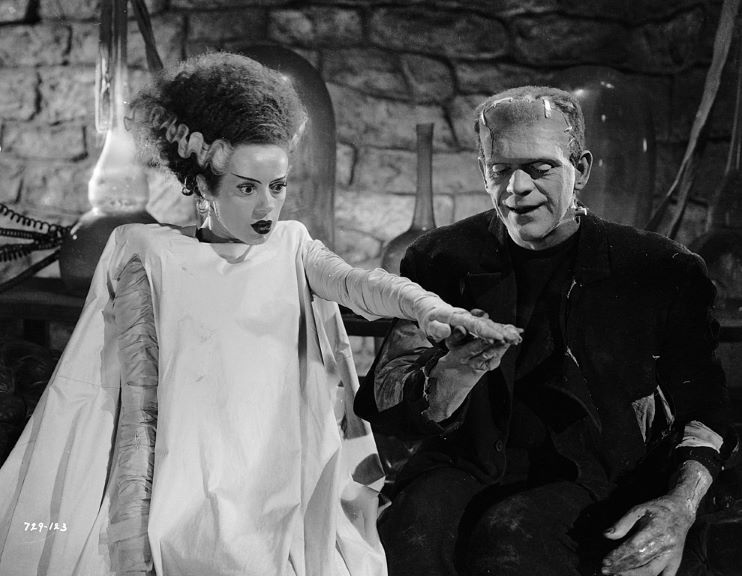
The scene with the hermit and the Monster was parodied in Young Frankenstein (1974) (“Fire is good. Fire is our friend.”) in excruciating detail.
The viewer feels both pity for and horror at the Monster. He kills people, but he also longs to be loved. The people in the village hunt him like an animal, not without cause. This existence thing is confusing and frightening. Because his creator rejected him, he has no one to guide him.
While there may be an excess of melodrama for 21st-century audiences and many side plots, this is an enjoyable movie. I had an emotional investment in the Monster. I didn’t care about Henry, but I wanted the Monster to catch a break.
Title: The Bride of Frankenstein (1935)
Directed by
James Whale
Writing Credits
Mary Shelley…(suggested by: the original story written in 1816 by) (as Mary Wollstonecraft Shelley)
William Hurlbut…(adapted by) and
John L. Balderston…(adapted by) (as John Balderston)
William Hurlbut…(screenplay)
Josef Berne…(adaptation) (uncredited)
Lawrence G. Blochman…(adaptation) (uncredited)
Robert Florey…(story) (uncredited)
Philip MacDonald…(adaptation) (uncredited)
Tom Reed…(contributing writer) (uncredited)
R.C. Sherriff…(adaptation) (uncredited)
Edmund Pearson…(screenplay) (uncredited)
Morton Covan…(adaptation) (uncredited)
Cast (in credits order)
Boris Karloff…The Monster (as Karloff)
Colin Clive…Henry Frankenstein
Valerie Hobson…Elizabeth
Ernest Thesiger…Doctor Pretorius
Elsa Lanchester…Mary Wollstonecraft Shelley / The Monster’s Mate
Gavin Gordon…Lord Byron
Douglas Walton…Percy Bysshe Shelley
Una O’Connor…Minnie
Released: 1935
Length: 1 hour, 15 minutes
Short Story Published (YIPPEE!!)

One of my short stories was published today in an online magazine called The Worlds Within Welcome to The Worlds Within – The Worlds Within.
My short story is called Devil’s Bargain. Devil’s Bargain – The Worlds Within
I must warn the reader that story is it somewhere north of 6000 words long. I hope someone enjoys it!
The first couple of paragraphs read:
“I’m not worthy. I—I’m not a virgin.”
Gods help me; it was the truth. A few gasps escaped from the people gathering outside our front door. Other people tittered. My beloved Vane, the cobbler’s son, stepped away toward the edge of the crowd, but he did not escape Papa’s glare.
“The lot fell upon you, Hilda, Brennen’s daughter,” the priest said. “To refuse is to bring the penalty of death on your family.”
Review of “The Monster that Challenged the World” (1957)
This black-and-white monster flick is our latest Saturday pizza and bad movie offering. It was the usual fare in many ways, but atomic contamination did not spawn the monster this time.
Plot:
Outside a naval research base near the Salton Sea in Southern California, an earthquake rocks the seabed. Later, a seaman named Hollister executes a parachute jump into the water, and a patrol boat carrying Seamen Fred Johnson (Jody McCrea) and Howard Sanders (William Swan) goes to recover him. His parachute floats on the surface, but they find no sign of the jumper. Johnson dives into the water to search for him but sees no trace. He submerges again to look on the other side of the boat.
Sanders becomes concerned when Johnson does not resurface. A shadow falls across him, and the viewer sees panic on his face. He screams.
When the land radio operator, Seaman Wyatt (Charles Tannen), cannot raise the patrol boat, he eventually contacts Naval Intelligence. The new guy in charge, Lt. Cmdr. John “Twill” Twillinger (Tim Holt), goes out with Lt. Robert “Clem” Clemens (Harlan Warde) in a boat to investigate.
They find Sanders dead aboard the anchored boat but no sign of Johnson. They also find a white, sticky substance and collect a sample (in a cigarette case?) for analysis at the lab. While they search, the body of Hollister, the parachutist, surfaces, oddly desiccated and the skin darkened.
The authorities wisely close the beaches.
At the lab, the viewer (and “Twill”) meet the lovely Gail MacKenzie (Audrey Dalton), who works the phones and types. Her friend, Connie Blake (Marjorie Stapp), brings Gail’s daughter, Sandy (Mimi Gibson). She’s there to pick up her husband, George (Dennis McCarthy), a lab assistant. Judging by the oversized smock-like shirt she’s wearing, Connie is either an artist or in the family way.
George Blake tells Twill that the white substance is a “marine secretion,” whatever that is, and that he wants to perform more tests on it.
When Twill checks with Coroner Nate Brown (Byron Kane), he learns that Hollister died of a puncture wound. Something drained all the fluids from his body. Sanders died of a stroke, induced, the coroner supposes, by extreme fear or excitement.
Two men from the lab, George Blake and Dr. Tad Johns (Max Showalter, credited as Casey Adams), dive into the lake and find an odd balloon-like structure. They cut it loose and bring it up. A creature about the size of a Volkswagen, looking like a segmented worm with pincers at the sides of its mouth, attacks and kills Blake. Johns returns to the surface.
An egg/larval stage of the creature, which the science-y people insist on calling a mollusk, is submerged in a vat of cold water to keep it from maturing.
What could possibly go wrong with that? Especially when there are no failsafe mechanisms?
Thoughts:
The movie contains some genuinely scary moments. The viewer can’t help but feel for the poor sailors who end up as monster fodder during the opening scenes. Where is Hollister? There’s his ‘chute. He can’t be far. Johnson jumps in the water after him, and then Johnson’s gone.
The monster is goofy-looking, but its shadow is scare-the-bejesus-out-of-you material.
To my surprise, one scene reminded me of Jaws. After a fight with her mother, one character, Jody Simms (Barbara Darrow), takes off to the beach—after it’s been closed, naughty girl—to go swimming with her boyfriend, of whom her mother disapproves. She is suddenly swimming by herself. Something pulls her under. There are no ominous alternating two-note bass note march of death warning her she’s going be munched, of course.
The big flaw in this flick is that it is a bit slow and complicated. It involved a lot of people. There is some comedic relief with the introduction of eccentric characters. The title doesn’t fit the movie, either. The monster is a danger, but he’s just doing his monster thing. Bummer that he finds humans tasty. He’s not trying to take over the world.
The cynical part of me can’t help but note the irony: the “mollusk” is a disaster released when water from the Salton Sea (an artificial lake) awakens dormant monsters. The Salton Sea, regarded as a resort in the 50s and 60s, became a real-life environmental disaster. How aware of that the people making the movie were, I can’t say.
Overall, I enjoyed this movie. There are scary moments, goofy-looking monsters and all. Not everything that the trailer shows happened in the movie.
Unfortunately, the only places I could find it for streaming were subscription services.
Title: The Monster That Challenged the World (1957)
Directed by
Arnold Laven
Writing Credits
David Duncan…(story)
Pat Fielder…(screenplay)
Cast (in credits order)
Tim Holt…Lt. Cmdr. John “Twill” Twillinger
Audrey Dalton…Gail MacKenzie
Hans Conried…Dr. Jess Rogers
Barbara Darrow…Jody Simms
Max Showalter…Dr. Tad Johns (as Casey Adams)
Released: 1957
Length: 1 hour, 24 minutes
Review of “The Evil of Frankenstein” (1964)
Our Saturday night pizza and bad movie night resumes. This one catches Baron Frankenstein late in his career. He’s been run out of town, lost his creation, and is ready for a comeback. Can’t keep a good mad scientist down.
Plot:
A grieving middle-aged couple leaves their humble home to find a priest. They don’t notice the man (Tony Arpino) lurking in the woods outside. He’s not after them. While their young daughter walks through the dark house, and their recently deceased adult son lies with a crucifix on his chest, the man opens a window and drags the corpse through it. The little girl screams and flees through the woods, briefly meeting a silently sinister, well-dressed man (Peter Cushing), Baron Frankenstein. She keeps fleeing.
The body snatcher knocks on a door, where he’s admitted. Inside, the viewer hears the thumping of various scientific equipment. Beating organs hang suspended in jars. The body snatcher shows his curiosity about the goings-on, but Hans (Sandor Elès), the Baron’s assistant, pays him off and sends him on his way. Over the titles and some dramatic music, the Baron cuts out the corpse’s heart.
The bereaved couple and the little girl have not been idle but have summoned the priest, who then comes to the Baron’s lab and threatens the Baron, smashing some of his equipment. The Baron and Hans take off.
The Baron returns to his hometown of Karlstaad, intending to sell the furnishings of his chateau to buy more lab equipment. Ten years earlier, the authorities ran him out for assaulting a police officer and crimes against God.
They find a fair going on in the village. They also find the Baron’s chateau has been trashed.
The Baron and Hans have to return to the village for dinner. Until the police break up the show, a hypnotist (Peter Woodthorpe) calls our heroes up onto his stage. After attracting attention to himself, the Baron takes to the hills. It’s the only way out of the village. Of course, a storm overtakes them, but a deaf and mute woman (Katy Wild), seen earlier at the fair, comes to their rescue and shows them a shelter in caves in the mountainside. And guess what they find in those caves.
Thoughts:
From the lab where the Baron cuts out a heart to music in the beginning to the flashback of his creation of the monster before the good citizens of Karlstaad sent him packing, the sets in this flick are all elaborate and make all the appropriate buzzing and hums. How very cool. Some have more in common with Buck Rogers than the old Universal monsters. A dome opens with a probe reaching into the sky to attract lightning.
The monster (Kiwi Kingston) is not the traditional, green-skinned monster (copyright issues) but a clay-faced monstrosity that would give anyone nightmares. Peter Cushing is a great Frankenstein, a cold-blooded evil scientist who sees value only in his research and proving his theories about the origin of life. And he’s pretty pissed at the self-satisfied “Burgomaster” (David Hutcheson), who somehow ended up with a lot of loot from the Frankenstein chateau.
The Baron doesn’t count on the hypnotist coming into the picture as the one who can control the monster and thus control him.
While I would hardly call this a work of art, this scored high for me on the entertainment value. And the melodrama! The only thing missing was a burning windmill at the end.
I know these things are not everyone’s cup of tea, but if you enjoy monster movies, you should find this one fun.
Unfortunately, it’s not available for streaming for free. It can be rented or bought on YouTube and the usual places.
Title: The Evil of Frankenstein (1964)
Directed by
Freddie Francis…(directed by)
Writing Credits
Anthony Hinds…(screenplay) (as John Elder)
Cast (in credits order)
Peter Cushing…Baron Frankenstein
Peter Woodthorpe…Zoltan
Duncan Lamont…Chief of Police
Sandor Elès…Hans (as Sandor Eles)
Katy Wild…Beggar Girl
Released: 1964
Length: 1 hour, 24 minutes
Review of “The Invisible Ray” (1935)
This is our latest Saturday pizza and bad movie entry. I knew it was an oldie just hearing the dramatic music scored by Franz Waxman. The flick was a classic mix of science fiction and horror I’d never heard of before. The print and audio were nice and clear, though I didn’t notice a note as to whether the film had been restored.
Plot:
Dr. Janos Rukh (Boris Karloff) has invited two imminent scientists up to his hilltop home/mad scientist lair to demonstrate a newfangled telescope he’s developed, one that captures light from earth hundreds of thousands of years ago, and projects on a planetarium dome.
Arriving are the skeptical Sir Francis Stevens (Walter Kingsford) and Dr. Felix Benet (Bela Lugosi). Dr. Rukh’s much younger wife, Diane (Frances Drake), and his mother (Violet Kemble Cooper) welcome them. Sir Francis brings his wife, Lady Arabella (Beulah Bondi), and her nephew, the charming Ronald Drake (Frank Lawton). Ronald makes doe eyes at Diane.
Dude, she’s pretty, but, you know, she’s married—to your host!
The group assembles in Dr. Rukh’s lab. After the appropriate lights flash and buzzers buzz, they watch an ancient meteorite crash into Africa somewhere around modern-day Namibia—my best guess. Dr. Rukh is convinced the meteorite contains a new element. There are congratulations all around and the guests invite Dr. Rukh to join them on their expedition to Nigeria—a fair hike from Namibia.
Mother Rukh warns her son not to go to Africa because he will not find happiness there.
Thanks to help from locals, the expedition successfully finds the ancient meteorite and the new element, dubbed “radium-X.” Rukh harvests some secretly and finds his skin glows in the dark. After he pats a dog, it drops dead with a glowing handprint in its fur. Rukh concludes he’s been poisoned and seeks help in secret from Benet. Benet whips up a serum that controls but does not cure the poisoning. Rukh must continue to inject himself with it at regular intervals.
Back in Europe, Rukh realizes that radium-x is also something of a cure-all and uses it to heal his mother’s blindness. Diane has left him and is working for Lady Arabella. Rukh claims to accept that, but—
Dr. Benet has set up shop in Paris, also using the radium-x to cure various grateful patients. Rukh claims the invention and discovery should be his. He feels betrayed and sets out to kill all those on the expedition he feels have not given him his due.
Thoughts:
This movie gives the reader a lot to enjoy. The elaborate sets and mattes are nicely done. The dialogue is a bit overdone. The science is silly, even for 1935. But it’s nice to see Bela Lugosi playing a good guy for a change. Karloff may ham it up a bit, especially when going nuts, but this is part of the mad scientist schtick.
Speaking of 1935, when black actors were maids and chauffeurs, the black actors in this film are “native” Africans in loincloths who say things like (of a messenger), “Da boy run fast,” and “Yes, boss?”
Things play out to their inevitable end with few surprises, though the few that show up are nice. And the special effects, while they hardly hold up to present expectations, are plenty and decent for the time.
This movie is not great or particularly good, but it is enjoyable. It meets the fun criterion. I liked it, warts and all.
Unfortunately, I could not find this flick available for streaming. I’d suggest trying a library if you’re interested in seeing it.
Title: The Invisible Ray (1935)
Directed by
Lambert Hillyer
Writing Credits
John Colton…(screenplay)
Howard Higgin…(original story) &
Douglas Hodges…(original story)
Cast (in credits order)
Boris Karloff…Dr. Janos Rukh (as Karloff)
Bela Lugosi…Dr. Felix Benet
Frances Drake…Diana Rukh
Frank Lawton…Ronald Drake
Violet Kemble Cooper…Mother Rukh
Released: 1936
Length: 1 hour, 20 minutes
 Reviews of Old and New Stories. Mostly Old