We’re still on delayed viewing with Svengoolie because of our bout of Covid. I’m enjoying it—the delayed viewing. Covid was wretched. We zip through commercials and get to choose an earlier start time, which leads, of course, to an earlier bedtime. There is indeed a silver lining to every cloud.
And then there’s this movie…
Plot:
A priest (Anthony Dawson) runs through the woods carrying a bag with something squirming inside. Three men in red robes—could they be Satan-worshippers?—chase him. The priest breaks the glass on a door in a closed car repair place and ducks inside. The three Satan-worshippers run by, look in, and decide no one is around. He notices a frothing open barrel marked “TOXIC.” All the cool car repair places have them, so they say.
The priest thanks God for the opportunity to destroy demons and dumps his bag’s contents into the barrel. Out of nowhere, a flying demon knocks him into the barrel.
In the meantime, our hero Larry (Damon Martin) is driving with his soused Uncle Ned (Royal Dano). The radiator in their truck needs water. Larry uses the CB to call ahead to the carnival where they’re headed to let them know they’re having mechanical difficulties and may be late.
Uncle Ned and Larry run the “Satan’s Den” house of horrors at the carnival. Their truck has a banner to this effect, complete with drawings of horrors and some goofy-looking things that bear a striking resemblance to the ghoulies.
Of all the repair joints in all the towns in the world, Uncle Ned and Larry pull into the one where the demons are swimming in toxic waste. The hair on one demon is dry. A red-tinted human skull floated with them.
After ascertaining that the place is closed, Larry gets water. Uncle Ned walks around. The ghoulies/demons break the lock in the back of the truck and move in. They’re going to the carnivals.
The next day, little person Sir Nigel Penneyweight (Phil Fondacaro) works at the carnival gate as P. Hardin (J. Downing) drives up. Sir Nigel is an actor who quotes Shakespeare. Hardin is a member of the family who owns the carnival—and the business accountant. He wants to meet everyone and tell them that if they don’t start bringing in the receipts, he’s going to let them go, and that includes Satan’s Den.
Yeah, bad guy.
Thoughts:
This movie had nothing to do with the first in plot or characters. One could easily understand it without having watched part one. Or, one could easily go about the day without watching either.
As soon as they set up shop in Satan’s Den, the ghoulies murder one of the dancers, Patty (Ames Morton). Patty thinks she hears her lost cat, Muffy, meowing in Satan’s Den. It is a cat (?) ghoulie. The ghoulies dress Patty up to look like a prop mummy.
This follows one of the many tacky exchanges of dialogue.
Patty: Have you seen my little Muffy? Zampano, the strong man (Romano Puppo): Who hasn’t? Patty: I mean my kitten, musclehead!
Muffy’s fate is never discussed.
It’s all fun and games, of course. The kids who go to the House of Horrors take the ghoulies for props and think they’re cool. They tell their friends. One spoilsport gets upset when a ghoulie breaks his boom box (“My tunes!”). The ghoulies vomit on people. I guess they must have seen The Exorcist.
I laughed once throughout the whole movie. A ghoulie was at the shooting gallery, shooting at two other ghoulies who were ducking between the various targets. It was just goofy. A shortened version is in the trailer, so if you’ve seen the trailer, you’ve seen (IMHO) the best part of the movie.
The big improvement over the first movie is that the ghoulies appear for a while as stop-action figures in addition to puppets. The writers give the viewer some less-than-credible character development. And, of course, the evil green baby ghoulie crawls out of a toilet, much to the detriment of a deserving individual.
We get hints of a sequel—which I’m not going to watch.
Altogether, I can’t say I enjoyed this movie. It wasn’t as much mean-spirited—though there was a bit of that—as it was just empty.
I couldn’t find it available for free download. You have to pay to see this turkey. I advise buying yourself a cup of coffee and reading a book you enjoy.
Title: Ghoulies II (1987)
Directed by Albert Band
Writing Credits Charlie Dolan…(story) Dennis Paoli…(screenplay) Luca Bercovici…(characters) (uncredited)
Cast (in credits order) Damon Martin…Larry Royal Dano…Uncle Ned Phil Fondacaro…Sir Nigel Penneyweight J. Downing…P. Hardin Kerry Remsen…Nicole
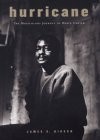
This is a biography of Rubin “Hurricane” Carter, a boxer who was wrongfully convicted along with his friend, John Artis, of a 1966 triple homicide in a bar in Paterson, New Jersey. Carter and Artis were convicted twice and finally exonerated in 1985 in a federal court.
The book follows not only his legal but his personal and spiritual struggles.
Thoughts:
The book does not depict Carter as a saint. Author James Hirsch says in his epilogue that he told Carter he would write the book only if he could “walk through any door in his life and write” what he found “good or bad.” The book is frank about Carter’s violence and juvenile convictions for purse theft and mugging, as well as his later alcoholism. However, it shows him changing, learning, and growing.
Author James Hirsch writes like the journalist he is (Wall Street Journal and New York Times). The book begins with an incident that led Carter to get in touch with a group of people who helped him on his journey to freedom, then describes Paterson, New Jersey, where the crime occurred in the 1960s.
Hirsch tells a fascinating, sad, tragic, but ultimately triumphant story. No one can restore the years lost, the time away from family, the lost careers, the health problems, or anything else.
In prison, Carter began reading such authors as psychiatrist and concentration camp survivor Viktor Frankl and Hermann Hesse.
In an often-quoted passage from a press conference Carter gave after his final release, he sums his feelings up (in part):
“After all that’s been said and done—the fact that the most productive years of my life, between the ages of twenty-nine and fifty, have been stolen; the fact that I was deprived of seeing my children grow up—wouldn’t you think I would have a right to be bitter?… If I have learned nothing else in my life, I’ve learned that bitterness only consumes the vessel that contains it.”
He does not minimize the injury, nor does he forgive it. He gets on with life, becomes involved in projects for other wrongfully convicted people, and works as a motivational speaker.
This was an engaging and interesting read.
The book was published in 2000. Carter passed away in 2014 of prostate cancer.
Bio: According to the jacket blurb, author James S. Hirsch worked as a journalist for the Wall Street Journal and The New York Times. This book above is his first book, but he has since written Riot and Remembrance about the Tulsa race riots and biographies of Ty Cobb and the Beach Boys.
Title: Hurricane: The Miraculous Journey of Rubin Carter Author: James S. Hirsch First published: 2000
We’re still watching these a week behind schedule, catching up from our Covid sleep-in. It’s nice to watch these on delayed viewing, fast-forward through the commercials, and go to bed early. I don’t know if it’s the summer heat, the Covid hangover, native laziness, or a combination of the three, but staying awake is harder than when I was a month younger.
Plot:
The warlock Malcolm Graves (Michael Des Barres) performs a ritual in a basement before assembled followers. The ritual will culminate in the stabbing death of his son, Jonathan (Jamie Bronow), but—like Clytemnestra before her—the child’s mother (Victoria Catlin) objects. Unlike Clytemnestra, the mother is sacrificed in the child’s place, while a follower, Wolfgang (Jack Nance), takes the baby and leaves at the orders of Malcolm. Wolfgang tells the baby he is safe.
Some years later, Jonathan Graves (Peter Liapis), all grown up now, inherits the old house and moves in with his girlfriend, Rebecca (Lisa Pelikan). The house is in shambles, with cobwebs, dust, and peeling paint. Wolfgang, who raised Jonathan, is the groundskeeper or something.
While cleaning up, Jonathan finds a suitcase in the basement with robes and books of magic. He gets curious.
He decides they should have a party. After dinner, Jonathan entertains their guests by summoning a spirit in the basement. It’s a bust. He calls after the departing partygoers, “Wait! I have to dismiss the spirit.”
Mist gathers around the triangle where the spirit was supposed to appear. A rat-like being stands in the triangle, then takes off to cause mayhem.
Jonathan gets better at the demon-summoning thing. He wants his demons to remain invisible to his friends and Rebecca. Something stirs in the grave he and Rebecca noticed when they first arrived.
Thoughts:
The demons are not frightening but misbehaved and ugly, taking baths in soups while Jonathan and Rebecca’s guests eat dinner, for instance. The claim to fame of this flick is a green-skinned evil baby demon crawling out of the toilet with the tagline, “They’ll get you in the end.”
The humor is juvenile. I can accept juvenile humor, but the are so many places in this flick that logic takes a lunch break, I couldn’t buy it.
When Jonathan tells Rebecca he’s going to drop out of school to work on the house, she’s nearly reached her limit. After Jonathan neglects everything for magic and his eyes start glowing green, she leaves.
What does a budding warlock do? He summons demons to bring her back, whether she wants to come or not.
But set all that aside. In the meantime, the demons, now answering to resurrected zombie Malcolm, are happy to create terror and mayhem throughout the house.
Malcolm supposedly wanted to sacrifice baby Jonathan to obtain his youth, soooo, Malcolm wanted to become a baby initially? Wasn’t the youth of Jonathan’s mother enough? She wasn’t much older than Jonathan is now, and Malcolm has been dead for a while. So how much is he gaining by killing Jonathan now? Wouldn’t he be better off killing another baby? Or maybe getting a mani-pedi?
There are some amusing scenes with the stoner partygoers, but these are all window dressing. This is a silly, puerile movie. To borrow a phrase, mostly harmless.
Cast (in credits order) Peter Liapis…Jonathan Graves Lisa Pelikan…Rebecca Michael Des Barres…Malcolm Graves Jack Nance…Wolfgang Peter Risch…Grizzel Tamara De Treaux…Greedigut Released: 1984 Length: 1 hour, 21 minutes
Recovering from “mild” cases of Covid, the dearly beloved and I watched this silly movie last night. We’re doing a lot better, mostly coughing up an occasional lung and sleepy. I wouldn’t wish this on anyone, though.
Plot:
The film opens with a reworked “Dies Irae,” “Day of Wrath” perhaps by Thomas of Celano, according to IMDB. There is also a quote by Church of Satan founder, Anton Lavey, “Oh great brothers of the night who rideth upon the hot winds of hell, who dwelleth in the Devil’s lair; move and appear.”
Other than sounding spooky, the quote has nearly nothing to do with the rest of the movie. Is the car driven by one of the great brothers of the night, riding on the hot winds of hell? It spooks around hallowed ground. Someone ought to have filled the local car washes will holy water. Maybe dropped a Eucharist into the radiator fluid. But I’m getting ahead of myself.
Two innocent, wholesome young people (Joshua Davis and Melody Thomas Scott) ride bikes in the desert outside Santa Ynez. Out of nowhere, a sinister-looking black car, resembling a Lincoln Continental chases them, toying with them and terrorizing them before killing them.
Later, a hitchhiker (John Rubinstein) plays Grieg’s “Morning” on his French horn, much to the annoyance of homeowner Amos Clements (R.G. Armstrong) who is in the middle of thumping on his hapless wife, Bertha (Doris Dowling) and throwing her out of the house. A truck marked “Chekhov’s Gun”—I mean, “Explosives”—is parked in their driveway.
The French horn player protests the woman’s treatment but doesn’t get far. The couple goes back into the house. In the meantime, a wind kicks up, and the sinister black car comes barreling down the road. Thinking he has a ride, the hitchhiker sticks out his thumb. After the car drives by, he sticks out a different finger and hurls verbal abuse.
The car stops. It backs up—into and over the hapless hitchhiker several times.
Amos the wifebeater sees the goings-on and calls the police, like a good citizen.
In yet another part of town, police officer Wade Parent (James Brolin) is rising and saying goodbye to his girlfriend, school teacher Lauren Humphries (Kathleen Lloyd) before his two daughter Lynn Marie (Kim Richards) and Debbie (Kyle Richards ) get up. Little does he know, they’re both standing outside his door, listening to them.
On his way to the office, he’s summoned to the scene at the house of Amos, the wifebeater. Amos swears he saw the whole thing, but all he can tell them about the car is that it’s black.
Thoughts:
It’s hard for one who spent Saturday mornings watching cartoons back in the days of yore to watch a rising trail of dust on a desert road and not hear BEEP BEEP or see a humiliated coyote falling off a cliff edge holding up a sign that says MOTHER.
Duel obviously influenced this movie. There is never any reason for this car to be out killing people. (It’s evil, and that’s what evil cars do? Yeah, that makes sense.) The one exception is a person who taunted it, calling it, among other things, “chicken shit” and revealing its one weakness. This person pissed it off.
The taunting is one of the best scenes in the movie.
But the bicyclists? The hitchhiker? Nah, they were just there and vulnerable.
The viewer sees the car’s worldview when the screen is tinted orange.
The credits roll over a hint at a sequel. Or the need to fear the evil car out there hunting us all down.
This was silly. There was some intended comic relief. A fellow teacher shows Lauren a nude picture one of her students drew of her. She discusses the student’s perspective.
Not an awful movie, but not something I’d watch again soon.
Writing Credits Dennis Shryack…(screenplay) & Michael Butler…(screenplay) and Lane Slate…(screenplay) Dennis Shryack…(story) & Michael Butler…(story)
Cast (in credits order) James Brolin…Wade Parent Kathleen Lloyd…Lauren Humphries John Marley…Everett Peck R.G. Armstrong…Amos Clements (as R. G. Armstrong)
In discussing writing workshops and classes, author Francine Prose writes, “But that class, as helpful as it was, was not where I learned to write. Like most—maybe all—writers, I learned to write by writing and by example, by reading books.” (p .2)
But using what the author calls “close reading,” a writer can learn various techniques to translate the author’s imagination into words and images that capture the reader’s attention.
Prose uses a wide variety of examples of mostly classic but some modern books, such as Scott Spencer (b. 1945). The chapters are arranged by topic: sentences, paragraphs, narration, character, dialogue, details, gesture, learning from Chekhov, and reading for courage.
The author offers a list of “Books to be Read Immediately.” These include the expected: Alcott’s Little Women and Austin’s Pride and Prejudice and Sense and Sensibility. It also includes a few I didn’t expect, like Tolstaya’s Sleepwalker in a Fog. One that came out of left field (IMHO) is Gibbon’s Decline and Fall of the Roman Empire. To be charitable, it makes War and Peace look like a beach read. One might start it immediately, but finishing would take a while. Maybe it was there to see if people were paying attention.
Thoughts:
While her selections and descriptions are short, this was like talking to a fellow book nerd from page one. Not all the samples were ones I enjoyed—The Great Gatsby? EWW—but several of them I had read. It was like talking to old friends again. Reading the ones I didn’t know was like being introduced to new friends.
She chose illustrations well.
At the same time, the author shows her vulnerability in the chapter “Learning from Chekhov.” At a time when she’s teaching a class on writing, she’s reading Chekhov’s short stories that seem to prove her wrong. Are there rules to writing? In any event, she doesn’t take herself too seriously.
I won’t say there weren’t dull bits in this book, but overall, I enjoyed it and would recommend it to any book nerd interested in learning to write or to write better.
Title: Reading Like a Writer: A Guide for People Who Love Books and For Those Who Want to Write Them Author: Francine Prose First published: 2006
trail from YouTube believe it or not, this is the PG-rated version
This was our Saturday pizza and bad movie night movie, a little something different. I’m glad it came with subtitles.
Plot:
On Guy Fawkes Night in South London, nurse Sam (Jodie Whittaker) walks home after work, on the phone to her mother, explaining that she got stuck at work. Young gang members— Pest (Alex Esmail), Dennis (Franz Drameh), Jerome (Leeon Jones), Biggz (Simon Howard), and Moses (John Boyega)—surround her and demand her phone, wallet and ring. A meteor (or something) strikes a car near them, severely damaging it.
Sam takes off. The boys want to go after her, but their leader, Moses says, “Allow it.” He turns his attention to the car, rifling through it for more valuables. Instead, a creature bearing an uncanny resemblance to E.T. of movie fame claws his face. He and the other boys kill it. They realize they have a strange animal and might be able to make some money out off it.
They decide to take it to Ron (Nick Frost), a drug dealer, who watches National Geographic, and ask him to keep it in his weed room. He tells them he only works there. They’ll have to get Hi-Hatz (Jumayn Hunter) to agree. Hi-Hatz agrees on one condition: Moses has to start selling “white” (cocaine) for him.
Moses agrees.
“You’re my boy now,” Hi-Hatz tells him.
The boys notice something odd about the Guy Fawkes Night fireworks. It’s coming down from the sky rather than going up into it. More aliens are coming down in ships like meteors, like the one that smashed the car.
The boys go home and arm themselves—cricket bats, machetes, fireworks. The new aliens are different. They’re blind, but with mouths full of glowing teeth and look something like a cross between black gorillas and wolves. They kill Dennis’s dog, Pogo. The boys flee, right past a police van where Sam is waiting to identify Moses as the boy who mugged her. Two police officers arrest Moses only to die gruesome deaths at the hands—claws— of the aliens while the rest of the gang watch.
Thoughts:
While there is some humor in this, the outlook is mostly dark. It humanizes the criminals, which is a good idea, IMHO, but it also forces the nurse to accept their help and deny that she was wronged. People on the block stick together against the conventional authorities, who do nothing for them.
Moses later admits he was wrong to steal from someone who lives on the block.
When Sam says (reasonably enough), “My fucking heroes,” Pest (?) tells her, “Hey, he’s trying to apologize.”
The aliens attack only the building the boys, Sam, and Hi-Hatz live in. (There is a reason for this). The police do nothing, nor can they do anything. It’s up to the gang to save themselves and, consequently, the world.
I guess I was hoping for something more playful. There was back and forth among the boys, but mostly, this was a deadly serious movie with some brief horrific killings. I found it rather depressing. And damn, Pogo died.
Plenty of people disagree with me and love the movie, however.
According to IMDB, this film was nominated for thirty-nine awards and won nineteen, including the 2012 Black Reel Outstanding Foreign Film.
I could not find it for free. It is recent.
Title: Attack the Block (2011)
Directed by Joe Cornish
Writing Credits Joe Cornish…(written by)
Cast (in credits order) verified Jodie Whittaker…Sam John Boyega…Moses Alex Esmail…Pest Leeon Jones…Jerome Franz Drameh…Dennis
Released: 2011 Length: 1 hour, 28 minutes Rated: R
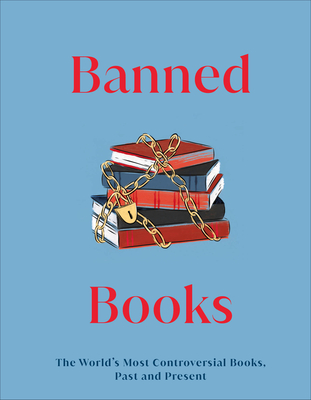
This is a survey of approximately one hundred books that have been banned or challenged, beginning with the fourteenth-century work, The Decameron by Giovanni Boccaccio, and ending with the 2021 book by Chinese author Ai Weiwei, 1000 Years of Joys and Sorrows.
The entries are arranged chronologically. One or two pages are dedicated to each book, and the text, by and large, remains neutral in tone.
For example, the description of the Marquis de Sade’s 120 Days of Sodom reads:
The [unfinished] novel follows four men who torture, rape, and murder a group of children, aged 12-15, over the course of four months (the 120 days of the title).
Most of the books run afoul of authorities for sexual content, profanity, or for challenging the religious or civic powers that be. The most recent books raise hackles for racial justice, gay, or trans content.
The book also describes the struggles to censor. In general, there were short-term victories in democracies, but the books reappear. In totalitarian regimes, it can take decades. For example, Dr. Zhivago was first published in Italy in 1957 but not in the Soviet Union until 1988 under Mikhail Gorbachev. It was considered a “heinous calumny”against the achievements of the Bolshevik Revolution.
Thoughts:
What surprised me when I first picked up this book at the library was how many of these “banned” books I’d read—The Adventures of Huckleberry Finn, The Diary of Anne Frank, and I Know Why the Caged Bird Sings, to name a few.
Long ago and far away, when I was in high school, one of the board members tried to get The Diary of Anne Frank removed from the library. I’d read it by this time, but I read it again to see if I’d missed anything. He claimed there was something in it about masturbation (there isn’t)
The whole affair left my young and impressionable self with the notion that removing books from school libraries is silly—readily available books, like The Diary of Anne Frank in particular.
The current book shows that tragedy and loss are sometimes involved in book banning. I support parents being able to choose what their children read. I’m less enthusiastic about any one set of parents choosing what the kids down the block read.
On the other hand, I support Amazon’s decision not to sell The Turner Diaries. The Turner Diaries is a work of fiction that advocates eliminating non-white people and a violent overthrow of the government to establish a white people’s utopia to spread wisdom and benevolence (like the wisdom and benevolence they used to bring about that utopia?). It has inspired real-life violence and murder, including the 1984 killing of Denver radio talk show host Alan Berg, the 1995 Oklahoma City bombings, and the 1999 London Nail Bombings.
I have not and do not intend to read The Turner Diaries—not because I’m afraid it will send me into a wave of right-wing extremist violence, but frankly, because I just don’t need to spend my time with that shit.
But I’ve gone off on a tangent. About the book: little tidbits delivered with minimum drama. I think I’ll start reading some of the more recent books it mentions: Persepolis, The Kite Runner, The Bastard of Istanbul, Fun Home: A Family Tragicomic, The Absolutely True Diary of a Part-Time Indian, Melissa (formerly George), The Hate U Give, Killing Commendatore, I Hate Men, Stamped: Racism, Antiracism, and You, This is a Swedish Tiger, and 1000 Years of Joys and Sorrows.
DK Publishers, who put out the book without an author’s name, is known for illustrated adult and children’s hardcover books, often on travel. This book fits that mold.
I enjoyed it. While much more could be said about each book, it is only a quick survey. This was fun, bringing memories and introducing things I didn’t know.
Title: Banned Books: The World’s Most Controversial Books, Past and Present Publisher: DK Books First published: 2022
This is this week’s Saturday night pizza and bad movie offering, a decent movie with a goofy-looking but punctual demon who seemed to pop out of some sort of firecracker explosion and liked to hang out in the trees.
Plot:
Professor Henry Harrington (Maurice Denham) drives through the dark woods to arrive at Lufford Hall, the home of Doctor Julian Karswell (Niall MacGinnis). He’s come to ask Karswell to “call it off.”
The clock strikes nine.
Karswell, who bears more than a passing resemblance to Mephistopheles, sends him on his way, promising to do all he can.
Harrington drives home. He’s parking his car when a sort of exploding cloud appears at the end of his driveway. Out of the cloud comes one of the goofiest demons you’ll ever see.
It’s the end of poor Mr. Harrington.
As his clock strikes ten, Dr. Karswell takes a newspaper off his desk and throws it into a fire. The headline reads: “Karswell Devil Cult Expose Promised at Scientists’ Convention.”
On a plane from the United States are Harrington’s niece, Joanna Harrington (Peggy Cummins), and John Holden (Dana Andrews). They have yet to meet. Holden is flying in for a parapsychology convention that was, in part, determined to expose Karswell as a fraud.
After he lands, he’s confused about why Dr. Harrington won’t answer his phone. He learns soon enough Dr. Harrington has passed away in a terrible car accident and attends his funeral, where he meets his niece.
Holden is a man of science. He doesn’t believe any of this demon or witchcraft stuff, and he’s here to prove it ain’t so.
Thoughts:
I rather liked this movie.
It opens with a nice shot of Stonehenge c. 1957, when there was much less traffic and much more tall grass. The narration talks about evil from the days of yore and so on.
Karswell’s creepiness is particularly well-done without crossing the line into camp. During one scene, Karswell is performing magic tricks at a children’s party. He is in stereotypical clown makeup. The viewer is already convinced the man is a threat and possibly a killer. Yet, he hands out candy to kidlets. Chilling. To add to the atmosphere, he summons a storm for Holden’s benefit that sends chairs flying and children scurrying.
In another scene, Karswell and Holden play hot potato with a cursed item that apparently sets a human up as demon bait. “You take it” “No, you take it.” Karswell refuses a cigarette, for example, because you never can tell. Those things could kill you.
There is a disturbing scene with a mental patient released to be hypnotized for the edification of the conference members (all guys, BTW). The family agreed, but the patient has been in a coma. It’s complicated.
According to IMDB, the movie exists in at least three version in English. The original British release is titled Night of the Demon. The American version is titled Curse of the Demon and is shorter, with some scenes deleted. The DVD versions often have both edited and restored versions in the US.
The Curse of the Demon is inspired by 1911 story by M. R. James, “Casting the Runes.”
In 1957, the Faro Island Film Festival nominated this film for a Golden Moon Award (best film).
A colorized version of the film can be watched here:
Title: The Curse of the Demon (1957)
Directed by Jacques Tourneur
Writing Credits Charles Bennett…(screenplay) and Hal E. Chester…(screenplay) M.R. James…(story “Casting the Runes”) (as Montague R. James) Cy Endfield…(uncredited)
Cast (in credits order) Dana Andrews…John Holden Peggy Cummins…Joanna Harrington Niall MacGinnis…Doctor Julian Karswell Maurice Denham…Professor Henry Harrington Athene Seyler…Mrs. Karswell Liam Redmond…Mark O’Brien
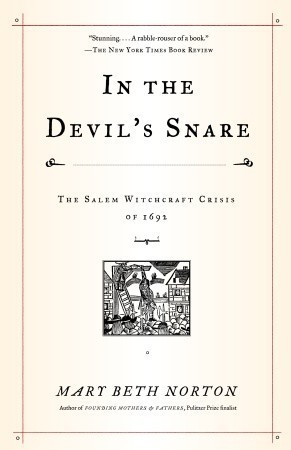
Author Mary Beth Norton, Professor Emerita at Cornell University, writes that the Salem witch crisis took place in the midst of another crisis—the devastation of the First and Second Indian Wars (King Philip’s War) of the late seventeenth century, which wreaked havoc. Traumatized refugees fled south.
While the “afflicted” people spoke of the devil as a “black man,” (a designation that did not mean the same thing in the seventeenth century that it does in the twenty first), they also described him as “tawny,” and looking like an “Indian.”
Because of the religious outlook of the colonists, they viewed the setbacks, losses of family, homes, and attacks as punishment from God. It was not a great leap to see God allowing the devil to torment them.
Thoughts:
Norton uses trial records (when available) and other public documents, and lays out the whole say, tragic business chronologically. It makes for some thick reading, particularly because she retains the original spelling and syntax when quoting the documents. Seventeenth-century spelling was variable and depended a lot on the degree of education of the writer.
A lot of the sensationalism the topic often falls prey to is avoided. However, it is also dry and does take a lot of effort to get through. One has to wonder, nevertheless, if the colonists and the special court (“Oyer and Terminer”) drawn up to try the witchcraft cases didn’t begin to wonder sooner about the “afflicted” who would go into fits when a particular person was being examined.
A hotly debated issue was “spectral evidence,” that is, that the specter of a witch appeared to torment a person often by pinch or sticking pins into their body. Could this really be the devil, taking on a form? Could he disguise himself as an innocent person? What about people who had bad reputations beforehand—those who squabbled with relatives? If a witch confessed (often under torture) to have seen Goody So-and-So and the witch’s sabbath, could anyone believe her?—but why would she lie?
To twenty-first-century readers, these questions sound arcane, if not nonsensical, but people died while the colonists sorted out this stuff.
The book follows a lot of people, some of whom have the same name, and it can get difficult to keep everyone straight. Norton is usually clear about which Ann Putnum she is talking about, for example.
A few colorful people stand out, not for signing the devil’s book or anything like that, but for being all too human. For example, Captain John Alden, who, it was said, was an “Old Indian trader.” “The Indians have a saying that Mr Alden is a good Man, & loves Indian very well for Beavers,” one man said.
When he brought the Wabanaki and French goods to trade, Captain Alden found a fellow Englishman being held prisoner. The prisoner asked Alden to ransom him. The prison later related Alden said, “he came to Trade & not to redeem Captives.”
Pretty cold. The good people of Salem (not the ex-prisoner) accused him of being a witch.
The ex-prisoner probably just thought he was a miserable SOB.
While the book is definitely worth a read, I have to warn that it will take time and dedication.
Title: In the Devil’s Snare Author: Mary Beth Norton First published: 2002


 Reviews of Old and New Stories. Mostly Old