
This week’s Saturday pizza and bad movie offering is a cheap black-and-white 50s space disaster flick, hearkening back to the war movies of a decade earlier. We watched it with Svengoolie.
Plot:
The credits roll over an illustration of a crunched cylindrical spaceship on an extraterrestrial plane surrounded by craggy mountains. The viewer is informed that “The events and characters depicted in this photoplay are fictitious. Any similarity to actual persons, places, or firms is purely coincidental.”
Or perhaps miraculous.
In 1973, the first manned mission to Mars met with tragedy soon after landing. A rescue ship now arrives and finds only one crew member, Col. Edward Carruthers (Marshall Thompson), remains alive. He narrates how he will be going back to Washinton to face his superiors and perhaps another kind of death.
Meanwhile, back in Washington, the Science Advisory Committee of Interplanetary Exploration holds a press conference to inform the public that Col. Carruthers will be brought back to earth to face a court-martial for the murders of the rest of his crew.
As the rescue ship prepares to return, Col. Van Heusen (Kim Spalding) sees a warning light flash. Someone left an emergency airlock open. Lt. James Calder (Paul Langton) ‘fesses up. He was dumping empty crates. Col. Van Heusen closes the door remotely, and the shadow of something huge moves across the wall.
Later, Van Heusen, who believes Carruthers guilty, shows him one reason why: a skull recovered from Mars of one of the former crew members with what appears to be a bullet hole. “There’s only one kind of a monster that uses bullets,” he tells Carruthers.
While everyone is smoking and watching a chess game—except the girls, who are in their place and serving coffee—Keinholz (Thom Carney) hears a noise. He goes off to investigate, and that’s the last of Keinholz.
Thoughts:
This could have and should have been a better movie. Indeed, this was one of the inspirations for Alien (1979). The actions are not logical. For example, one tactic our heroes resort to is setting off perhaps two dozen hand grenades aboard a spaceship while traveling between Mars and earth. This, in addition to repeated small arms fire. None of the stores are tied down, not even during take-off.
Sitting in a car at a drive-in (kids, ask your grandparents), I would have found the hulking monster with its fangs and three talons scary as hell, but on tv, it resembled a guy in an over-the-top gorilla suit. This was, in large part, because it was a guy in an over-the-top gorilla suit.
The guy in the gorilla suit was Ray Corrigan, who made a living playing gorillas in movies. He retired after this movie and bought a ranch, which was open to the public on weekends.
The end was not credible, sadly. While I found this movie fun, there were serious credibility issues. If you don’t take things too seriously, this can be an enjoyable little flick.
I could not find this for free download.
Title: It! The Terror from Beyond Space (1958)
Directed by
Edward L. Cahn
Writing Credits
Jerome Bixby…(screenplay)
Cast (in credits order)
Marshall Thompson…Col. Edward Carruthers
Shirley Patterson…Ann Anderson (as Shawn Smith)
Kim Spalding…Col. Van Heusen
Ann Doran…Mary Royce
Dabbs Greer…Eric Royce
Paul Langton…Lt. James Calder
Released: 1958
Length: 1 hour, 9 minutes
Spring Clean Part #6 Five More Books
This is my next round of cleaning out my books for donation. Posting about them is my way of saying goodbye. Nothing as exciting as clearing off a shelf, but I have more clear space to put the books that are clogging up nightstands and end tables.
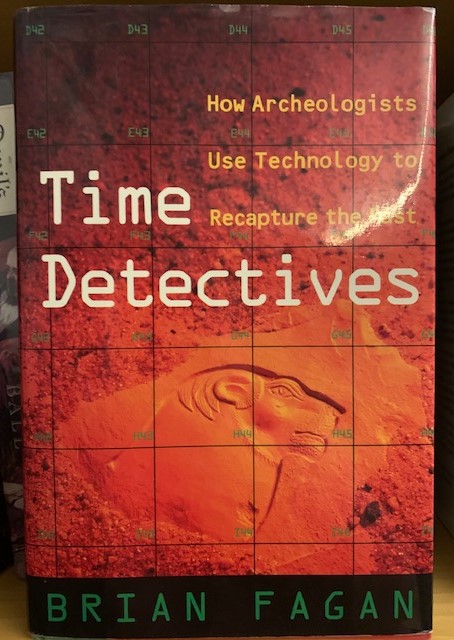
Time Detectives: How Archaeologists Use Technology to Recapture the Past (1995) by Brian Fagan describes how archaeology, long abandoning the world of Indiana Jones and treasure-hunting, now uses a wide variety of technology and disciplines to reconstruct the past. He opens with an example of 7000-year-old discarded flint-workings from present-day Belgium left by two different people. Analysis shows one of the two people was left-handed. Fagan visits more than two dozen sites worldwide, from well-known places such as Olduvai Gorge in Tanzania to less well-known places like Guilá Naquitz Cave in Oaxaca, Mexico. The topics are wide-ranging. I enjoyed this book.
Bio: Brian Fagan (b. 1936) is a British archaeologist, author, and professor emeritus of Anthropology at the University of California, Santa Barbara. His writings include standard introductory textbooks in the field of archeology, a column in Archaeology magazine. His latest book, Climate Chaos: Lessons of Survival from our Ancestors (2021), is written with Nadia Durrani.

Six Easy Pieces: Essentials of Physic Explained by Its Most Brilliant Teacher (1963) by Richard P. Feynman is a selection of the six easiest chapters from Feynman’s textbook on physics. They are not “easy” but are geared toward a general audience without knowledge of the specialized mathematics that usually accompanies college-level mathematics. Feynman wrote an original preface when the work was published in 1963. A special preface was added in 1989 by David L Goodstein and Gerry Neuberger of Cal Tech (where Feynman taught) after the author’s death. In 1984, Paul Davis wrote an introduction. The “pieces” are: “Atoms in Motion,” “Basic Physics,” “The Relation of Physics to Other Sciences,” “Conservation of Energy,” “The Theory of Gravitation,” and “Quantum Behavior.”
It takes a bit of effort to get through the book, but it’s worth it.
Bio: Richard Feynman (1918-1988) worked on the Manhattan Project and joined Cal Tech in Pasadena, California, in 1950. In 1965, he shared a Nobel Prize with Julian Schwinger and Shin’ichiro Tomonaga for their independent work in quantum electrodynamics. In 1986, he worked on the commission investigating the Challenger space shuttle explosion. Among his works are Six Not-So-Easy Pieces, Surely You’re Joking, Mr. Feynman, The Pleasure of Finding Things Out, and The Meaning of it All.
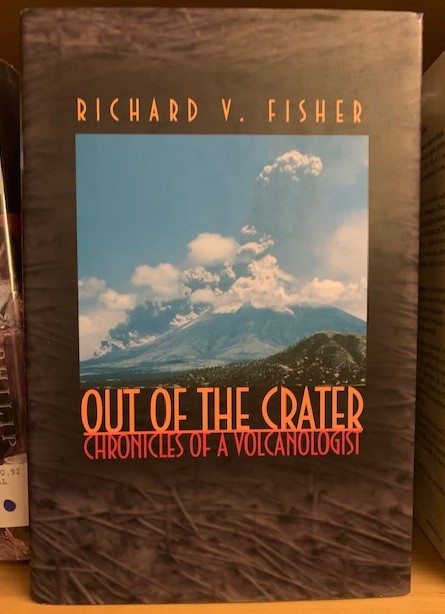
Out of the Crater: Chronicles of a Volcanologist (1999) by Richard V. Fisher is a memoir. In the words of the volcanologist author, it is “mostly about walks and talks with some of the volcanoes I have studied, visited, climbed, or contemplated.” While he discusses scientific concepts, he denies this is a scientific book. Early in the book, he recounts witnessing the explosions of atomic bombs on Bikini Atoll while he was in the service. This is not superfluous: the explosions later helped in his research of pyroclastic volcanic flows.
I liked this book.
Bio: Richard V. Fisher (1928-2002) was professor emeritus of geological sciences at the University of California, Santa Barbara. His first book, Pyroclastic Rocks (1984), remains the definitive work on the topic. Another book, Volcanoes— Crucibles of Change (1997), was for a popular audience.
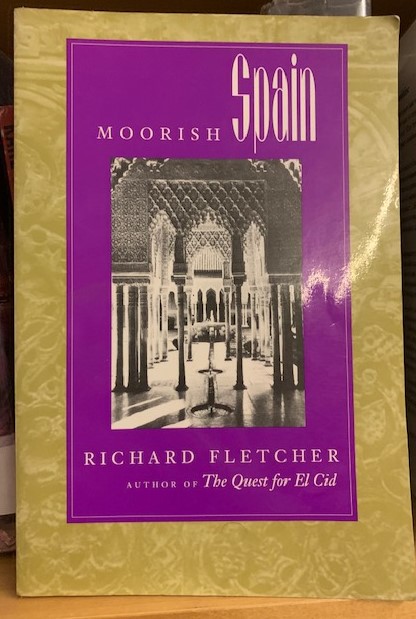
Moorish Spain (1992) by Richard Fletcher is a brief account of Muslims in the Iberian Peninsula, which began with a raid by Berbers from North Africa in 711 and lasted into the reign of Philip III (1598-1621). However, a few hearty souls hung on into the 17th and 18th centuries to be prosecuted as “secret Muslims.” While the account can read like a laundry list of which king did what to what king when, Fletcher does not romanticize the subject.
Bio: Richard Fletcher (1944-2005) was a professor emeritus at York University. His book The Quest for El Cid (1989) won the Wolfson Literary Award for History (1989) and the Los Angeles Times Book Prize for History (1990).
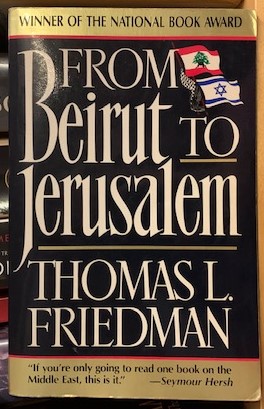
From Beirut to Jerusalem (1989) by Thomas Friedman is a memoir of the author’s time as a foreign correspondent in Beirut for UPI and then The New York Times beginning in 1979, and in Jerusalem in 1982 for The New York Times. The author chose an excerpt from The Adventures of Huckleberry Finn as epigraph dealing with a feud between the Grangerford and Shepherdson clans. The feud and the killing have to keep going though no one remembers how the problem started or who fired the first shot.
This is a harrowing read; Friedman never becomes hardened to the atrocities he witnesses or writes about. During his first night in Beirut, he writes about hearing a shootout and notes that it was the first time in his life he’d heard gun fire. At the same time, Friedman takes pains to provide historical context for what’s happening. This is not an easy book to read and may be dated now, but it is informative.
From Beirut to Jerusalem won the National Book Award.
Bio: Thomas Friedman (b. 1953), a foreign affairs correspondent for The New York Times, has been awarded three Pulitzer Prizes for his reporting. His books include The World is Flat (2005), The Lexus and the Olive Tree: Understanding Globalization (1999), and Longitudes and Attitudes: Exploring the World after September 11 (2002).
Review of “The Haunted Strangler” (1958)
This week’s Saturday pizza and bad movie offering is a black-and-white horror flick with monster movie great, Boris Karloff.
Plot:
The film opens in 1860 at Newgate Prison for the occasion of the hanging of Edward Styles (an uncredited Michael Atkinson), known as the Haymarket Strangler. Styles was convicted of killing five women. The crowd laughs at the man who fights his way to the gallows and protests his innocence. A moment of silence for the bells tolling the hour when the trap door opens, but the spectators laugh as condemned man’s bound feet swing.
Twenty years later, novelist James Rankin (Boris Karloff) begins looking at the Styles case afresh. He’s convinced Styles was innocent and only went to gallows because he was too poor to afford a good lawyer. One of the clues he and his assistant, Dr. McColl (Tim Turner), uncover is that the doctor who performed the autopsies on the Haymarket Strangler’s victims was locked up in an asylum then disappeared with a nurse. He also discovers the doctor’s scalpel is missing.
In the meantime, Mrs. Rankin (Elizabeth Allan) has been trying to tell him something. He promises to talk to her—later. It’s only when he comes across their daughter Lily (Diane Aubrey) and McColl kissing that he realizes what his wife has on her mind. Neither of them knows McColl has promised to immigrate with their little girl to Canada.
There’s something else Mrs. Rankin hasn’t quite gotten around to telling her husband.
Thoughts:
According to Wikipedia, this adapted from a story originally titled “Stranglehold” and written especially for Karloff by screenwriter Jan Reed. Karloff does well in it, both as a concerned social-reforming writer, then as a transformed violent mentally ill man.
Some elements toward the end are unusual in this type of movie. Rankin doubts reality. The viewer doubts his sanity—but—but he meant well. He had every intention of exonerating the poor bastard who hanged.
Scenes such as chorus girls undressing and inmates in an asylum being force-fed are gratuitous. Most of the violence is off-camera, but this is not a film for the kiddies.
While the ending is unhappy, it is logical and there is a nice plot twist toward the end I didn’t see coming. It is a good—not great—film.
The Haunted Strangler can be watched here.
Title: The Haunted Strangler (1958)
Directed by
Robert Day
Writing Credits (in alphabetical order)
John Croydon…(as John C. Cooper)
Jan Read…(screenplay)
Jan Read…(story “Stranglehold”)
Cast (in credits order)
Boris Karloff…James Rankin
Jean Kent…Cora Seth
Elizabeth Allan…Barbara Rankin
Anthony Dawson…Supt. Burk
Vera Day…Pearl
Released: 1958
Length: 1 hour, 18 minutes
Spring Clean #5 Five More Books
This is my next donation of books and an achievement of sorts. I clear off my first shelf—at least for a little while. It will soon be full of books I have lying around the house. But savor the victory for the moment.
History and Documentation of Human Rights in Iran (2000) by Shirin Ebadi is a compilation, beginning with the Universal Declaration of Human Rights (1948) of various laws, treaties, and declarations intended to protect the Iranian civilian’s individual rights with respect to nearly all aspect of everyday life. After a brief preface, the documents are presented with little introduction. It doesn’t make for a rip-roaring yarn, but it is an important collection in the field of human rights research and defense.
Frankly, I don’t recall what I thought I was getting when I ordered this book—but not this. Nevertheless, I read it, appreciating the irony and poignancy it silently highlights.
Bio: At the time of the Iranian Revolution in 1980, Shirin Ebadi (b. 1947), like all female judges, was removed from the bench. She became a secretary in her own court. She was eventually able to practice law, where she defended dissidents and worked to protect the rights of women and children. In 2003, she was awarded the Nobel Peace Prize. She has written many other books, including Until We Are Free (2016), and currently lives in the UK because of persecution for her human rights work in Iran.
The Worst Hard Time: The Untold Story of Those Who Survived the Great American Dust Bowl (2006) by Timothy Egan is a heartbreaking collection of oral histories of people who lived through the Dust Bowl of the Midwest of the 1930s Great Depression. Egan not only talks to the now-elderly survivors, he combs through historical records and includes iconic photographs. His admiration for the toughness and resilience for the people who made it—or who tried—shows through in his account, as does his contempt for disastrous government policies.
When it was over, no one wanted to talk about it, of course. But it changed the way people lived. It changed people’s outlook.
The Worst Hard Time was awarded the 2006 National Book Award for Nonfiction and the 2006 Washington State Book Award in History/Biography.
The Spirit Catches You and You Fall Down: A Hmong Child, Her American Doctors and the Collison of Two Cultures (1997) by Anne Fadiman is an examination of the misunderstandings among a Hmong child who is too young to speak for herself, her parents who don’t speak English, and her doctors who care, but misunderstand what is going on. The child, Lia, has epilepsy. A Hmong description of a seizure forms the title. The author admits to wanting to blame someone for the tragedy that befalls the child, but realizes the more she learns the less she can blame anyone.
She does an excellent job from the first page of painting the Hmong world. This is a moving, sad book.
Bio: Anne Fadiman (b. 1953), according to the blurb, worked as a wilderness guide. She has also been a staff writer for Life, editor-at-large of Civilization, and editor of The American Scholar. She is the author of two collections of essays, Ex Libris: Confessions of a Common Reader (1998) and At Large and At Small: Familiar Essays (2007) in addition to a memoir, The Wine Lover’s Daughter (2017)
Eyewitness to Discovery: First Person Accounts of More Than Fifty of the World’s Greatest Archaeological Discoveries (1996) edited by Brian Fagan is a collection of first-hand accounts of archaeological discoveries from the 18th to the 20th centuries. They’re divided first by topic: Part I is Human Origins and contains accounts by the Leakeys, for example. Part II is “Great Discoveries” and contains all the biggies and a lot of the adventure stories: Austen Henry Layard at Nimrud, Howard Carter at the tomb of Tutankhamun as well as some lesser-known, but no less revealing finds such as an African cemetery in Manhattan. This part is divided by geographic location and makes up the bulk of the book. The third and final main part is about archaeology becoming a science. There are black-white-photos scattered throughout the text and a center section of color plates. A short introduction opening each entry gives the account context.
I had a lot of fun reading this.
Bio: Brian Fagan (b. 1936) is a British archaeologist, author, and a professor emeritus of Anthropology at the University of California, Santa Barbara. His writings include standard introductory textbooks in the field of archeology, a column in Archaeology magazine. His latest book, Climate Chaos: Lessons of Survival from our Ancestors (2021) is written with Nadia Durrani.
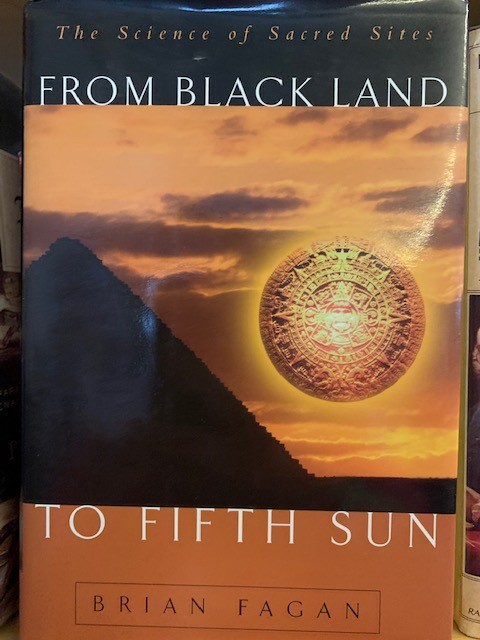
From Black Land to Fifth Sun: The Science of Sacred Sites (1998) by Brian Fagan describes the technical methods used to examine the sacred sites from more than a dozen sites all over the world. He opens with what he calls “The Archaeology of the Intangible.” It’s unlikely that we’ll fully understand what these sites meant to the people who built and used them. The “black land” of the title is the fertile soil around the Nile, and the “fifth sun” refers to Aztec Tenochtitlan and the Templo Mayor at the time of the Spanish Conquest. Fagan also discusses San rock art in Africa and (how could he escape it?) Stonehenge. This is not light reading, but Fagan uses stories from his own field work to add narrative to make the work enchanting.
Bio: see Eyewitness to Discovery
Review of “Earth vs. The Flying Saucers” (1956)
This is another of our Saturday pizza and bad movie offerings. We watched the flick with Svengoolie. This flick was a super serious, if a bit improbable, good ol’ rendition of those horrible critters from Outer Space who want our earth, donchya know.
Plot:
Dr. Russell Marvin (Hugh Marlowe) is riding back to work at Project Skyhook while his new bride, Carol (Joan Taylor), drives. Marvin makes notes into a reel-to-reel tape recorder. (Kids, ask your grandparents.) From his dictation, the viewer gathers Project Skyhook involves a series of three-stage rockets launched to place satellites in orbit to monitor things like cosmic rays. They’ve launched ten. They’re on their way to send off number eleven.
While he’s talking, a strange sound arises. Out their back window, the viewer can see a flying saucer hovering, a central cylinder with a revolving discus. The craft flies over the roof of the car and appears in the front windshield, making the strange noise, then takes off and disappears.
Astoundingly, Russell and Joan talk themselves out of believing they’ve seen anything and continue on to work. They’ve got a rocket to shoot off.
Joan is transcribing the tape Russell made in the car. Wait—the strange noise is on the tape. They don’t have time to study it now; they have to head for the bunker and set off a rocket.
Arriving at Skyhook shortly after Russell and Joan is General John Hanley (Morris Ankrun). They thought he was in Panama. He wants Russell to halt the missile launch. Russ says that’s not possible. These things are on a schedule.
Number eleven goes off without a hitch.
The General is also Carol’s father. Carol and Russell break the news they’re married. The General is happy, and Carol invites him to dinner. Here, the General breaks the news. That wasn’t a meteor that crashed in Panama but a satellite. All the satellites have crashed. They exploded in space. This puzzles Russ. They carry no explosives.
“It’s as if someone or something is shooting them down,” he says.
“No gun in the world could shoot that high,” the General says.
Hmmm…
The next day when the aliens land—on a restricted military base—they’re met with force, and one of them dies. In turn, they wipe out every soldier who attacks them with a single ray gun. To make matters interesting, they kidnap General Hanley. The aliens are surprised by their reception. Didn’t Russell Marvin receive their message?
Oh… the tape… the strange noise. Maybe there’s a message that recorded too fast for humans to hear?
Thoughts:
Their ships look like the Jupiter II, a stationary cylinder surrounded by a revolving disk. They also have a sort of retractable elevator that emerges from the bottom through which the occupants can enter and exit the ship. Weapons also appear from the bottom.
The aliens themselves are not seen until near the end of the film. They march around in metal suits, including featureless headgear. They claim to be escapees from a dying solar system.
The aliens have a universal translator built into their helmets. Carol tests it out by reciting Shakespeare:
“The quality of mercy is not strained.
It droppeth as the gentle rain from heaven…”
Another universal translator, looking like an oversized white silk rose, descends spinning from the ceiling of the aliens’ oddly spacious spacecraft.
In the ensuing war, saucers slice through the Washington Monument, take a chunk out of what I think is the Capitol Building, and—really—land on the White House lawn. Stock footage is used, some depicting actual tragedies, like a crash at an airshow in the 1940s. Other, show the launch of Viking rockets—so much for those three-stage rockets Skyhook promised.
Ray Harryhausen created the stop-action motion in the film. Earth vs. the Flying Saucers was one of the inspirations for the Mars Attacks! (1996). The movie won the 1957 Golden Reel Award from Motion Picture Sound Editors (USA) for Best Sound Editing in a Feature Film.
While slow at times and improbable at others, this movie was a lot of fun.
This is available for rent or to buy. There is an original black-and-white version on YouTube, but the alignment is off and a good chunk of the sides are cut off the screen. The colorized version is available here.
Title: Earth vs. the Flying Saucers (1956)
Directed by
Fred F. Sears
Writing Credits (WGA)
Bernard Gordon…(screenplay) &
George Worthing Yates…(screenplay)
Curt Siodmak…(screen story)
Donald E. Keyhoe…(supported by “Flying Saucers from Outer Space” by) (as Major Donald E. Keyhoe)
Cast (in credits order)
Hugh Marlowe…Dr. Russell A. Marvin
Joan Taylor…Carol Marvin
Donald Curtis…Maj. Huglin
Morris Ankrum…Brig. Gen. John Hanley
John Zaremba…Prof. Kanter
Released: 1956
Length: 1 hour, 23 minutes
Spring Clean #4 Five More Books
Spring cleaning continues with the fourth donation run set for next Tuesday of the following five books. It’s my way of saying goodbye to books I read a while ago. Most of them I loved.
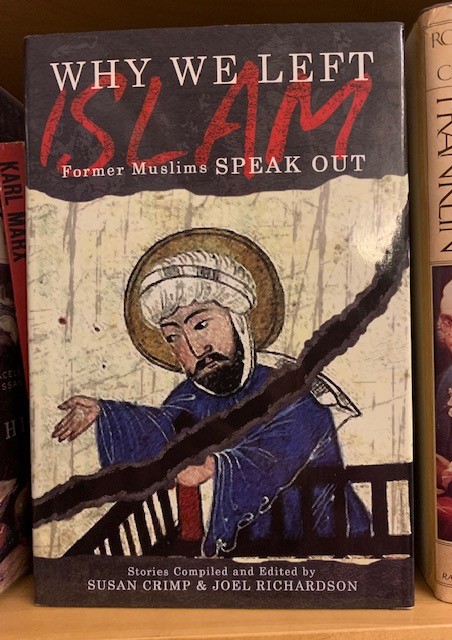
Why We Left Islam: Former Muslims Speak Out (2008) compiled and edited by Susan Crimp and Joel Richardson
This is pretty much as advertised, a collection of stories of people who have left Islam. The first entry is by Parvin Darabi, an Iranian-American activist whose sister, Homa, died by suicide, burning herself to death publically in 1994 in Tehran as a protest against the Iranian regime. Her last words before pouring gasoline on herself and setting herself ablaze are reported to have been: “Death to tyranny! Long live liberty! Long live Iran!”
The story is ghastly. Darabi wrote her own book about her sister’s life and death, Rage Against the Veil.
This is not an easy book to read. And it’s hard not to wonder if the editors don’t have an agenda as they as both Christian, an element they’re coy about. The worst of the atrocities seem to arise when religion of any stripe is given governmental power. These stories deserve to be heard.
My feelings about this book are mixed. One person who has suffered because of their religious views is one person too many. At the same time, vilifying one religion in favor of MY religion which would, of course, never do anything like that, is hypocrisy of the lowest order.
Bio: Susan Crimp I could find little about this editor. The jacket blurb states she “is a respected journalist and author specializing in Middle East affairs.” The contributor notes say she is the author of eight books, including a biography of Rose Kennedy and one of Mother Teresa, Touched by a Saint.
Joel Richardson uses a pseudonym because “of threats against his life and the life of his family due to public and private dialogues with Muslims who wished to leave Islam.” He calls himself “an independent religious scholar who has lived and worked in the Middle East.”
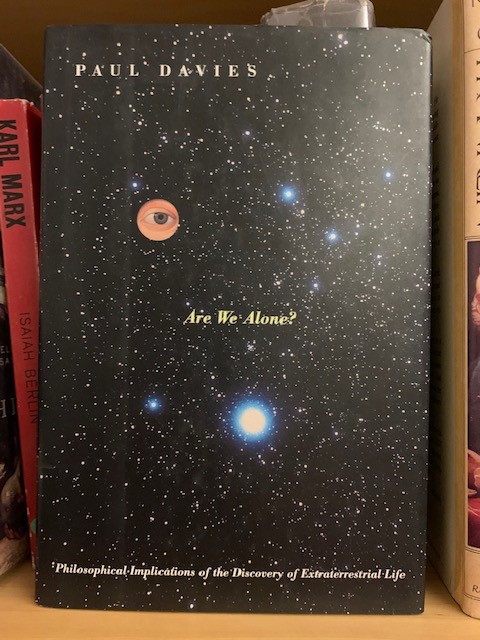
Are We Alone? Philosophical Implication of the Discovery of Extraterrestrial Life (1995) by Paul Davies
This was based on a series of lectures given initially at the University of Milan in November 1993.
Davies discusses with a lot of facts and figures and a healthy dose of speculation what the odds are of extraterrestrial life. A thornier problem, of course, than whether intelligent beings are out there is whether we’ll ever be able to communicate, much less meet them.
The author takes the reader through the history of SETI, cosmology, and the nature of consciousness. It is an interesting read.
Bio: Paul Charles William Davies (b. 1946) is an English theoretical physicist, cosmologist, educator, and writer.

Sweet Dreams: Philosophical Obstacles to a Science of Consciousness (2005) by Daniel C. Dennett is a collection of essays based on lectures the author gave in Paris in 2005. The essays explore different models approaching investigation the nature of consciousness. The author cautions they should be read in order: “The Zombic Hunch,” “A Third-Person Approach to Consciousness,” “Explaining the ‘Magic’ of Consciousness,” “Are Qualia What Make Life Worth Living?,” “What RoboMary Knows,” “Are We Explaining Consciousness Yet?,” “A Fantasy Echo Theory of Consciousness,” and “Consciousness: How Much is That in Real Money?”
Some sixteen years after I read this book, my feelings remain mixed. I remember feeling anger after I finished it, as if Dennett has told the reader we humans are just blithering idiots but he’s the only one of us smart enough to figure it out. On the other hand, rereading bits of it now, I have to admit much of what he says makes sense.
I doubt most of us humans are blithering idiots, or it we are, how tiresome for someone of Dennett’s intellect.
The book is a sequel Dennett’s 1991 work, the modestly titled Consciousness Explained.
Bio: According to his Tufts University page, Daniel C. Dennett (b. 1942) is the Director of the Center for Cognitive Studies and Austin B. Fletcher Professor of Philosophy. His books include Breaking the Spell (2006), Freedom Evolves (2003), and Darwin’s Dangerous Idea (1995), (an excellent book I read somewhere in the beginning of time). Dennett has also published many scholarly publications.
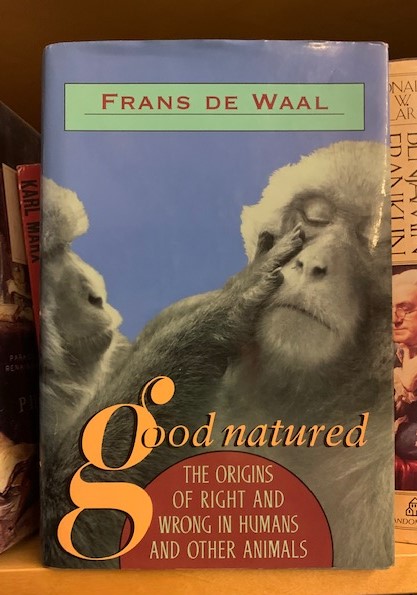
Good natured: The Origins of Right and Wrong in Humans and Other Animals (1996) by Frans de Waal
The main argument is that morality as humans know it has its roots in biology and evolution. While he stops short of calling non-human primates moral—in the sense of understanding right and wrong in abstract and language to pass that understanding on—DeWaal sees rudiments of fellow-feeling among some primates. Specifically he notes a sense of expectations as to how others ought to behave, with respect to things like food-sharing, for example. He sees the idea of “morality” as representing a continuum across various species (our own included) without clear dividing lines. That is, empathy and reciprocity are present in greater or lesser degrees in different species of primates, not simply absent or present.
De Waal obviously enjoys the work. This is an enjoyable, informative book.
Bio: Frans de Waal (b. 1948) is a Dutch primatologist and ethologist. According to Wikipedia, he is the Charles Howard Candler Professor of Primate Behavior in the Department of Psychology at Emory University in Atlanta, Georgia, director of the Living Links Center at the Yerkes National Primate Research Center at Emory, and author of numerous books.
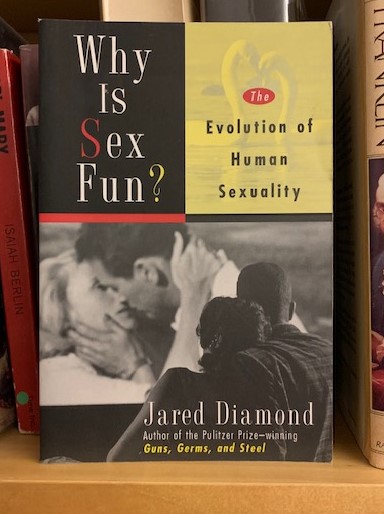
Why is Sex Fun? The Evolution of Human Sexuality (1997) by Jared Diamond
The author sidesteps the obvious answer to the question of the title and takes a different route by explaining just how odd we humans are in our behavior with respect how the birds and the bees do it. His tone is light but not salacious. “If your dog had your brain and could speak,” Diamond starts his first chapter, “and you asked it what it thought about your sex life, you might be surprised by its response.”
The rest of the short book (146 pages of text) discusses why human sexuality works for humans and not for animals.
Bio: Jared Diamond (b. 1937) is a Professor of Geographer at University of California, Los Angeles. According to his personal website (Jared Diamond), he began his scientific career in physiology and expanded into evolutionary biology and biogeography. He’s probably best known for his book Guns, Germs, and Steel (1997), for which he was awarded a Pulitzer. He is also active in the climate change movement.
Three Book Recommendations and How They Worked
Short Wave is a popular science (as opposed to a scholarly science) podcast put out by NPR I listen to occasionally. It covers a wide range of topics in 10-15 minute segments that are light, often funny, and usually quite informative. Veering off their usual foray into the natural world, the hosts on December 22 recommended science fiction for the “beginner.” I’m hardly a beginner in science fiction, but I tend to read older stuff. I figured a sample of some newer fare for a change couldn’t hurt.
The three books the hosts recommended were praised by the others. Most had won or were nominated for Hugo or Nebula awards, so they couldn’t be lightweights.
The first was The Goblin Emperor by Katherine Addison, a pseudonym for American author Sarah Monette.
Maia is a young man of mixed elvish (the main population) and goblin heritage, being brought up in obscurity by a brutal guardian. One day word comes that the emperor (his father) and all his half-brothers have been killed in a horrific airship disaster. He is now emperor and has to navigate learning to become a ruler of a vast sprawling empire. Whom can he trust? Who will do him harm? What about his half-sisters and the widows and children of his half-brothers he never knew?
I found this to be an engaging and enjoyable book. There is some magic and some science involved. According to Wikipedia, it received the Locus Award for Best Fantasy Novel and was nominated for Nebula, Hugo, and World Best Fantasy Awards.
But it is not science fiction. It is fantasy. One could quibble about what kind of fantasy (high fantasy, grim-dark, and so on), but it is unquestionably fantasy with magic operating rather than science.

The second book they recommended is On Fragile Waves by E. Lily Yu.
This is a lyrical, heartbreaking story, told from the point of view of a child refugee, Firuzeh, from Afghanistan on her way to Australia. Atay (Dad) and Abay (Mom) tell her and her brother stories. More important are the stories Firuzah tells herself and others. These bring comfort and hope. Firuzeh is haunted by the ghost of a girl who drowned during a storm at sea. They swore to never leave each other.
The author abandons a lot of conventional punctuation in the book, but following conversations is not hard. The violence in Kabul is abstract; the reader doesn’t know exactly what happened, but it is enough to make the family flee. We know there was physical violence, and the family also received threats.
This was a great book, but it was difficult for me to read emotionally.
Again, this is not science fiction. If I had to pick a label, I’d call it magical realism.

The third (and final) book they recommended was a novella: This is How You Lose the Time War by Amal El-Mohtar and Max Gladstone.
Two adversaries, Red for the Commandant and Blue for Garden, fight a time war “upbraid” and “downbraid,” slaughtering millions and destroying empires or sometimes whole planets as they see fit. One day, Red finds a letter telling her: “burn before reading.” Thus begins an exchange that can be encoded in the rings of trees, in bees, in the entrails of animals, or in any number of creative patterns. At first, the messages are taunting, then curious, then the two agents—both the best in their field—fall in love.
I enjoyed watching two main characters tease, taunt, and then get sappy all over each other.
According to Wikipedia, the book won the BSFA Award for Best Shorter Fiction, the Nebula Award for Best Novella of 2019, and the 2020 Hugo Award for Best Novella.
Because it is set in a world where time travel is apparently routine, this has a greater claim to being a science fiction work than either of the other two books. My quibble (of course, I have to quibble…) is that the time travel element is never explored. With a couple of exceptions, the two main characters might as well have been taking buses downtown or uptown. Primarily, this is a love story set in a time war. Having two main characters who are female and remorseless killers (ick…) doesn’t change that.
If I had to pick a favorite of the three books, it might be On Fragile Waves. But then again, I also liked The Goblin Emperor. Overall, I enjoyed these books and am glad to have read them. I just didn’t get much science fiction reading in.
Spring Clean #3 Five More Books
The spring cleaning continues. I say goodbye to five more books. They’ll be donated to the local library on Tuesday. As before, there is no theme with these books. They were arranged alphabetically and they’re going to the library alphabetically.
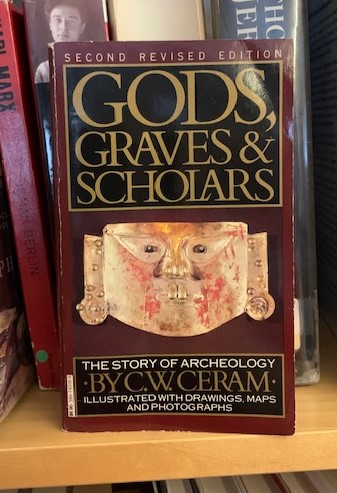
Title: Gods, Graves, and Scholars: The Story of Archaeology
First published: 1951, rev. 1967
This is an early survey of the archeology of the ancient world, focusing on the ancient Aegean, Egypt, Mesopotamia, and the Americas. The author focuses on writings from the early explorers and excavators. There is one section of black and white plates with some iconic pics.
The info is dated, but it’s written with a scene of adventure and admiration that makes the reading fun.
Bio: C. W. Ceram (1915-1972), pseudonym of Kurt W. Marek, a German writer and journalist specializing in ancient cultures, particularly ancient Egypt. According to Wikipedia, Marek wrote Nazi propaganda, but the entry offers no citation for this claim. His New York Times obituary claims he was drafted, fought in Norway and Italy, and taken prisoner by US forces in Italy. He lived for a while in the United States.

Title: Why Things Are the Way They Are (1998)
First published: 1998
This is a discussion of material physics intended for the general reader. The topics include crystals, particles and waves, the atom, etc. Chandrasekhar uses mathematics, but they’re not overtaxing. I can say this with confidence because I read the book, and my head did not explode. At the same time, I would not exactly call it a breeze. It does take a bit of effort. I found the reading rewarding and interesting.
Bio: B. S. Chandrasekhar (b. 1928) is a physicist and another author I had trouble finding much bio info on. The blurb on the back of the book says he was educated in Nanjangud, Bangalore, Delhi, and Oxford. He conducts research and teaches in universities in the US, England, India, Switzerland, and Germany. Though given what his age must be now as opposed to when the blurb was written, I imagine he’s slowed down a bit.
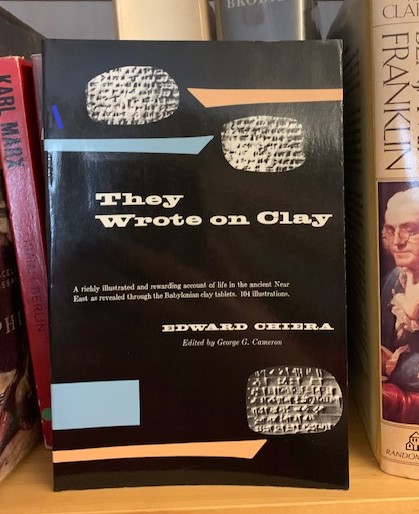
Title: They Wrote on Clay
First published: 1938, rev.1966
Although dated and imbued with orientalism (“Dissonant to Western ears is the music of this modern oriental orchestra”), this book nevertheless describes what it was like to uncover for the first time in millennia the clay cuneiform tablets of ancient Mesopotamian civilizations and read familiar stories. Black and white photographs dot the pages.
Bio: Edward Chiera (1885-1933) was an Italian-American Assyriologist, linguist, archaeologist. He is primarily remembered for the recovery of cuneiform tablets during a series of digs at Khorsabad during the 1920s. According to his obituary in the Chicago University Press, he passed away at the age of 48 after a prolonged illness.
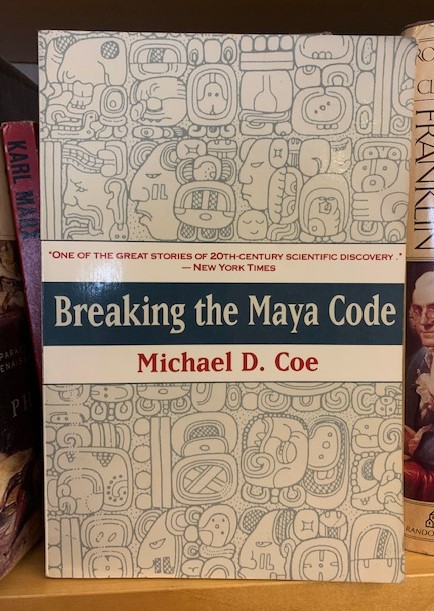
Title: Breaking the Maya Code
First published: 1992
This examines both the history of decipherment with respect to cuneiform, hieroglyphic, and Linear B, and the specific story of Mayan glyphs and the author’s work in the field. While the book is not a technical manual, it breaks down in detail how glyphs work and includes some Mayan language, grammar with showing translations. The author discusses some work of colleagues and students, not all of whom he agrees with. Nevertheless, he presents disagreements respectfully. This is not an easy or light book to get through, but I enjoyed it and remain grateful to the author.
Bio: Michael D. Coe (1929-2019) was Charles J. MacCurdy Professor Emeritus of Anthropology at Yale University. He was an American archaeologist, anthropologist, epigrapher, and author, primarily known for his research in pre-Columbian Mesoamerican studies, particularly for his work on the Maya civilization, where he is regarded as one of the foremost Mayanist scholars of the latter 20th century. During the Korean War, Coe worked for the CIA as a part of the front organization Western Enterprises in Taiwan created to subvert Mao’s China. He wrote many scientific papers across a broad range of archaeological, anthropological, and ethnohistorical topics. He also popular works for the non-specialist audience, such as The Maya (1966) and Breaking the Maya Code (1992). He also co-authored the book Mexico: From the Olmecs to the Aztecs (1962, sixth edition, 2008) with Rex Koontz.

Title: The Mind of the Bible-Believer
First published: 1988
One of the reasons I’m posting this on Friday and not Thursday is that I started rereading so much of this book. The author’s thesis is that the Bible is a mind-control tool that evangelical Christianity uses it for political advantage. The author and many others (like Senator McClosky) were instrumental in the collapse of televangelist Pat Robertson’s 1988 presidential bid, not by any dirty underhand smear campaign but by repeating Robertson’s own words.
The author became a born-again Christian as an adult and remained a practicing Christian for three years. He even enrolled in a (Protestant) seminary, where, as he describes it, he had a sudden and complete loss of faith. He woke up, said morning prayers when a thought he describes as “extraneous” occurred to him, “The door to paradise stands open, and now I’m going to close it.” He associated this with a work by Kafka. “In that moment,” he writes, “the entire Christian indoctrination collapsed like a house of cards.”
In conclusion on Robertson, he writes:
…I expect Robertson to fade from view. … When someone does come along who can overcome the fragmentation and disagreement on issues that now substantially neutralize the Religious Right as a force in national politics—and it will take a few years for that to occur—he will not particularly resemble Robertson or any other current Religious Right leader.
This was written around 1988. Pretty damn scary.
One is not likely to call this a joy to read. It is densely written, with footnotes that take up half a page at times. The author often quotes source material at length. Yet, for those willing to forge ahead, there are poignant moments and insights.
Bio: Edmund D. Cohen Unfortunately, I can find little bio info on this author. According to the book blurb, he has a Ph.D. in psychology. Later, he earned a J.D. from National Law Center at George Washington University.
Review “Frogs” (1972)
This is an “eco-horror” film from 1972 with a message: the critters of the world have had their fill of pollutin’ humans, and it’s payback time. The dearly beloved and I watched it as our Saturday bad movie and pizza offering. The $7.99 bottle of cab from Costco grew on me.
Plot:
The movie opens with wildlife photographer Pickett Smith (Sam Elliott) canoeing through a swamp, snapping pics of the local wildlife—lizards, an alligator, and a FROG (cue the title). He also takes pictures of evidence of pollution—garbage floating in the water, runoff from pipes.
As Pickett makes his way over the broader lake with his expensive camera gear in his canoe, Clint Crockett (Adam Roarke) takes a sip from his beer can and makes a too-fast turn in his speedboat, capsizing the canoe. Crockett’s sister, Karen (Joan Van Ark), berates him and laughs when Pickett pulls a sloshed Clint into the water.
The Crockett siblings can’t recover any of his equipment, but they can offer him a shower and clean clothes at the old family mansion. A family tradition is to celebrate several birthdays, including Grandpa Jason’s (Ray Milland), along with the Fourth of July, which will fall on the next day, as one big party. Grandpa’s children and grandchildren come, despite Grandpa being a miserable old coot, because there’s going to be an inheritance someday… soon.
For some reason, a lot of frogs come around. They make an awful racket. The Crockett women complain they can’t sleep. Jason invites Pickett to explore the island (because, of course, they’re on a private island…). He has a request, though. He sent “his man” Grover out to spray to control the frogs. Could Pickett keep an eye out for him?
Pickett later finds Grover dead in a bit of water, with snakes slithering over him, his face swollen and blotched. The family guesses something is up when Pickett returns in Grover’s Jeep without Grover and asks to speak privately to Grandpa Jason.
Thoughts:
The frogs aren’t particularly menacing by themselves, but they’re the ones in charge. Before any of the progressively gruesome attacks, they hop around ribbiting to their hearts’ content. They’re marshaling the troops. Why would cottonmouths or tarantulas listen to frogs? Good question.
The frogs assault windows.
“That’s not normal,” Pickett tells Grandpa Jason.
As is de rigueur in these films, the phone dies and remains dead, despite reassurances it should be fixed soon.
Grandpa Jason is the embodiment of evil: He’s not only rich, he’s “ugly rich.” (“We have every right to be ugly rich,” says sister Iris Martindale (Hollis Irving). “We pay enough in taxes.”) He displays more hunting trophies than any the room has a right to hold. He sprays for pest control. And he’s stubborn. Long after the danger is evident and multiple gory deaths have occurred with some people still missing, he refuses to leave. He’s going to sleep like a baby.
Iris’ son Kenneth (Nicholas Cortland) has a black girlfriend, Bella Garrington (Judy Pace). No one says anything about her race, but she tells the black maid, Maybelle (Mae Mercer), that she’s “Maybelle too,’ ‘cuz I guess the writers couldn’t come up with another name for a black woman from the South…?
Eden State Park in Florida was used as a location for the swamp scenes. The Wesley House, also located within the park, was used as the Crockett family mansion. According to IMDB, “many of the 500 Florida frogs and 100 giant South American toads” purchased (good lord, hate to ask where…) for the film escaped. Presumably, their descendants are happily hopping around the great state of Florida without ordering attacks on humans.
Frogs was nominated for the Grand Prize in 1973 at the Avoriaz Fantastic Film Festival (France).
The characters are not people as much as plot points. The grotesque and bizarre deaths border satire. Given all this, I rather liked this film. It is silly but entertaining.
With respect ot kiddies: There is no sex, but a lot of death by bizarre means, although the gore is minimal.
The movie can be watched here: Frogs 1972 Horror 4th of July – YouTube
Title: Frogs (1972)
Directed by
George McCowan
Writing Credits
Robert Hutchison…(screenplay) &
Robert Blees…(screenplay)
Robert Hutchison…(story)
Cast (in credits order)
Ray Milland…Jason Crockett
Sam Elliott…Pickett Smith
Joan Van Ark…Karen Crockett
Adam Roarke…Clint Crockett
Judy Pace…Bella Garrington
Lynn Borden…Jenny Crockett
Released: 1972
Length: 1 hour, 31 minutes
Rated: PG
Spring clean: Five more books
This is the second group of books to be donated. I ‘ll miss some of them more than others, of course. I hope they all find happy homes. There is no theme. The books are arranged by alphabetic order on the shelf, so they’ll be going to donation in alphabetical order.
This is sort of my way of saying goodbye to all these books. I won’t be reading any of these again. It’s time to get rid of some of them.
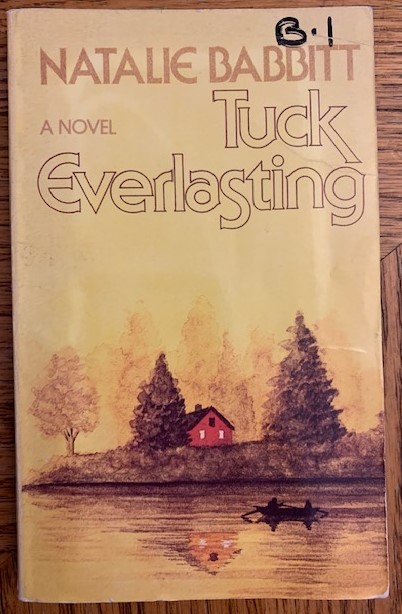
Tuck Everlasting by Natalie Babbitt is a children’s novel originally published in 1975. Ten-year-old protagonist Winifred (“Winnie”) Foster’s family lives outside the village of Treegap. Winnie runs away into the woods where she meets a man by a spring who at first tells her his age is 104, then tells her, no, he’s seventeen. She wants a drink from the spring. He prevents her and tells her how drinking from the spring made his family immortal.
Bio: Natalie Babbitt (1932-2016) was an author and illustrator of children’s books. Among the picture books she wrote and illustrated are Nellie: A Cat on Her Own (1989) Bub; or, The Very Best Thing (1994), and Elsie Times Eight (2001). She was originally from Dayton, Ohio, but spent much of her adult life in Connecticut, where she passed away.
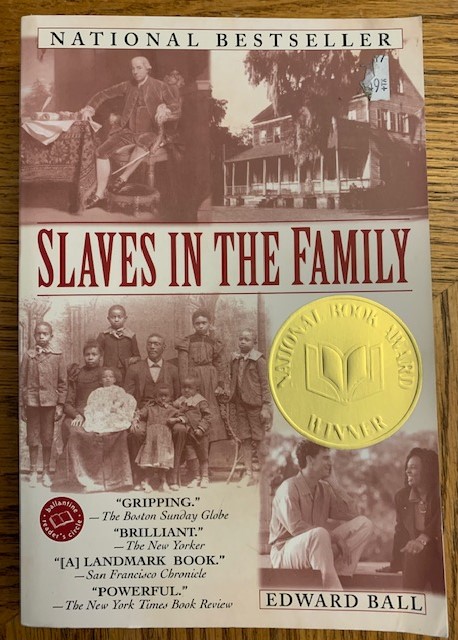
Slaves in the Family by Edward Ball is the result of the author’s search into his family history to discover his ancestors were large slaveholders and slave traders. Using estate records, he finds and interviews the descendants of those who were enslaved, among others, even traveling to Africa to interview the descendants of those who ran the slave trade there.
Bio: Edward Ball (b. 1958) is a native of Savannah, Georgia. He earned a B.A. from Brown University and an M.A. from the University of Iowa. In addition to Slaves in the Family, he’s written The Sweet Hell Inside (2001), The Genetic Strand (2007), and The Inventor and the Tycoon: A Gilded Age Murder and the Birth of Moving Pictures (2013).
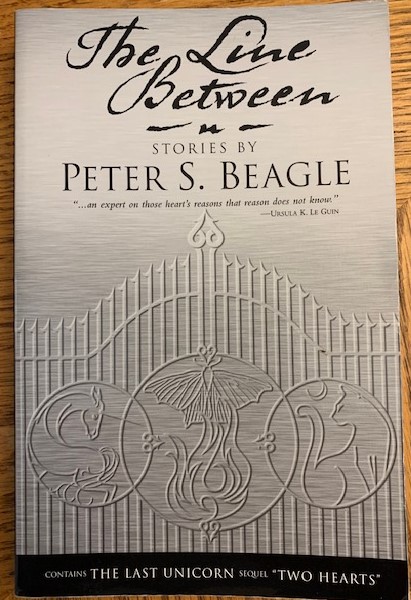
The Line Between: Stories by Peter S. Beagle (b. 1939) is a collection of short stories by this author of The Last Unicorn. The line between is, in the author’s words,“the invisible boundary between conscious and not, between reality and fantasy, between here (whatever ‘here’ is) and there (whatever ‘there’ might be)”
The stories are:
“Gordon, the Self-Made Cat”
“Two Hearts” (the sequel to The Last Unicorn)
Four Fables
“El Regalo”
“Quarry”
“Salt Wine”
“Mr. Sigerson”
“A Dance for Emilia”
Bio: Peter S. Beagle is an American writer and screenwriter, particularly of fantasy. His best-known work is The Last Unicorn (1968). Other works include A Fine and Private Place (1960) and Lila the Werewolf (1974).
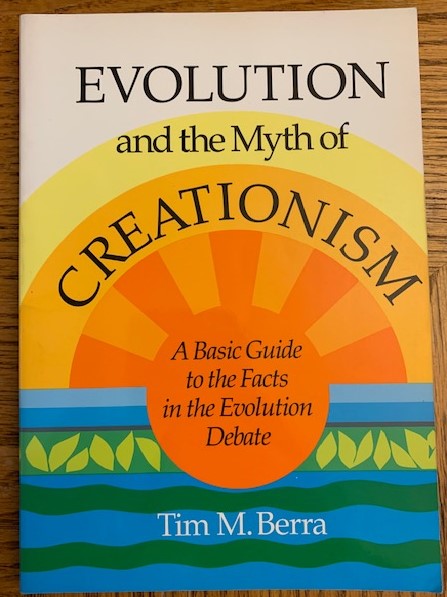
Evolution and the Myth of Creationism: A Basic Guide to the Facts in the Evolution Debate by Tim M. Berra is a primer on the basics of what evolution is and a description of some creationist arguments against it. Since the latter change and the book was published in 1990, it may be dated in some respects, but it still is good in explaining the basics of evolution with a lot of pictures.
Bio: According to his profile at Ohio State University, where he is Professor Emeritus of Evolution, Ecology, and Organismal Biology, Tim Berra (b. 1943) has written more than eighty-five scientific publications and nine books, including Evolution and the Myth of Creationism (1990), A Natural History of Australia (1998), Freshwater Fish Distribution (2007), Charles Darwin: The Concise Story of an Extraordinary Man (2009), Darwin & His Children: His Other Legacy (2013) and Bourbon: What the Educated Drinker Should Know (2019).
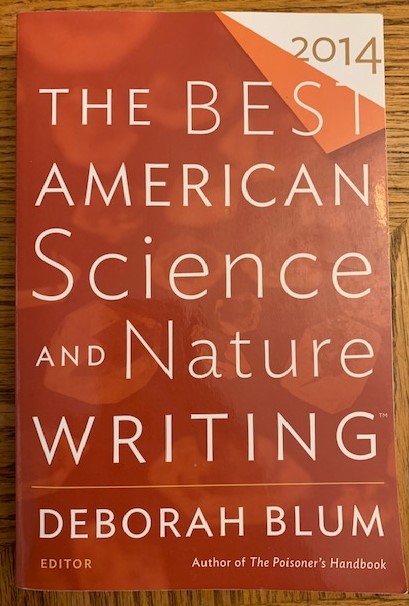
The Best American Science and Nature Writing 2014 ed. Deborah Blum is a collection of some twenty-six science and nature articles written over the calendar year 2013 and pulled from periodicals as diverse as National Geographic, Audubon, and The Atlantic. The article authors include scientists like E.O. Wilson (“The Rebirth of Gorongos”), science writers like Robin Marantz Henig (“A Life-or-Death Situation”), and novelists Barbara Kingsolver (“Where it Begins”).
The writing is often beautiful, heartbreakingly so, as is Pippa Goldschmidts’ “What our Telescopes Couldn’t See.” Much of it deals with important issues, particularly climate change, but overall, the articles in the book are incredibly pessimistic. “We’ll all going to die!” they seem to be screaming.
Indeed, one is actually titled “Learning to Die in the Anthropocene.” In it, author Roy Scranton, an Iraq war veteran, draws on his war experience and the philosophy used then as well as from study. In addressing the current climate crisis, he writes:
The biggest problem we face is a philosophical one: understanding that this civilization is already dead. The soon we confront this problem, and the sooner we realize there’s nothing we can do to save ourselves, the sooner we can get down to the hard work of adapting with mortal humility to our new reality.
Yeah, cheery. And this is long before Covid.
Bio: Editor Deborah Blum (b. 1954) is a science journalist who grew up with an entomologist for a father and a freelance writer for a mother. Among the books she’s written are The Ghost Hunters (2006) and The Poisoner’s Handbook (2010).
 Reviews of Old and New Stories. Mostly Old