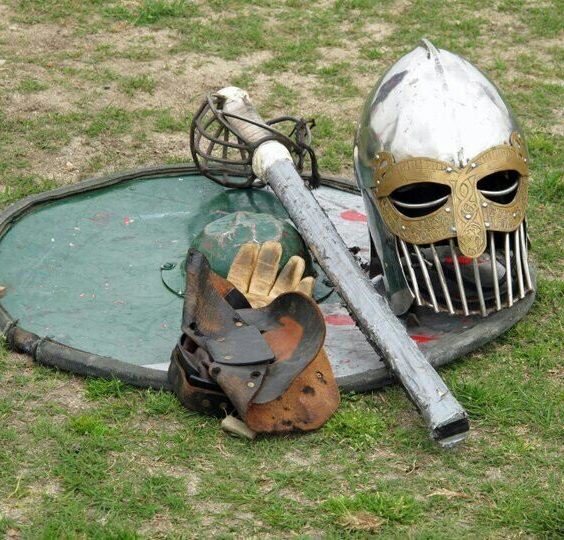
This is our Saturday pizza and bad movie offering, the first of three movies following the doings of the (fictional) “Office of Scientific Investigation” (OSI). The two other later flicks are Riders to the Stars (1954) and Gog (1954).
Plot:
The opening narration tells the viewer about “new dangers” facing humanity’s existence: sound frequencies that can penetrate the human brain and destroy life, “deadly isotopes of unknown elements” that “burn and sear the flesh,” and “pilotless aircraft crashing the sonic barrier can gain complete mastery over the skies.”
“To meet this challenge to our existence, a new agency has been formed, OSI, the Office of Scientific Investigation. The operatives of the OSI are called A-men.” Not G-men, but A-men.
After reminding—or nagging— his pregnant wife Connie (Jean Byron) about her doctor’s appointment, A-man Dr. Jeffrey Stewart (Richard Carlson) kisses her good-bye outside the office and goes to work. Once inside, he greets coworker Dr. Dan Forbes (King Donovan), who tells him about climbing radiation levels in air samples he has received.
Meanwhile, in an unassuming appliance store in town, Mr. Simons (Byron Foulger) berates clerk Albert (William “Billy” Benedict) for letting the clocks in the display case run down and show the wrong time… but even the electric clock shows the wrong time. The pots and pans are all magnetized. Magnetic doors on the front-loading washers (or maybe dryers?) open and close. A push lawnmower rolls down the aisle on its own. What’s a taxpaying appliance store owner to do? Call the power company, of course, who will then pass the hot potato onto the A-men of the OSI.
Jeff and Dan’s investigation leads them to a lab above the appliance store, where one man lies dead of radiation poisoning. With Geiger counters, they find an empty lead-lined container. It’s hot. But where has the source of the radiation/magnetism gone?
Further investigation leads to a Dr. Denker (Leonard Mudie), who’s leaving town on a plane. The strong magnetism endangers the working of the engines. He’s dying but tells Jeff that he bombarded selenium (or perhaps “serrenium”—whatever that is?) with alpha particles. He also cautions to keep the new element under constant electrical current. It’s hungry. It’s a monster that will reach out with its “magnetic arm” and take the energy it wants. What Dr. Denker doesn’t get around to telling Jeff is why he did such a thing in the first place.
Jeff oversees the removal of the element to the state university. Later, alas! there is a disaster resulting in deaths. (“Not an explosion,” the viewer is told helpfully, “but an explosion in reverse. An implosion.”)
The element is unstable and needs an increasing amount of energy to avoid a crisis. Of course, the need for increasing amounts of energy itself is a crisis.
Thoughts:
The science in this is goofy. Magnetism and radiation are not related. I confess I don’t know what would happen if someone bombarded selenium with alpha particles, but probably not the events of this movie.
Setting all that aside, I thought this was a lot of fun. Besides being bizarre, the early scene in the hardware store is cute. Things show up the stodgy old boss. The visuals are weird and a bit loopy, too.
The A-men eventually seek help from a colleague in Nova Scotia, who had overseen the creation of “deltatron,” located in an old mine dug deep under the earth and the Atlantic Ocean. The deltatron can generate enough power to “overfeed” the isotope and kill it, Jerry hopes, although this is not without risk.
The deltatron itself is reminiscent of the 20s film Metropolis. It is, in fact, borrowed footage from a 1934 German film about modern alchemists titled Gold. The biggest giveaway for me was the iron cross at the end of the plunger Jerry must push to get the deltratron to go critical. The word “Danger” appears on the side of it. I don’t believe iron crosses are big decorations in Nova Scotia.
Footage of the MANIAC I (Mathematical Analyzer Numerical Integrator and Automatic Computer Model I) is also shown at work with vacuum tubes and punch cards. This did exist once upon a time at the Los Alamos Scientific Laboratory. In the movie, it analyzes the properties of the new element. In the meantime, a hand with a pencil makes notes on a pad covered with calculations. This is how the A-men of the OSI learn when the element will go critical again. Nifty nonsense.
The tension rises to a perhaps predictable climax near the end. The OSI pursue nullification of the element as if it were an elusive enemy. The element is inanimate, but the characters attribute malice and murder to it. Without being noir, the film also has a noir-ish feel to it.
Just before the credits roll, Jerry and Connie move into their new house. She is visibly pregnant. Jerry pauses to ponder the beauty of creation when it involves love (huh?) and the horrible results when evil intent is involved.
I liked this movie, despite its unbelievable and paternalistic aspects.
I could not find it available for free download.
Title: The Magnetic Monster (1953)
Directed by
Curt Siodmak
Herbert L. Strock…(uncredited)
Writing Credits
Curt Siodmak…(screenplay) and
Ivan Tors…(screenplay)
Cast (in credits order)
Richard Carlson…Dr. Jeffrey Stewart
King Donovan…Dr. Dan Forbes
Jean Byron…Connie Stewart
Harry Ellerbe…Dr. Allard
Leo Britt…Dr. Benton
Leonard Mudie…Howard Denker
Released: February 18, 1953
Length: 1 hour, 16 minutes
Review of “The Measure of Reality: Quantification and Western Society 1250-1600” by Alfred W. Crosby

The Stuff:
The author says in the first lines of his preface that this is his third book, “in my lifelong search for explanations for the amazing success of European imperialism.” Cyrus the Great, Alexander the Great, Genghis Khan, and Huayna Capac were all “great conquerors,” but they were “homebodies” compared to Queen Victoria. His argument is, in part, that Europeans in the late medieval period developed the ability and the habit of (relatively) precise measurement for both physical and intangible properties, such as hours of the day, something the author describes as “pantometry” or measuring everything.
To put the change in perspective, the author first takes the reader into the medieval view of the world, which he calls “The Venerable Model.” Time and distance did not need to be precise to be meaningful. Numbers themselves were imbued with mystical meaning from their relationship to religious stories and texts. These were often as important, if not more important, than their quantities. Ten miles could be nine miles (three times the perfect number of three, the number of the Trinity, for example) if the need arose.
He then describes a gradual but profound sea change in thinking beginning about 1250, to an outlook he calls “The New Model.” This new thinking—the need to precisely measure and quantify everything— is expressed in art (the development of perspective), music (plainsong to polyphony, written music), and bookkeeping (narrative records to double-entry bookkeeping). There is more to it than that, of course. More detailed and reliable maps allowed sailors to travel (and return) safely, bringing wares and news (and alas! disease) from faraway lands.
I liked a lot about this book. I enjoyed reading about the medieval world and the changes in the Renaissance. This was a fun read. For example, after the development of polyphonic music, people who remembered plainsong complained about the newfangled stuff. It’s comforting to know that we old fogeys have been complaining about kids’ music since at least the 14th century.
However, a flag went up when Crosby implied Queen Victoria spent her days gallivanting around that empire the sun never set on. Queen Victoria never left Europe. Hmmm…
As engaging as I found this book, I did not see that Crosby ties the change in European measuring habits to imperialism. He does not support his basic thesis. Granted, the habit and ability to measure would make imperialism easier, but whence the impetus in the first place? That’s never discussed.
IMseldomHO, Crosby also gives short shrift to knowledge gained through Arab and Indian contacts. Other people in the world measured things.
If the reader goes into the book with these expectations, it can be an enjoyable read. If the reader seeks eternal and ultimate truth, the book will disappoint.
Bio:
Alfred W. Crosby (1931-2018) was an American historian, writer, and professor specializing in environmental history. He was a professor of History, Geography, and American Studies at the University of Texas at Austin and the University of Helsinki. One of his earlier books, The Columbian Exchange: Biological and Cultural Consequences of 1492 (1972), details plant and animal exchanges between the Americans and Europe. Among his other books are Epidemic and Peace, 1918 (1976) (Republished as America’s Forgotten Pandemic: The Influenza of 1918 1989, 2003), and Children of the Sun: A History of Humanity’s Unappeasable Appetite for Energy (2006).
Title: The Measure of Reality: Quantification and Western Society 1250-1600
Author: Alfred W. Crosby (1931-2018)
First published: 1997
Review of “X: The Man with the X-Ray Eyes (1963)”
Our latest Saturday night pizza and bad movie offering has a mad scientist on the road to perdition. Back in the day, I watched this flick on broadcast TV. We watched it last night with Svengoolie.
Plot:
Dr. James Xavier (Ray Milland) wants humans to see further than the “visible” light spectrum. To this end, he’s working on eye drops, an experiment he’s dubbed X. The foundation paying for his work sends a liaison, Dr. Diane Fairfax (Diana Van der Vlis). He demonstrates to her how his drops work on a caged monkey. Unfortunately, the monkey dies, probably of shock.
The foundation withdraws its funding, but Dr. Xavier remains undeterred and proceeds to experiment on himself. He argues with his friend, Dr. Sam Brant (Harold J. Stone), to help him. Brant, with the dose of good sense Xavier lacks, refuses. Only after Xavier insists on going ahead alone does he agree to help him, and then… cue special effects. The viewer understands what freaked the poor monkey out but not why Xavier wants a second dose.
Comic relief arrives when the lovely Dr. Fairfax invites Xavier to a party. Why, he can see through clothing! The dancing partygoers are all young, quite becoming, and quite in the buff. (No explicit nudity is shown, however.)
In surgery the next morning, however, he’s still seeing through clothing. His colleague, Dr. Willard Benson (John Hoyt), has seriously misdiagnosed the young patient’s condition. To keep the other doctor from cutting her open, Xavier slices his hand open, rendering him incapable of surgery, and then finishes the operation in a miraculously short time.
During another argument with his friend, Xavier accidentally (and carelessly) kills him. Yeah, the road to perdition. Does he ‘fess up and turn himself in? Nah. With help from friendly Dr. Fairfax, he heads out on the lam. The next the reader sees him, he’s performing as a mind reader in a carnival with an acerbic barker, Crane (Don Rickles—really).
He rubs people the wrong way there and soon must disappear—again. Imagine that. Nevertheless, Crane sees through (sorry) Xavier and blackmails him into setting up a business. He’s a “healer,” actually, a “seer.” People come to him to receive a diagnosis—for a donation. Think he’s found his forte? His shot at redemption?
Thoughts:
Aside from the cute repetition of X all over the place, this was a serious movie. Dr. Xavier had it good in the beginning. His friend Dr. Brant gives him an eye exam and tells him his eyesight is perfect. Neither realizes his ambition is blinding him. When Dr. Fairfax asks why he wants to see further into the light spectrum, he gives this rambling, incomprehensible speech that amounts to, “Because it’s there, and I might find cool things there.”
Like bee purple? Yeah, that’d be useful for pollinating flowers.
Xavier is like a drug addict with the eye drops. He needs more—and needs money. The ability to see is a disability. He wears wrap-around sunglasses because everyday light is too much to bear.
At every step, he makes a bad choice. Not even realizing he’s killed his friend, lost his position in society, and his career wakes him up.
Not a happy movie.
Are our dreams coming true a disability? Are ambitions a bind? No—it is not the dream or the ambition per se. Xavier has sold his soul long before the drops have become a reality.
The ending is meant to shock, and it is depressing.
X: The Man with the X-Ray Eyes was a nominee for the Astronave d’argento (Silver Spacecraft) for best film at the 1963 Trieste Science+Fiction Festival.
I could not find this available for a free download.
Title: X: The Man with the X-Ray Eyes (1963)
Directed by
Roger Corman
Writing Credits
Robert Dillon…(screenplay) and
Ray Russell…(screenplay)
Ray Russell…(story)
Cast (in credits order)
Ray Milland…Dr. James Xavier
Diana Van der Vlis…Dr. Diane Fairfax (as Diana van der Vlis)
Harold J. Stone…Dr. Sam Brant
John Hoyt…Dr. Willard Benson
Don Rickles…Crane
Released: September 18, 1963
Length: 1 hour, 19 minutes
Review of “The Bounty: The True Story of the Mutiny on the Bounty”

The Stuff:
In April 1789, crew members of HMS Bounty mutinied in the South Pacific near Tofua and set their captain adrift in a launch with eighteen loyal crew members. Some of the mutineers would settle on Tahiti. Others would settle on uninhabited Pitcairn. Three would eventually hang. Some would receive pardons, and others would be acquitted.
Alexander’s account begins with a young (thirty-three) naval officer, Lieutenant Bligh, awaiting his final sailing orders. The author notes some complications: Blligh is departing late in the year when he will meet the worst weather at Cape Horn. The ship is small, and the Admiralty has not assigned it marines, as was the custom.
The first section ends with the surprising (to the recipients) letters from Bligh from a Dutch colony—not where he is supposed to be—some to the authorities and one to his wife: “my dear dear Betsy…I have lost the Bounty.”
The author takes pains to document with primary sources every transaction—the letters, the public notices, the legal accounts. For example, in recounting the courts marital of the mutineers, she discusses the backgrounds of the judges and the weather on the days of the trials. This level of detail might seem tedious at times, but she has a story to tell, and she tells the complete story.
The recollections and testimonies of the various participants often conflict. The author relates each one with minimal interference. The narrative continues beyond the trial, with sentences carried out and pardons.
The author shows how the story became a sensation in its own time, with the truth disregarded for the sake of a good tale. She also posits that with all his faults, was Captain Bligh a Captain Bligh? That is, was his reputation as a martinet exaggerated, perhaps in an effort to save a well-connected young man? She examines his post-Bounty career.
The fate of the mutineers who were not apprehended is related, as much as it can be, by the single surviving crew member found on Pitcairn Island some twenty years after the mutiny.
I liked this book, despite its tendency to get bogged down in details on occasion. Thankfully, the author romanticized nothing and held up no one as a hero. There was no single answer as to why Fletcher Christian mutinied. Clearly, he was unhappy. The story left one with the impression of how sad it all was. After all, the original mission was to find a cheap food source for slaves in the West Indies.
Bio:
Caroline Alexander (b. 1956) is an author, classicist, and filmmaker. She studied philosophy and theology at Oxford as a Rhodes scholar and has a doctorate in classics from Columbia University. She has written for The New Yorker, Granta, Condé Nast Traveler, Smithsonian, Outside, and National Geographic. Her books include The War that Killed Achilles: The True Story of the Iliad and the Trojan War (2009), Lost Gold of the Dark Ages: War, Treasure and the Mystery of the Saxons (2011), and The Iliad: A New Translation (2015).
Title: The Bounty: The True Story of the Mutiny on the Bounty
Author: Caroline Alexander (b. 1956)
First published: 2003
Review of “Yongary, Monster from the Deep” original title “Taekoesu Yonggary”(1967)
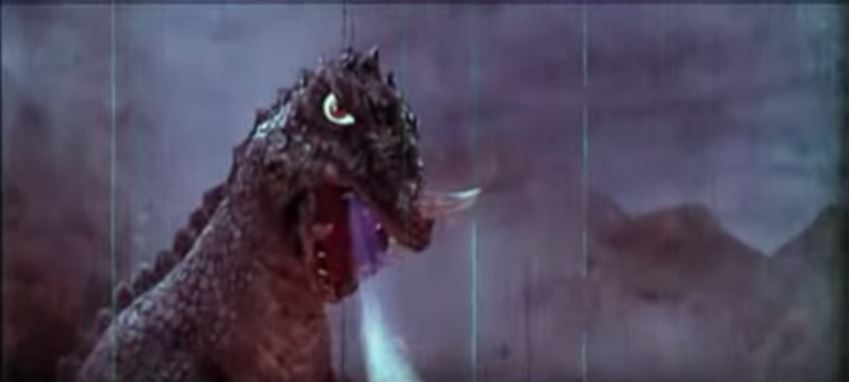
This is our Saturday pizza and bad movie offering, a Mystery Science Theater gem of a Godzilla imitator from Korea—except there’s more than meets the eye. Time for a glass of prosecco.
Plot:
The movie begins with a wedding between Astronaut Yoo Kwang-nam (Soon-jae Lee) and the lovely Yoo Soon-a (Jeong-im Nam). As they depart for their honeymoon, brat Icho (Kwang Ho Lee) tells them he has a surprise for them.
Driving down the road, the new Mr. and Mrs. Yoo are suddenly overcome with itching and have to get out of the car. Oh, what has that little scamp done? Lucky for them, their scientist friend Il-lu (Yeong-il Oh) is driving behind them. (EW. Dude. They’re off on their honeymoon. Leave them alone.)
Il-oo finds the boy Icho hiding behind some rocks, shooting an “itch ray” at the newlyweds.
“I told you I had a surprise,” the youngster says.”
Such a lovable imp. Il-lu scolds the boy for stealing his itch ray and takes him back to the lab.
The newlyweds continue on their way.
At the hotel, Soon-a has just changed into a (modest) frilly nightgown. Kwang-nam sits staring at curtains. Or maybe it’s the sky. When she starts to snuggle (chastely) with the new hubby, the phone rings. It’s Soon-a’s dad and Kwang-nam’s boss. Kwang-nam must return to headquarters immediately. There seems to have been a nuclear test in the Middle East and he’s the only one who can fly a reconnaissance mission of it.
In a rocket.
Following the nuclear test, an earthquake strikes. The important people are puzzled. Its epicenter is moving—toward Korea!
Thoughts:
At first blush, Yongary appears to be nothing more than Godzilla with a horn pasted on its schnoz. This is partly because Yongary looks like Godzilla with a horn pasted on its schnoz.
Most of the factual and background material in the following commentary comes from American film Steve Ryfle, commentator and Korean film journalist and blogger Kim Song-o, available here.
While no one will argue this is an art film, this version suffers from bad translations and non-Korean inability to pick up on some cultural references. I know as much about Korea as you average English speaker and do not speak a word, not even enough to ask the way to the ladies’ room.
The gods know there are goofy things galore in this flick. Sending a man into orbit to check out a nuclear explosion? An earthquake with a moving epicenter? “Itch-ray”? Um, yeah.
All but about 45 minutes of the original Korean version is lost. The version available in the States was dubbed and originally aired on TV. It was later released for home viewing.
In the commentary available on YouTube, Kim Song-o says he has read the original Korean script. The discrepancies are not major but deal mainly with generalities versus specifics. Some of the characters’ names are changed as well. For instance, the boy, called, Icho in the dubbed version, is Young. (“Icho isn’t even a Korean name!”) The scientist called Il-oo is Il-woo.
There are things that non-Koreans will inevitably miss. For example, one of the buildings Yongary smashes bears a striking resemblance to a building that the Japanese colonial government used. Patriotic helicopter pilots (…on strings…I know. Spoil the moment.) lure Yongary away from one of the historic Eight Gates in the city of Seoul, revered landmarks established in the fourteenth century.
However, if you’re paying attention (and paid attention in history class), you’ll hear that, after the nuclear test and the earthquake with the moving epicenter, Yongary emerged from a crack in the ground in Panmunjom, Korea, the city where the ceasefire of the Korean War was signed.
The movie also uses the trope of the precocious child who has an odd connection with a monster.
It is unfortunate that the English-language version can’t translate what Koreans would understand, but that is a tall order.
For the English speaker, is watching this fun? Sneering is easy, of course. I do it myself on occasion. But this film, even without understanding the cultural references, is a lot of fun. The special effects do not hold up in 2022—essentially, a guy in a rubber suit stomping on a model city and toy tanks. I personally don’t mind unconvincing special effects. They can be delightful. I’m looking for a story, and a goofy story can be fun. It doesn’t have to be Pulitzer Prize-worthy.
I realize it won’t be everyone’s cup of tea, of course. But I enjoyed it. It was entertaining, silly as it was.
I couldn’t find this as a free download anywhere. Even Internet Archive charges for it.
Title: Yongary, Monster from the Deep Original title: Taekoesu Yonggary (1967)
Directed by Ki-duk Kim
Writing Credits
Ki-duk Kim…(screenplay)
Yun-sung Seo
Cast (in credits order)
Yeong-il Oh…Ko Il-woo (scientist)
Jeong-im Nam…Yoo Soon-a
Soon-jae Lee…Yoo Kwang-nam (as Sun-jae Lee) (astronaut)
Moon Kang…Kim Yu-ri
Kwang Ho Lee…Yoo Young (boy)
Kyoung-min Cho…Yongary (as Cho Kyoung-min)
Released: 1967
Length: 1 hour, 20 minutes
…And the Spring Clean is Complete

This is my last group of books going to the library. The great spring clean is done. The book cases are not quite as full as they once were. But some nifty books found happy homes; a few went directly to friends. That made me feel great. And I got a chance to flip through some old books and recall some happy memories. There were a few exceptions, but most of the time, this was a happy exercise. I imagine I’ll do something like it again in a couple of years, but with fewer books.

The Stuff: When the author visited the town of Lily Dale, founded by Spiritualists in the 19th century, she was a religion reporter for the Dallas Morning News. She’d read a skeptical New York Times article about the hamlet an hour outside Buffalo, New York. She wanted to know more. “I wanted to know why this strange little outpost clings to such absurd ideas,” she writes. “I wanted to know who these people are and what makes them tick.”
A book about people trying to contact their deceased relatives and loved ones shouldn’t be fun, but this is. Wicker gives a history of Spiritualism, the founding and running of Lily Dale, as well as a portrait of its present. Many of the mediums are convinced their deceased loved ones are still around and directing their lives, even when it comes to things like room décor.
The book contains several pages of black and white plates of vintage photographs, suggested reading, questions for the reader, and an interview with the author.
Bio: Christine Wicker (b. 1953) worked for seventeen years as a feature writer, columnist, and religion reporter for the Dallas Morning News. She grew up in the South, with a Baptist preacher and a coal miner in her family tree. Her books include (with John Matthews) The Eyeball Killer (1996), God Knows My Heart (autobiography) (1999), and The Fall of the Evangelical Nation: The Surprising Crisis Inside the Church (2009).
Title: Lily Dale: The Town that Talks to the Dead
Author: Christine Wicker (b. 1953)
First published: 2003

The Stuff: I don’t think I’ve looked at this book since I finished it some twenty-five years ago. My primary memory of it is that the author blames the Enlightenment for a host of modern evils. He also uses words like “holon,” meaning something that works as a whole but is also part of something else. I remember thinking as I was reading this, I liked to think I had a life apart from work, so I was a holon. I was a wage slave and a human being off the time clock.
The bulk of the book is presented in question-and-answer format. Typical of this is the beginning of chapter 7, “Attuned to the Kosmos”:
Q: We must listen very carefully. You mean, to all four types of truth.
K.W. Truth, in the broadest sense, means being attuned with the real. To be authentically in touch with the true, out of touch with the true and the beautiful. Yes?
While this may sound like babbling on the surface, some profound thought is going on. It just didn’t add up to the promise for me. And it sure wasn’t a history of everything, nor did I expect it to be. That’s a promise no one can keep. He didn’t quite sell me on the proposition that all knowledge is one. Yet, I have often noticed connections in things I might not have otherwise.
Bio: Ken Wilber (b. 1949) is an American philosopher and writer influenced by Eastern religion and thought. He developed an intellectual framework he refers to as integral theory that views all knowledge as one. Nothing is entirely wrong or right. Among his books are The Spectrum of Consciousness (1977, anniv. ed. 1993), Sex, Ecology, Spirituality: The Spirit of Evolution (1st ed. 1995, 2nd rev. ed. 2001), and The Marriage of Sense and Soul: Integrating Science and Religion (1998, reprint ed. 1999).
Title: A Brief History of Everything
Author: Ken Wilber (b. 1949)
First published: 1996
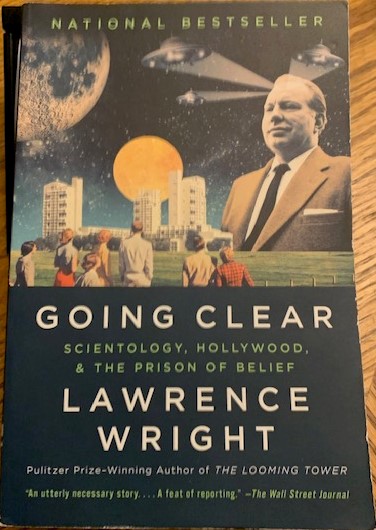
The Stuff: This is an examination of the Church of Scientology from its inception to the writing of the book. Wright focuses on the workings of two principal people, L. Ron Hubbard, Scientology’s founder; and his successor, David Miscavige. It is told in straightforward prose, nevertheless it makes for hard reading. Constant themes are the exploitation of people, the courting of celebrities, the abuse—often physical— of members, the separation of families, and the vindictive treatment of anyone who dares to speak out against the organization. This is a sad, scary read.
Wright asks, what makes a religion?
Bio: Lawrence Wright (b. 1947) is an author, screenwriter, playwright, and staff writer for The New Yorker magazine. He’s written eleven nonfiction books, two novels, and one play, in addition to numerous articles. His best-known work is probably The Looming Tower Al-Qaeda and the Road to 9/11 (2006).
Title: Going Clear: Scientology, Hollywood, and the Prison of Belief
Author: Lawrence Wright (b. 1947)
First published: 2013

The Stuff: This was originally written to examine incidents like terrorist attacks on American (and other) interests in places like Beirut and the hostage crisis in Tehran. After the 9/11 attacks, the author added new material and re-released the book. Early on, Wright makes the point that Muslims are not a monolith. Seventy nations have significant Muslim populations, and cultural, historical, and sectarian differences exist. Islam does not condone terrorism.
After examining the history, Wright makes a few remarks saying that the U.S. and other Western countries need a stable, consistent Mid-East policy.
I liked this book, as dire and harrowing a read as it is. Much of the information will be dated. Bin Laden and Sadam Hussein have gone on to meet their makers, for example, but broader questions of a consistent U.S. policy are worth some thought.
Bio: Robin B. Wright (b. 1948) is an American foreign affairs analyst, author and journalist who writes for The New Yorker, she is also fellow of the U.S. Institute of Peace and the Woodrow Wilson Center. Among her books are The Last Great Revolution: Turmoil and Transformation in Iran (2000), Dreams and Shadows: The Future of the Middle East (2008), and Rock the Casbah: Rage and Rebellion Across the Islamic World (2011).
Title: Sacred Rage: The Wrath of Militant Islam
Author: Robin Wright (b. 1948)
First published: 1985 ad. Material 2001
The bookcases I worked on now look like this (with their scared guardians). They are just two of many, I confess.

Review of “Count Yorga, Vampire” (1970)
This is our Saturday pizza and bad movie offering. Yum. Pizza and prosecco.
Plot:
While the viewer watches an old-fashioned wooden coffin being hauled in the back of an old-fashioned pickup truck, a narrator describes the legend of the vampire. The truck drives the gates of a large estate.
Donna (Donna Anders) has invited some friends over for a séance to try to contact the spirit of her recently deceased mother. Conducting the séance is the nattily dressed Count Yorga (Robert Quarry), who is older than the others and is in dead earnest. Donna misses her mom.
A couple of the young men at the table don’t take the proceeding seriously. Donna’s boyfriend, Michael (Michael Macready), and Paul (Michael Murphy) yuck it up, but eventually relax, join hands, and… Donna screams. Did she see her mom? Chances are better than you might think.
Erica (Judy Lang), Donna’s friend and Paul’s girlfriend, offers to give the Count a ride home. She thinks he’s kinda cute. He’s old enough to be her father. ICK.
After Paul and Erica leave to take the Count home in Paul’s bright red VW Microbus, Donna tells her dearly beloved that the Count was dating her mother before she died. They grew close. He talked her out of cremating her mom. But he didn’t show up for her service…hmm.
On the way back from the Count’s door to the gate, Paul’s VW gets stuck in the mud. He can’t get it out. The viewer sees a hand holding a curtain up, watching them from the house. Once they realize they can’t free the van, does this couple do anything sensible, such as go to the house and ask for help pushing the van out of the mud? Maybe get a shovel or some pieces of plywood? Nah, they crawl in the back and have sex, which spells doom and despair in anyone in a horror movie.
Thoughts:
This was a bit slow going in the beginning. Quarry played a nice, subtly menacing vampire with a harem to look after. Dr. Jim Hayes (Roger Perry) steps in as a reluctant Van Helsing after discovering something odd in Erica’s blood. He also paws her more than necessary to check out the puncture marks on her neck. ICK.
According to Wikipedia, Count Yorga was originally intended to be a “soft porn” flick. Quarry told actor/producer Michael Macready he would play the vampire role if the story were a straight horror film. The original intent explains why, for example, Erica and Paul occupy themselves in the van rather than occupy themselves with getting home as rational people might.
Amusing moments crop up, intentionally or not. The two guys who acted like naughty children at the séance got a snicker out of me. Watching a pickup drive around with a pine coffin was delightful. Imagine what the neighbors must think! And the Count! “Damn it, Brudah! Watch those speed bumps!”
A lot of blood shows up. Interestingly enough, while the Count is a threat to pretty young things, the guys die gruesome deaths at the hands of those pretty young things. A rape also occurs, but it’s off-camera and not directly depicted.
While this movie had its enjoyable moments, I’d have to say overall, it’s a no-go.
It can be bought or rented here.
Title: Count Yorga, Vampire (alt. The Loves of Count Iorga, Vampire) (1970)
Directed by
Bob Kelljan
Writing Credits
Bob Kelljan…(written by)
Cast (in credits order)
Robert Quarry…Count Yorga
Roger Perry…Dr. James “Jim” Hayes
Michael Murphy…Paul
Michael Macready…Michael “Mike” Thompson
Donna Anders…Donna
Judy Lang…Erica Landers (as Judith Lang)
Edward Walsh…Brudah
Released: 1970
Length: 1 hour, 13 minutes Rated: PG-13
Spring Clean #21
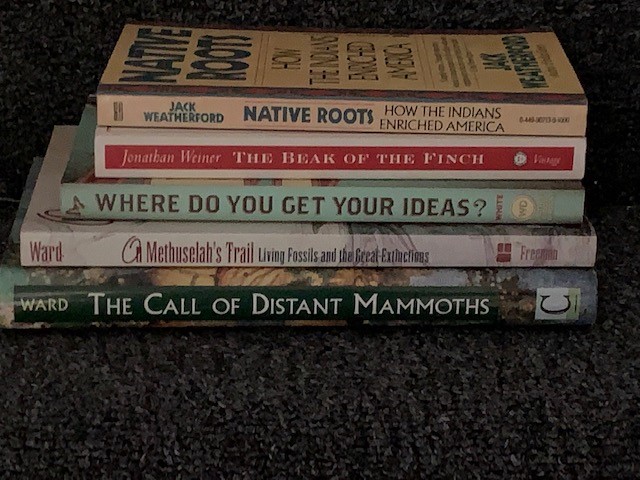
This group of books from the last shelf in my great clean-out of books. Of course, it will soon be covered in books from other parts of the house, but that’s a matter for another day. I have a chance to wipe the dust off in momentary triumph and rearrange the whole bookshelf. Yeah.

The Stuff: The author writes about the die-off of Ice Age megafauna, especially the mammoths. The populations were under stress because of a warming world. Now there’s the introduction of a new predator: human beings. He uses what he calls a “time machine” to imagine traveling back in time to imagine long-gone worlds. What was the world like just before the asteroid hit and wiped out the dinosaurs?
Did any of the creatures take note of the dim celestial light growing brighter each night as the giant comet raced inward toward the sun from its deep-space birthplace? Was its ever-larger tail a distraction to the night-flying fauna of the latest Mesozoic, the insects and newly evolved birds, or the soaring pterosaurs and other saurians of the late Cretaceous? Did the head of the comet eclipse the moon in brightness as it hurled inward those last few nights of the dinosaurs? In those last days, the comet plunged sunward—and coincidentally earthward—at 25 kilometers a second, 90,000 kilometers each hour, passing inward across the moon’s orbit in its final few hours, traversing the distance from the moon to Earth in a bare 4 hours. (p.55)
Ward also tends toward the dramatic, referring to the killing of megafauna as “murder.” The book ends with a cry for the protection of biodiversity, particularly that found in the earth’s rain forests. He takes a final trip in his “time machine” to imagine a time after the burgeoning human population has all but starved itself and is recovering. Humans have survived, indeed thrived, but elephants have not.
While I enjoyed this book, the author’s penchant for the melodramatic annoyed me.
Bio: Peter D. Ward (b. 1949) is an American paleontologist and professor at the University of Washington, Seattle, and Sprigg Institute of Geobiology at the University of Adelaide. His books include Gorgon: Paleontology, Obsession, and the Greatest Catastrophe in Earth’s History (2004), Life as We Do Not Know It: The NASA Search for (and Synthesis of) Alien Life (2005), and Under a Green Sky: Global Warming, the Mass Extinctions of the Past, and What They Mean for Our Future (2007).
Title: The Call of Distant Mammoths: Why the Ice Age Mammals Disappeared
Author: Peter D. Ward (b. 1949)
First published: 1997

The Stuff: This is about “living fossils”— “small groups of animals or plants that are the only living representatives of geologically ancient categories of life.” The most famous example is perhaps the coelacanth, a fish caught in off South Africa in 1938 once thought to have been extinct for millennia. More recent DNA analysis, which Ward could not have been aware of, has shown the fish was not quite what it was believed to be.
Ward examines the stories of brachiopods, clams, nautiloids, the horseshoe crab, and various plants. He further discusses the mass extinctions of the past.
I liked this book. Ward writes with an eye for detail and a feeling for the poetic.
Bio: see The Call of Distant Mammoths
Title: On Methuselah’s Trail: Living Fossils and the Great Extinctions
Author: Peter D. Ward (b. 1949)
First published: 1992

The Stuff: “The past deserves our attention not merely for the sake of antiquarian curiosity, but because our culture and society today descend from ancient Cahokia as much as from medieval London, Renaissance Rome, and ancient Athens,” writes author Weatherford. He describes mostly in broad areas how North American society, rather than simply being European society transplanted on new soil, absorbed and exchanged cultural aspects with the people living here first. Too seldom is this acknowledged or understood.
Overall, it was an interesting read. I remember thinking when I read this that he didn’t go far enough. Since reading the book, I’ve only learned more—for example, the native contribution to American music, specifically rock and roll.
The book was published around the 500th anniversary of Columbus’s landing in the “New World.”
Bio: Jack Weatherford is a cultural anthropologist and DeWitt Wallace Professor, Emeritus Macalester College, St. Paul, Minnesota. He began teaching anthropology in 1983. His most recent interest is in tribal peoples in Mongolia. His books include Indian Givers: How the Indians of the Americas Transformed the World (1988), The History of Money (1997), and Genghis Khan and the Quest for God: How the World’s Greatest Conqueror Gave Us Religious Freedom (2016).
Title: Native Roots: How the Indians Enriched America
Author Jack Weatherford
First published: 1991

The Stuff: The author profiles the work of two Princeton scientists, Peter and Rosemary Grant, who have been studying the finches on Daphne Major in the Galapagos Islands for twenty years. They’ve chartered population rises and falls and changes in the populations. On the surface, it doesn’t sound like much, but the implication show evolution in action. The different species don’t normally interbreed but will do so in times of stress. Even minor differences in beak size can determine who can make use of food and who lives or dies. Later in the book, the author applies these findings to drug-resistant bacteria.
This was a fantastic read. It won a 1994 Pulitzer Prize.
Bio: Jonathan Weiner (b. 1953) is a science writer and professor at Columbia University, teaching science writing at the Graduate School of Journalism. His writing focuses on biology and evolution. Among his books are Planet Earth (1986), the companion book to the 1986 PBS series of the same name; Time, Love, Memory: A Great Biologist and His Quest for the Origins of Behavior (1999); and Long for this World: The Strange Science of Immortality (2010).
Title: The Beak of the Finch: A Story of Evolution in Our Time
Author: Jonathan Weiner (b. 1953)
First published: 1994

The Stuff: This opens with the old saw from Harlan Ellison, who, when asked where he got his ideas, is supposed to have replied, “From Schenectady.” The author then ticks off several scholarly works he’d read on the creative process then concludes, “there always comes a point at which any attempt to explain the creative process fails.” At the same time, what he wants in this book is to take ideas and transform them into workable fiction. Not all ideas work. He also offers practical advice like keeping notebooks, reading classical mythology and newspapers, making worksheets, etc. The book is arranged in a clear outline so finding what you want is simple. It’s a Writer’s Digest publication.
Bio: Fred D. White holds a Ph.D. from the University of Iowa. He has taught writing and literature to undergraduates for more than thirty-five years. He is professor of English emeritus at Santa Clara University in Northern California. Among his books are Writing Flash: How to Craft and Publish Flash Fiction for a Booming Market (2018) and Essential Muir (Revised): A Selection of John Muir’s Best (and Worst) Writings (2021).
Title: Where Do you Get Your Ideas? A Writer’s Guide to Transforming Notions into Narratives
Author: Fred D. White
First published: 2012
Review of “The Loves of Hercules” (1960″
This is our Saturday night pizza and bad movie offering, a beefcake flick filmed initially in Italian. The eye candy was a nice accompaniment (your mileage may vary) to the pizza and wine, and it brought up the apocryphal reaction of Harry Warner (one of the Warner Brothers) to talkies: “Who the hell wants to hear actors talk?”
Plot:
The opening shows (…Greek?) soldiers pillaging a town. A wealthy woman is in her home, ready to flee with her maid when two soldiers enter. After confirming that she’s Hercules’ wife, they kill her, stabbing her in the back.
“Hercules will avenge me,” she tells them.
“I hope he will,” says chief bad’un Licos (Massimo Serato). “For his vengeance will fall on the person I wish to destroy.”
To show what a bad’un he really is, Licos goes to his boss, Eurysteus (Cesare Fantoni), and tells him his orders have been carried out. His boss is happy. Hercules is not going to figure out who did all the rapin’ and killin’.
Licos doesn’t want to risk him finding out. Hercules will be appeased if he knows his wife’s murderer has been killed.
Bummer for Eurysteus.
Hercules (Mickey Hargitay) comes back from consulting the Oracle, who might have told him some was afoot rather than he’d lead a troubled life. He finds everything in ruin and knows damn well who’s responsible—except, well, hard to wreak vengeance on a dead guy.
He meets with the dead king’s daughter, Queen Deianira (Jayne Mansfield)—and yeah, he’s mourning his recently deceased wife and all, but she’s kinda cute. She’s mourning her recently deceased dad and all, but he’s kinda cute, especially since he runs around half-naked.
Alas! The course of true love never did run smooth. Queen Deianira is already engaged to Achilles (which they pronounced something like “Ah-kil-AY-o”). Herk knows where he’s not wanted and leaves.
Achilles turns up dead with Hercules’ dagger in his back. (Notice a pattern here?)
So, yeah, Queen Deianira is mourning her dead father and her dead fiancé, but Licos proposes to her anyway. She can’t be interested in Hercules. He killed Achilles, right?
Thoughts:
Jayne Mansfield and Mickey Hargitay were married at the time. Hargitay was a former bodybuilder, so he had the strength and apparently was not shy about the skimpy little outfits he had to wear in this flick. I doubt he picked up marble pillars or tree trunks, however.
The story is absurd. No other word comes to mind. The special effects are goofy, but that seldom bothers me. Hercules attacks a three-headed hydra that looks like it doesn’t even realize he’s there. The amazons wear uniforms left over from the latest alien invasion flick.
In one rather disturbing scene, the amazon queen, Hippolyta (Tina Gloriani), stands in a blasted forest, taunting a former lover she is gradually turning into a tree. Could this be Hercules’s fate?
Queen Deianira’s wardrobe is varied and quite striking. Her attendants wore various gowns of various pastel shades. Their hair was piled in nearly impossible beehives. This is all quite un-ancient Greek, but fun to watch.
This is a nitpicky point, but the characters kept calling Hercules the son of Jupiter—the Roman name. Greeks would use the Greek name, Zeus. But realism? I am asking a bit much.
After much sturm and drang, there is a happy ending, and the angels sing.
The movie can be watched here:
The sound is iffy, but the dialogue (dubbed in later) is more comprehensible than the music, which sounds like it was recorded off an AM radio.
Buy or Rent MST3K version here:
Title: The Loves of Hercules (original title: Gli amori di Ercole )(1960)
Directed by
Carlo Ludovico Bragaglia
Writing Credits
Sandro Continenza…(screenplay) (as Alessandro Continenza) &
Luciano Doria…(screenplay)
Alberto Manca…(story)
Cast (in credits order)
Jayne Mansfield…Queen Deianira / Hippolyta
Mickey Hargitay…Hercules
Massimo Serato…Licos
Tina Gloriani…Hippolyta
Rossella Como…Aleia
Giulio Donnini…High Priest
Arturo Bragaglia…Iolaus
Released: 1960
Length: 1 hour, 38 minutes
Five More Books Off to the Library/Spring Clean #20

This is this week’s group of books going to the library. As always, lots of fond memories. I’m surprised I’ve had the Vonnegut book this long. I believe I read it sometime around 1990. The sad part of donating all these books is as fast as I clear off the shelves, they fill up again with books I have lying around in other places in the house. The only book I’ve had longer is Tuchman’s.
As always, if there is a book anyone would like, let me know and I’ll get it to you. I generally don’t take the books to the library for a week after I post about them.
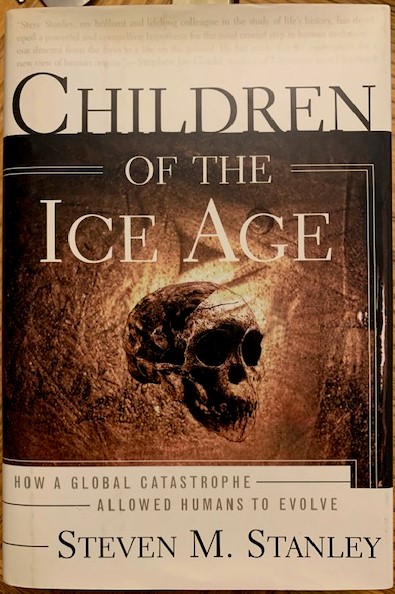
The Stuff: The author describes a novel mechanical origin for the onset of the Ice Age. This Ice Age changed the climate in the savannah of Africa where human ancestors lived, helping to bring about the evolutionary changes—large brains and bipedalism—that led to the rise of homo sapiens, that is, us humans. The writing is easy to follow, and the concepts are laid out convincingly without technical jargon.
Bio: Steven M. Stanley (b. 1941) is an American paleontologist and evolutionary biologist, currently a research professor at the University of Hawaii at Manoa. For most of his professional life, he taught geology at Johns Hopkins. He is best known for perhaps his work using the fossil record to make a case for punctuated equilibrium. Most of his publications are professional works and textbooks.
Title: Children of the Ice Age: How a Global Catastrophe Allowed Humans to Evolve
Author: Steven M. Stanley (b. 1941)
First published: 1996

The Stuff: The book begins with a description of a visit to cave paintings of Combrelles in France, leading the author to ask about human uniqueness and what sets us apart from even our closest relatives, who seem incapable of the symbolic logic we homo sapiens use almost as a birthright. Not even the Neanderthal were capable of speech. Some disagree on this point, and I am hardly one to weigh in with an opinion. Tattersall also strongly advocates for punctuated equilibrium, that is, the idea that populations generally undergo long periods of stability until there is some evolutionary pressure. At this point, a speciation event may occur. All this happens over extremely long periods of time from a human perspective. I enjoyed this book.
Bio: According to his website, Ian Tattersall (b. 1945) is curator emeritus in the Division of Anthropology of the American Museum of Natural History in New York City. He was educated at both Cambridge and Yale and has carried out fieldwork in Madagascar, Vietnam, Surinam, Yemen, and Mauritius. His three main areas of research are the analysis of the human fossil record and its integration with evolutionary theory, the origin of human cognition, and the study of the ecology and systematics of the lemurs of Madagascar. His books include (with Rob DeSalle) Race?: Debunking a Scientific Myth (2011), The Strange Case of the Rickety Cossack: and Other Cautionary Tales from Human Evolution (2015), and (with Peter Névraumont) Hoax: A History of Deception: 5,000 Years of Fakes, Forgeries, and Fallacies (2018).
Title: Becoming Human: Evolution and Human Uniqueness
Author: Ian Tattersall (b. 1945)
First published: 1998
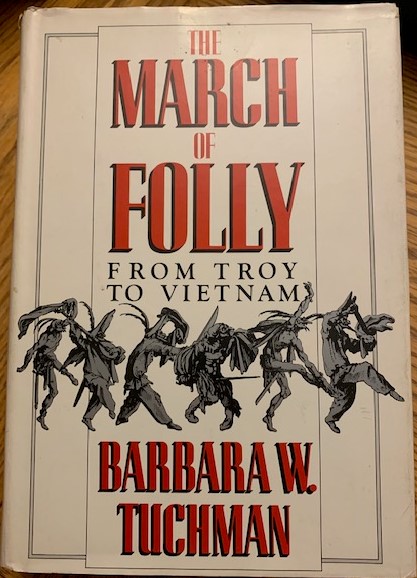
The Stuff: “Why do holders of high office so often act contrary to the way reason points and enlightened self-interest suggests?” the author asks at the beginning of the book. “Why, to begin at the beginning, did the Trojan rulers drag that suspicious-looking wooden horse inside their walls to suspect a Greek trick?” Tuchman examines three monumental losses in history that might have turned out better had the leaders acted differently: The Protestant Reformation (“The Renaissance Popes Provoke the Protestant Secession”), The American Revolution (“The British Lose North America”), and the Vietnam War (“America Betrays Herself”). These leaders did not act blindly. To meet her definition of folly, the leaders had to receive warnings. The prototype is Laocoön, who tried to warn his fellow Trojans about the horse the Greeks left. Athena sent two sea serpents to shut him up. They took his sons, too.
I read this book when it first came out, and I was a lot younger. I loved it and thought it had an important message. After a more recent reread, I found it preachy.
Bio: Barbara Tuchman (1912-1989) was an American historian and writer. Her father was the owner of Maurice Wertheim, the owner of The Nation. Her mother was Alma Morgenthau, the daughter of Henry Morgenthau, Woodrow Wilson’s ambassador to the Ottoman Empire. Her first book of note The Guns of August (1962), about the onset of WWI, won a Pulitzer Prize. She also won a Pulitzer for Stilwell and the American Experience in China, 1911-45 (1971), a biography of Gen. Joseph W. Stilwell.
Title: The March of Folly: From Troy to Vietnam
Author: Barbara Tuchman (1912-1989)
First published: 1984
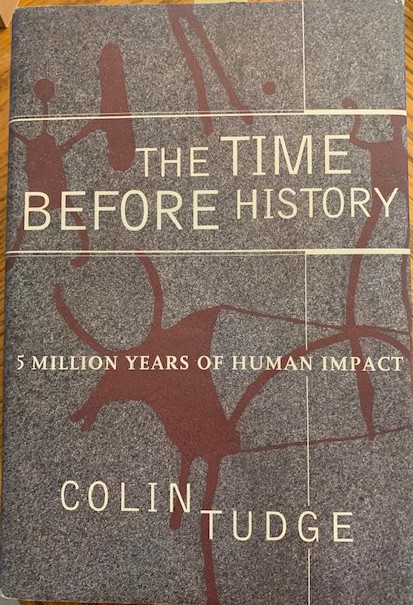
The Stuff: This book deals with prehistoric climate, climatic changes, and human response to those changes, as well as the effects humans have had on the environment. For example, many of the larger land species have disappeared wherever humans have gone.
Contrary to traditional views, he sees the adoption of farming as something done only under pressure. In his chapter “End of Eden,” he writes that what is called “The Agricultural Revolution” was not quick, nor were people enthusiastic about becoming settled agriculturists. It was hard work, with results always uncertain: “Farming, in its early days,” he writes, “seemed to offer very little advantage indeed. In fact, more and more evidence suggests that it was ghastly.”
His words portray the earth’s processes forever in a dance. Nevertheless, the overall outlook is dark. Humankind is a bit player on the great stage of the world. Tudge speaks forcefully for conserving the earth’s bountiful if limited, resources.
This is an interesting, if sad, book.
Bio: Colin Tudge (b. 1943) refers to himself as “a biologist by education and a writer by trade.” He read zoology and worked on the staff of Farmers’ Weekly, New Scientist, and BBC Radio 3. Beginning in the early 2000s, Tudge and his wife, along with Graham Harvey, have advocated for what they call “Enlightened Agriculture” or “Real Farming” with the stated goal of “Agriculture that is expressly designed to provide everyone, everywhere, with food of the highest standard, nutritionally and gastronomically, without wrecking the rest of the world.” His books include Consider the Birds: Who they are and what they do (2008), Good Food for Everyone Forever: A people’s takeover of the world’s food supply (2011), and Why Genes Are Not Selfish and People Are Nice (2012).
Title: The Time Before History: 5 Million Years of Human Impact
Author: Colin Tudge (b. 1943)
First published: 1996
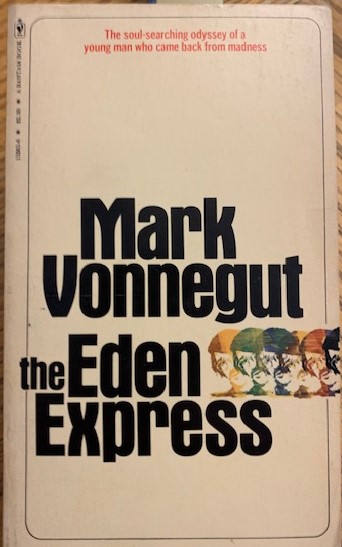
The Stuff: This is a little hard to read. It begins after (Mark) Vonnegut graduates from college and sets up a hippie commune in British Columbia with some friends. He starts showing symptoms of mental illness, but hippies take care of their own. One of the standout quotes is, “Knowing that you’re crazy doesn’t make the crazy things stop happening.” The narrative dances on the edge of what is real and what maybe isn’t. Vonnegut’s father eventually commits him to a mental hospital. Vonnegut writes frankly, giving the reader an inside-looking-out at experiencing a breakdown. This is chilling and frightening but not despairing.
Bio: Mark Vonnegut (b. 1947) is the son of the late Kurt Vonnegut. He is a pediatrician and memoirist. Among his books are Just Like Someone Without Mental Illness Only More So (2010) and The Heart of Caring: A Life in Pediatrics (2022).
Title: The Eden Express: A Memoir of Insanity
Author: Mark Vonnegut (b. 1947)
First published: 1975

