
Plot:
Journalist Alex is meeting a whistleblower named Burke in a parking lot. He has a tale to tell about government abuse, not just of people but also of history. Understandably, he is nervous. He starts babbling, telling her that before he worked in government, he worked in advertising. Alexa, understanding how anxious he is, lets him babble.
Alex asks, “What would the Government do if they knew you were talking to a journalist?” “If I were lucky, they would kill me,” Burke tells her.
Thoughts:
Maybe I’ve just gotten jaded, but this one was too predictable for me. The foreshadowing was about as subtle as a sledgehammer. I saw the tired X-Files trope of the government as some sort of brilliant master arch-villain behind the scenes, controlling everything. Unfortunately, the U.S. government functions about as efficiently as a group of quarreling grade-schoolers at recess. It’s only gotten worse in the last four years, with a dim-witted bully in charge, but that’s beside the point.
On the other hand, it is fun to speculate, as this story does, what might have happened if certain people had died sooner or lived longer than they did in history. And what did the government do to Abraham Lincoln? Author McGrance avoids the obvious here—Hitler doesn’t die in a tragic streetcar accident on his way home from grammar school one day.
While this story presented the reader with some fun things to think about, I found it disappointing overall.
Bio:
According to his blurb, Christopher McGrane is an Australian author. He has written many pieces of fiction and has received politely worded rejection letters from some of the world’s most prestigious publishers, literary competitions, and dating agencies. Chris’ short stories have appeared in several publications in Australia, the UK, and the US. When Chris isn’t dreaming of literary fame, he has a perfectly sensible office job.
“Erasure” can be read here.
Title: “Erasure”
Author: Christopher McGrane
First published: December 28, 2020, Daily Science Fiction
Review of “The Killer Shrews” (1959)
This is this week’s Saturday night pizza and bad movie entry. We had pizza and fruit with wine the day after a Christmas dinner of tamales, homemade mac and cheese, and half a cornbread muffin, with homemade pumpkin pie for dessert. Life is good. The movie sucked.
Plot:
The opening narration warns the viewer: “Those who hunt by night will tell you that the wildest and most vicious of all animals is the tiny shrew…”
Captain Thorne Sherman (James Best) and pilot Rook Griswold (Judge Henry Dupree) discuss what looks like a storm coming and an expected hurricane. They are delivering supplies to a scientific research team on a tiny, remote island. The team is the only humans on the island. Sherman has just taken over this route.
The island looks gorgeous, but they’re greeted on shore by unhappy-looking three people, one of them carrying a rifle under his arm, pointed at the ground. (Hmmm….) They’re glad to see the supply ship come in.
The senior scientist, that is, the one with the accent, Milo (maybe Marlowe?) Cragis (Baruch Lumet), tells him that once he’s unloaded, he wants Sherman to take his daughter, Ann (Ingrid Goude) with him. Sherman locks eyes on Ann. He says they will not unload that night (… which makes no sense to me…) nor leave because of the coming storm. The man with the gun, Jerry Ferrell (Ken Curtis), flips through the manifest. Sherman tears his eyes away from Ann long enough to ask him if there are dangers on the island. Jerry replies vaguely.
Rook goes back to the boat to take of… something. Sherman tells him if he comes ashore to wear a firearm.
Oh, just slap a red shirt on him.
Ann invites Sherman for a drink, and everyone except Rook heads for the compound. Sherman takes note of the high fence around the entrances. Huh? Are they expecting an invasion? From whom? When he sees a radio antenna on the roof, he asks why they sounded surprised when he told them about the hurricane. Hadn’t they been warned? He’s answered that the radio has been out for a week.
Dr. Craigis explains that they’re self-sufficient—chickens for eggs, cows for milk, etc. Makes you wonder what’s on the supply boat until you see the consumption of booze and cigarettes that soon follows.
Amid far too much alcohol and far too many cigarettes, absent-minded research scientist Dr. Radford Baines (Gordon McLendon) appears with a baby shrew to discuss the latest litter. The shrews are part of research into overpopulation. (hmmm…)
What could go wrong?
Thoughts:
We watched this via Mystery Science Theater 3000. Trying to follow what was going on in this film was complicated not only by the poor audio quality but also by the MST3K gang’s running commentary. The dialogue seems muted against a high noise floor. The result was a lot of “Huh? What?” from the dearly beloved and me. I found a better—but hardly perfect—copy on YouTube. If the reader is interested in watching the film, I recommend going to the YouTube route rather than catching the MST3K version.
When they appear, the giant killer shrews—who only attack at night, except when they’re really hungry—are so obviously dogs (poodles?) in costume—it’s hard not to laugh—with delight, not in derision. (“Here, boy!”) They seem to be running after their prey for fun. I can’t help but wonder if their “victims” had their clothes painted with peanut butter. How many lives could have been saved if they’d only brought a Frisbee?
Later, fake shrews eat their way into the adobe-brick house. (Was adobe really the best choice of building materials for the tropics?) The scientific compound, which has only been there a matter of months, also has a basement.
Ann is not a scientist, so her role in the scientific endeavor is never made clear. She is clearly uncomfortable with whatever is going on with the research, though she loves her father. She also is (or maybe was?) engaged to the gun-toting Jerry. When Sherman appears as her ticket out, she is drawn to him, inviting him not just for the marathon cocktail session but also to dinner. In the meantime, has anybody heard from Rook? This sets up tension between Sherman and Jerry.
The power goes out. The storm hits. You’d think it would flatten the house or at least blow out a few windows, but it amounts to people’s clothes fluttering in the wind when they stand outside the front door.
What eventually saves the brave few is as silly and unworkable as the rest of the movie. And about as convincing as poodles in costumes.
The MST3K crew kept making comments about the old TV show The Dukes of Hazzard, which I never paid much attention to. James Best, who played Captain Thorne Sherman, would later play Sheriff Rosco P. Coltrane on The Dukes of Hazzard. Another TV lawman was played by Ken Curtis: who is probably best known as Festus Haggen of Gunsmoke. Curtis also co-produced, along with Gordon McLendon, this film. There. You can say you saw them before they became famous if you watch this.
I cannot recommend this film. It didn’t make sense to me. Even setting aside the premise of the shrew-breeding program gone bad and the scientists being too distracted and/or self-absorbed to see what horror they’ve unleashed on the world, I just never understood why the people behaved the ways the did. Sure, Sherman is hoping for a little action. But why refuse to unload the boat because a storm is coming? I can understand staying. If conditions are unsafe, why not more concern about Rook? Shouldn’t everyone be busy with storm prep and less occupied getting souced and chasing tail?
Title: The Killer Shrews (1959)
Directed by
Ray Kellogg
Writing Credits
Jay Simms…(original story)
Jay Simms… (screenplay)
Cast (in credits order)
James Best…Thorne Sherman
Ingrid Goude…Ann Craigis
Ken Curtis…Jerry Farrell
Gordon McLendon…Dr. Radford Baines
Baruch Lumet…Dr. Marlowe (or maybe Milo) Craigis
Judge Henry Dupree…’Rook’ Griswold
Alfredo de Soto…Mario (as Alfredo deSoto)
Released: 1959 (UK)
Length: 1 hour, 9 minutes
Review of “Echo Volume 1: Approaching Shatter” by Kent Wayne

Plot:
More than a thousand years before the action of this book, the earth was abandoned because of environmental degradation, and humanity settled on the earth-like planet of Echo. Echo has stagnated, its citizens living under the autocracy of the Regime. There is perpetual civil war with the Dissidents. The military is highly developed, with specialized, lethal weapons. Additionally, its soldiers are also specialized and are offered enhancements.
One of those soldiers is Atriya, a member of the elite Crusaders unit. He trains for fun. The reader is told about Atriya:
“He embraced the pain. In a way, he was addicted to it. Not the pain itself, but the validation it gave him.”
One day, as he is out running, he comes across a Crusader (or “Crew”) Selection class. Part of the class is punishing those who fall behind (“stragglers”) with severe physical abuse and humiliation. The instructor, Clement (hmmm… an odd name for a character in that job….), recognizes Atriya as “Crew” and asks if he’d like to join in the abuse.
The ritual is nothing new to Atriya, but he finds himself unable to take part.
Thoughts:
I have to start by saying that this is not a genre that I usually read. I follow the author’s blog because I find him interesting. The book was offered as a freebie one day, and I thought I’d try it out, thinking f I could not give it a positive review, I would simply not review it. Happily, that was far from that case.
I do have to add that the language is, as one might expect, something other than dinner table polite. Given the genre, dinner table polite would be inappropriate.
The great strength of this book for me was the character of Atriya. The author makes him real, even in this dystopian sci-fi environment. As a reader, I easily became invested in him, although I have little in common with him. Atriya is violent and can and does kill without compunction, but something else bubbling to the surface, something he can’t grasp just yet.
He goes to seek advice from a chaplain, another Crusader, a woman named Verus. I suspect that Wayne is familiar enough with the Classical world to know that “verus” means “true” in Latin. (A purist might bellyache it’s for masculine nouns, of course.) Verus herself seems something of an enigma. Atriya understands this. She is a chaplain, but she is not overly religious. One overdone aspect of the character is she seems to be something of a prophet. She foresees Atriya leaving when he has no reason to leave.
Their relationship is platonic. As a matter of fact, unlike so much of this sort of writing, there is no sex. Atriya does not stop by to toss the sheets with a casual lover or working girl and discuss the meaning of life on Echo. I found the absence of such a hackneyed scene a relief.
However, the reader has to endure some info dumps regarding things like nifty weapons and societal hierarchy. The reader encounters a lot of specialized terminology throughout the book, including the title, which is only explained near the end. There are some gory scenes, including cannibalism.
Tension steadily builds till the end. Atriya manages to annoy the wrong people, who are willing to seek revenge with friends. As a reader, I’m fully there with him. I care. I want to see him succeed. His career is threatened, and his life is in danger. He has limited choices. He decides if this is it for him, he’s going to take as many of them as he can with him.
—Flip the page… the book ends… I mutter words that cast doubt on whether the author’s parents were married—
The first volume, which I admit I did not pay for, includes the first three chapters of the next volume, so the reader gets a good glimpse of what’s to come.
Tricky!
Will I read volume two? Probably. After I wade through some fifty other books, including the one my dearly beloved gave me for Christmas.
All in all, I enjoyed this book.
Title: Echo Volume 1: Approaching Shatter
Author: Kent Wayne
First published: August 7, 2015
Review of “Travelogue of the Perennially Lost” by Wendy Nikel

Plot:
The story is laid out in a series of vignettes that show the lives of a happy couple (who do quarrel) on occasions failing to make it to the destinations they intend. What matters is what they do with once they reach the alternative destination. Miss a concert because the map—or maybe the map-reader—was wrong? They choose not to let the night be ruined. The stars are bright. There’s a cornfield, a blanket, and a CD player—a sorta concert.
Thoughts:
One of the markers of time passing is the change in technology. Remember using a map to drive someplace? Author Wendy Nikel also projects into the future with developing technology and technology that doesn’t exist.
Nikel uses humor, but the story is full of nostalgia and poignancy. At its root, it is a love story. She says a lot in a few words and avoids the maudlin. One mix-up seems rather unlikely, but it is cute.
I generally dislike lists or groups of vignettes, but this one told a coherent story and stuck to its theme without appearing forced. I liked it.
Bio:
According to her blurb, Wendy Nikel is a speculative fiction author with a degree in elementary education, a fondness for road trips, and a terrible habit of forgetting where she’s left her cup of tea. Her short fiction has been published by Analog, Beneath Ceaseless Skies, Nature, and elsewhere. Her time travel novella series, beginning with The Continuum, is available from World Weaver Press. For more info, visit wendynikel.com.
The story can be read here.
Title: “Travelogue of the Perennially Lost”
Author: Wendy Nikel
First published: Daily Science Fiction, December 21, 2020
Review of “The Invisible Woman” (1940)
The movie for this week’s Saturday pizza and bad movie night was extremely silly. The pizza was yummy.
Plot:
Wealthy playboy Richard Russell (John Howard) is bothered by little—until his lawyer tells him he is broke. He regretfully has to turn down a request for $3000 from an eccentric scientist friend, Professor Gibbs (John Barrymore) he’s been underwriting for at least a decade. This, in turn, sends Gibbs to the classified ads department at the Daily Record, the local newspaper. He asks to change his ad, which reads:
Wanted—A human being willing to become invisible. $3000. remuneration
He crosses out “$3000,” writes “NO,” and hands the paperwork back to the clerk.
Later, Russel stops by Gibbs’ place to shamefacedly explain why he can no longer underwrite his experiments. He’s going fishing with George, his butler (Charles Ruggles). Gibbs pulls him inside. This time, things will work!
He and Russell read the responses to the ad with chagrin. Gibbs can’t understand why people view him as a crackpot. One letter is from a man offering money to make his wife disappear! He’s delighted to receive a serious response from one “K. Carroll,” and instructs his housekeeper, Mrs. Jackson (Margaret Hamilton—recognizable without flammable broomstick or green skin), to let him know when she arrives.
K. Carroll is, in fact, Kitty Carroll (Virginia Bruce), a model who has her own reasons to become invisible. She explains this to her patient landlady, Mrs. Patten (an uncredited Kitty O’Neil), who gently reminds her she’s behind on the rent before telling her not to be late for work.
She arrives two minutes late, and her boss, Mr. Growley (Charles Lane), docks her an hour. He also threatens to fire another model, who “has a cold in her head.” Kitty then resolves to do with her invisibility. “I’d kick him right in the pants,” she mutters.
However, Kitty isn’t the only one who wants to become invisible. Gangster Blackie Cole (Oskar Homolka), currently in hiding in Mexico, is getting homesick. The only way he’ll ever make it back home is if the law can’t see him. He sends his gang to steal the professor’s machine, not realizing that he needs an injection to make it work correctly. One member of his gang, Frankie, is played by Shemp Howard of Three Stooges fame. Blackie might have to wait a while for that machine.
Thoughts:
This is the third in Universal’s Invisible Man series (TheInvisible Man (1933) and The Invisible Man Returns (1940)) and a departure from the earlier horror films. It is a screwball comedy/lighthearted romance and not to be taken seriously.
In the opening scene, George, Richard Russell’s long-suffering butler, who hands in his resignation regularly, trips on an empty champagne bottle left on the staircase and tumbles down the stairs. That had to hurt.
Later, as Russell is writing his note denying the request for $3000 to the professor, George, who can’t stand the professor, leans over his shoulder. Russell objects.
Richard Russell: Stop breathing down my neck.
George: It’s the breath of pleasure, sir. And perhaps a touch of garlic.
Of course, Kitty is a model. It gives the audience a reason to see her removing her top and seeing her in her slip. At Professor Gibbs’ lab, she’s given explicit instructions on the necessity of disrobing. Mrs. Jackson acts as “chaperone.” Kitty is behind a translucent barrier, throwing her clothes out. Her outline is not visible. There is no nudity, only the verbal suggestion of it.
Later, at Russell’s cabin, when she complains about being cold while invisible and nude while her clothing is still drying, she wonders how “the nudists” do it. Russell calls her a nuisance, “a female nuisance.”
Yet, when the gangster goon, “Foghorn” (Daniel MacBride), steps into the machine, he doesn’t even remove his hat. Maybe it’s not as enticing to think of him throwing his clothes at people and running around in the buff, but a little consistency here, okay?
The special effects are nothing today but were state of the art. The film was nominated for an Academy Award in 1942 for Best Special Effects. The audience could watch as glasses of brandy filled themselves from a bottle and tipped themselves backward as if someone were drinking them. Footprints appeared where no one walked. A dress, with no one in it, paraded before an audience, sending patrons scattering. And bad guys—who really needed better security—were discomfited.
There are no belly-laughs in this movie, but it is cute, sexist attitudes aside. The best parts are in the dialogue one-liners. This is fun if the viewer accepts it for what it is: a silly romp from 1940.
Title: The Invisible Woman (1940)
Directed by
A. Edward Sutherland
Writing Credits
Curt Siodmak…(original story) (as Kurt Siodmak) &
Joe May…(original story)
Robert Lees…(screenplay) &
Frederic I. Rinaldo…(screenplay) (as Fred Rinaldo) &
Gertrude Purcell…(screenplay)
Cast (in credits order)
Virginia Bruce…Kitty Carroll
John Barrymore…Professor Gibbs
John Howard…Richard Russell
Charles Ruggles…George (as Charlie Ruggles)
Oskar Homolka…Blackie Cole (as Oscar Homolka)
Released: December 27, 1940
Length: 1 hour, 12 minutes
Review of “Optic Covenant” by Katherine Ley

Plot:
There really isn’t a plot to this flash fiction piece. It’s a portrait of a person held captive by a robot who loves him. (I use “him” for the sake of simplicity. The character’s sex is never indicated.) It’s for his own good that he’s tied to a chair and fed spoiled Brussels sprouts. ICK.
The bulk of the piece is the human contemplating his escape. The final line is the character’s single regret.
Thoughts:
The narrator wants to disable the robot and run away. He is intimately familiar with robot anatomy and imagines in gory detail the damage he wants to inflict, but there is no expression of hatred. There is no wish to see the robot suffer, even if that were possible. The reader senses no anger, only a desperate need to get away for self-preservation. When he tries to negotiate with the robot during an imagined dialogue, the reader understands they’ve had this conversation before. His options are limited.
I appreciated this skillful portrayal in so few words. The author knows how to create a work showing complex and convincing emotions in a remarkably small space. I just didn’t care for the piece—a personal preference.
Bio:
There was no author’s blurb attached to this story, but I did find this on the author’s website:
Katherine Ley was born in Santiago, Dominican Republic and raised in NYC, NJ, and MD. She graduated from the University of Maryland, College Park with a B.S. in Criminology and Criminal Justice, and a Minor in English. She is an alumna of Voices of our Nations (VONA) and the Hurston/Wright workshops.
Katherine is a speculative fiction writer, and is currently working on her first science-fiction YA novel set in the Caribbean. Fun fact: Katherine Ley is a pen name in honor of her Afro-Dominican and Chinese heritage. Contact her at katherine@katherineley.com.
This story can be read here.
Title: “Optic Covenant”
Author: Katherine Ley
First published: Daily Science Fiction, December 14, 2020
Review of “The Return of the Vampire” (1943)
This is this week’s Saturday pizza and bad movie entry. The pizza was good if the movie was lukewarm, but it was nice to see a suitably menacing Bela Lugosi with Svengoolie.
Plot:
The opening scenes show a wide-eyed young woman (uncredited Jeanne Bates) backing away from some threat. Next, the viewer sees a creepy, foggy cemetery. Two crows caw, but they sound more like seagulls. A sign lying on the ground alerts the viewer they’re entering Priory Cemetery.
An unseen narrator announces, “This is the case of Armand Tesla, vampire, as compiled from the personal notes of Dr. Walter Saunders, Kings College, Oxford. The following events took place on the outskirts of London toward the close of the year 1918.”
A man with a wolf’s head and hands (Matt Willis), carrying a bundle under one arm, walks toward a mausoleum while looking over his shoulder.
Inside the mausoleum, he says, “Master, it’s night again. Beautiful, dark silent night with the fog creeping in. It’s time for you to awaken. It’s time for you to go out.”
A hand wearing a ring appears from under an opening coffin lid. The viewer sees only the vampire’s shadow on the wall.
From seemingly out of nowhere, a voice with an Eastern European accent says, “Andreas, you will tell me what has transpired during the hours of light.”
The werewolf Andreas assures his master she is still alive and in Dr. Ainsley’s Sanitarium. As if they could ever figure out what’s wrong with her, heh-heh, heh-heh!
The vampire stalks off, his face obscured by the high collar of his cloak.
At the sanitarium, Dr. Ainsley (Frieda Inescort) is consulting with a Dr. Saunders (Gilbert Emery) on the puzzling patient, Miss Northcutt. Her blood shows no signs of anemia, yet she exhibits all the most severe symptoms of it.
Saunders has other ideas. He’s been reading an account regarding vampires, written by a Romanian mad scientist, Armand Tesla, who died in the eighteenth century.
The vampire, frustrated at not finding Miss Northcutt alone, attacks Dr. Saunders’ daughter Nikki, a child.
After convincing a skeptical Dr. Ainsley about the reality of vampires, the two search for the vampire’s grave. Footprints in Priory Cemetery leads to a coffin in the mausoleum. They drive a spike—not a wooden stake—through the inert bloodsucker. The wolfman is released from his curse.
Years pass, and another war breaks out. Nikki Saunders (Nina Foch) is all grown up and engaged to Dr. Saunders’ son, John (Roland Varno).
Dr. Saunders has been killed in a plane crash. His manuscript, describing how he and Dr. Ainsley drove a spike into the heart of a vampire, works its way to one Sir Frederick Fleet, chief commissioner for Scotland Yard (Miles Mander). He insists on exhuming the body of this man with the intent of charging Lady Ainsley with murder.
What bad timing. She’s got a wedding to plan, after all. The ex-wolfman now works as her assistant. To top it off, she’s expecting Dr. Hugo Bruckner, who has lately escaped from a Nazi concentration camp, to arrive courtesy of the underground. As they’re discussing things, the air raid sirens go off. “Jerry” comes to call.
The Priory Cemetery is bombed, disturbing the unmarked grave of the vampire. When Civil Defense workers (Billy Bevan and Harold De Becker, both uncredited) later come to set things right, they find a guy with a piece of metal sticking out of his chest. They can’t rebury him like that and pull the spike out.
It just goes to show—you can’t keep a vampire down.
This might have been gruesome or maudlin, but it is offered as comic relief. As unlikely as it sounds, it works, chiefly because of the two actors playing the Civil Defense members.
Thoughts:
The creepiness of the opening sequences is nice. The viewer doesn’t see Bela Lugosi’s face for a while, but his voice is unmistakable. This adds nicely to the suspense and to the eerie atmosphere.
The werewolf Renfield was hard to swallow. Wouldn’t he have to be out ripping up people on his own every once in a while? I doubt he’d be satisfied working through flies and spiders the way Renfield did.
The attack on the child Nikki is handled gently. The vampire enters her room while she’s sleeping. She sits up and screams, but the vampire never touches her or approaches her bed. The room fills with fog, an element that follows the vampire around in this film. She later has puncture wounds on her neck, but the viewer never sees him touch the child, nor, indeed, get near her. As an adult, she remembers nothing of the attack, nor knows nothing of her father’s reading in vampire lore.
The escaping Dr. Hugo Bruckner is never seen. He is killed, and the vampire assumes his identity during the Second World War. The vampire’s character is a little disappointing here; he seems permanently in a bad mood rather than cold and calculating. It’s hard to imagine him uttering such classic lines as, “I never drink… wine.”
The character of Jane Ainsley is convincing as a doctor, a mother, and ages nicely. Once persuaded vampires exist, she realizes the evil has to be dealt with and is willing to do so on her own. It follows in a wartime movie that she would be active in the British underground. She is unfazed by the possible charge of murder, knowing she’ll be exonerated, and even leads Sir Frederick to the spot where she and Dr. Saunders buried the vampire twenty-five years earlier. It is only a hole in the ground when they get there, letting Dr. Ainsley know something is amiss.
The movie is not a sequel to Lugosi’s 1931 Dracula. He’s playing another vampire in a film produced by another studio.
I liked a lot about this movie. I wish, though, the Renfield character hadn’t been a werewolf. There just doesn’t seem any reason for that. I wish, also, Lugosi’s character had been more suave and less crabby. I wonder if the non-Svengoolie version of this flick includes a pitch for war bonds.
Title: The Return of the Vampire (1943)
Directed by
Lew Landers
Writing Credits
Griffin Jay…(screenplay)
Kurt Neumann…(based upon an idea by)
Randall Faye…(additional dialogue)
Cast (in credits order) verified
Bela Lugosi…Armand Tesla / Dr. Hugo Bruckner
Frieda Inescort…Lady Jane Ainsley
Nina Foch…Nicki Saunders
Roland Varno…John Ainsley
Miles Mander…Sir Frederick Fleet
Released: November 11, 1943
Length: 1 hour, 9 minutes
Review of “The Sandman” by E. T. A. Hoffmann

This is a classic horror story, first published in 1816 in a collection titled “Nachtstücke” (“Night Pieces”) by E. T. A. Hoffmann, a writer, composer, and caricaturist with a day job as a jurist. It remains one of his most often anthologized works in English—and little wonder. Even if the language is a bit thick to the twenty-first-century ear, and it’s light on the boobs and booms so common in modern stories, this is the stuff of nightmares.
Plot:
The story begins with three undated letters. An oddly omniscient first-person narrator, who identifies himself only as a friend of one of the characters, finishes the tale.
In the letter written to his friend, Lothar, university student Nathanael tells how a recent encounter with a man trying to sell him barometers recalls tragic and terrifying events from his childhood.
Nathanael recounts how, as a small child, he would repeatedly hear “a heavy, slow step come thudding up the stairs” to his father’s room after his mother put him and his siblings to bed. This must be “the Sandman” his mother told them about.
Unsatisfied with his mother’s explanation that the Sandman is just a saying about being sleepy, he asked his sister’s nurse about him. She told him the Sandman punishes children who don’t go to bed by throwing sand in their eyes “so that they start out bleeding from their heads. These eyes he puts in a bag and carries them to the half-moon to feed his own children, who sit in the nest up yonder, and have crooked beaks like owls with which they may pick up the eyes of the naughty human children.”
Want to hire her to babysit your kids?
When he got a little older, Nathanael stayed up past his bedtime one night to see this Sandman for himself by sneaking into his father’s room while the Sandman was visiting. Much to his surprise, he saw a family friend, a lawyer named Coppelius, whom the children found repulsive. He was found out, leading to a violent confrontation, with Coppelius threatening to burn out his eyes. Nathanael’s father prevented this but failed to prevent Coppelius from beating the boy.
His next memory was waking up in his bed being comforted by his mother. She assured him the Sandman had gone and wouldn’t hurt him.
A year later, (Nathanael continues) Coppelius returned. His father promised his mother this was the last time. Nathanael and the other children were hustled off to bed. Sometime around midnight, a sound “like the firing of a gun” rattled the house. His father was killed. Coppelius disappeared.
Until the barometer-dealer appeared, Nathanael writes, he had not seen Coppelius. The man called himself Coppola, but he is sure he is the same Coppelius…
Clara, Lothar’s sister, who is engaged the Nathanael, responds to this letter. Among other things, she tells him that if there is a dark power that follows people, “it must form itself inside us and out of ourselves, indeed; it must become identical with ourselves.” She encourages him to put this Coppola/Coppelius out of his mind. She and Lothar have discussed the matter. Lothar told her, though she doesn’t quite understand (it would be too much for her pretty little head anyway), “It is the phantom of our own selves, the close relationship with which, and its deep operation on our mind, casts us into hell or transports us into heaven.”
He responds (…to Lothar) that she’s right, of course, and resolves to put it all out of his mind. He concentrates on his studies. He mentions the lectures of a professor of physics, Spalanzani: “His name is the same as that of the famous natural philosopher, Spalanzani, and he is of Italian origin. He has known Coppola for years.” Coppelius was German (“though no honest one”), and Coppola is Italian. They must be two different men—right?
He also describes seeing a tall, beautiful woman in a room who doesn’t appear to notice him. She seems to do nothing but sit at a table. Is something wrong with her? Is she simple-minded? Blind, perhaps?
In one stunning scene, he buys a “pocket spyglass” from Coppola after the man has laid out an array of spectacles in his room. The spectacles appear to Nathanael to be eyes in a momentary flash. Later, he uses the spyglass to look at the woman sitting passively at the table and is amazed at her beauty. He never finishes the letter he was writing to Clara.
He learns this is Spalanzani’s daughter, Olimpia, whom he keeps locked away from public view. Nathanael meets her at a coming-out party Spalanzani throws and falls madly in love with her, forgetting Clara entirely.
Spalanzani blesses his attempts at courting Olimpia by saying if he wants to spend time with the stupid girl, he won’t object.
They do not live happily ever after.
Thoughts:
Greater minds than mine have spilled vast quantities of ink analyzing this story. I doubt I will solve mysteries they didn’t. Nevertheless, there are some obvious recurring themes. The first and most prominent are eyes and the visceral fear of losing them.
I remember being literal-minded as a kid. Since little Nathanael hears someone coming after he and his siblings are sent to bed with his mother telling them, “The Sandman is coming,” it makes sense he would think this must be the Sandman. The governess’ story about the Sandman gouging out the eyes of children who don’t go to bed is the stuff of nightmares.
It then follows that when Nathanael stays up past his bedtime, discovers his father’s secret, and a man he already despises threatens to burn his eyes out, he would see this as his punishment for disobedience. Why does Coppelius cry, “We have eyes”? What on earth would he use an extra set for? (Not a rhetorical question).
The next time Coppelius appears, his father dies violently.
A separate and related theme is that Nathanael has trouble telling fantasy from reality. Nothing is as it seems for him. What he thought was a cupboard in his father’s study turns out to be a furnace used for alchemy. After his father’s death, he never mentions his siblings, only Lothar and Clara, who are distant relatives his mother took in after misfortune struck that part of the family. Marrying a cousin isn’t done anymore, but this was some two hundred years ago.
How much of that unfathomable world is of Nathanael’s own making? This question is never fully resolved. That, I think, adds to the horror of the story. Was Nathanael crazy? He certainly had moments of clarity, moments of uncontrollable violence, and moments of insanity. Was there an evil force out to destroy him? It becomes clear late in the game that Coppola and Coppelius are the same person, but what motive would he have for harassing Nathanael? This, too, is never answered.
Nathanael looked through the spyglass at Olimpia—who wasn’t even alive and couldn’t talk—and saw the perfect woman. He looked through the spyglass at Clara—who had the moxie to talk back to him—and called her a “wooden doll.” Is this inability to perceive reality a property of the spyglass or something innate in Nathanael? Or is his inability to perceive reality a result of deliberate deception?
One of the heavyweights who have analyzed this story is Sigmund Freud. In a 1919 essay titled “The Uncanny” (German, “Unheimlich”), he uses the story as an example to rebut a 1906 article by Ernst Jentsch, who saw the uncanny as a “lack of orientation.” Freud uses “The Sandman” as an example where the uncanny is not a lack of orientation, but a sublimated castration complex expressed as fear of losing one’s eyes.
Granted, I’m not a psychologist, but I think this says more about Freud than it does about the story. In my not quite humble opinion, the story is about the horror that arises when one is not able to trust the reality of the world. Is the Sandman a harmless fairy story or a punishment for disobedient children? Is Nathanael unable to release this childhood fear because it is entwined with his father’s death, or does some evil actually seek to destroy him?
It is difficult to dismiss Nathanael as merely insane with moments of clarity, a victim of a childhood trauma he cannot overcome, or (as was fashionable at the time) simply of weak moral character. He is traumatized, and the trauma is disregarded by those he is closest to. Since childhood, he has blamed Coppelius for his father’s death. Now, Clara tells him his father may be to blame for his own death.
Perhaps this is why he feels an affinity for a “wooden doll” (Olimpia) who has no feelings. At the same time, he is repulsed by a human (Clara) he sees as having no feelings for him despite her love for him. Neither she nor Lothar understands his trauma, and both regard his broodings as something he should just stop, although they care for him. When Nathanael writes a bizarre, prophetic poem, Clara tells him to throw it in the fire. On the other hand, Olimpia can listen to him read his writings for hours without interrupting him. She doesn’t knit during his readings or pause to pet the cat. What an appreciative audience!
The problem is Olimpia isn’t real. There is irony here and some humor, but that pales compared to Nathanael’s shock when he discovers Olimpia is not human.
I believe the horror—and the durability of the story—lies in its ambiguity.
My two cents’ worth.
Bio:
Born in Königsberg in 1776, then in the Kingdom of Prussia (present-day Kaliningrad, Russian Federation), author E. T. A Hoffman studied law. Additionally, he was a caricaturist, writer, composer, and critic. One of his works, “The Nutcracker and the Mouse King,” was the basis for the familiar “Nutcracker” ballet by Pyotr Ilyich Tchaikovsky.
The story can be read here.
A kindle version for $1.99 is available here.
Title: “The Sandman” (Originally “Der Sandmann”)
Author: E. T. A. Hoffmann (Ernst Theodor Wilhelm Hoffmann) 1776-1822
length: novelette
First published: 1816, in the collection Nachtstücke
Review of “Cold War” by Ike Lang
Plot:
A broadcast appears unbidden across all screens, addressing the citizens of earth. An elderly man appears in full military uniform, medals and insignias across his chest. At his side stand four other men, also in military uniform, though their uniforms differ from his.
“In early February, 1945,” he tells his audience, “our scientists picked up an incredibly dense object traveling at near light speed on a trajectory that would take it through our solar system.” He speaks calmly, unemotionally, with an accent from the southern United States.
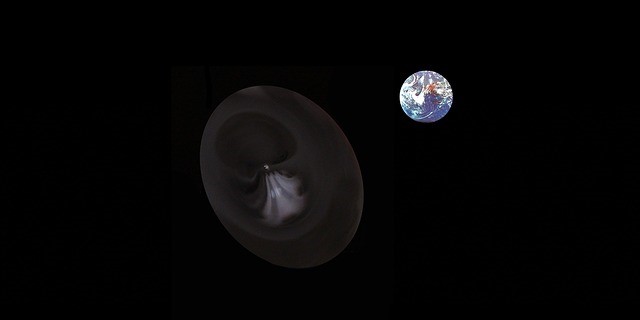
They later determine the anomaly to be a micro black hole. It would come close enough to perturb the orbit of the earth. There is even a small chance it could drive it from the solar system altogether.
“That being said, we haven’t just been sitting on our hands this whole time,” the man says.
Thoughts:
Curiously, this story contains an editor’s note that it is fiction: “I have been shocked the past four years by what millions of people are willing to believe, so I feel compelled to make clear: this is fiction.” I read this is a political statement, at least in part, and can sympathize. The story is not overburdened with verisimilitude but gives a whiff or two of a grand conspiracy theory.
For the most part, the narrative is written in second person, which is jarring, particularly in one area where the narration occurs between two blocks of quotes from the military man. Who is the “you” addressed?
Could anyone detect a black hole in 1945, let alone moving relative to the solar system? If it did, indeed, disturb the earth’s orbit, wouldn’t it disturb the orbits of the other planets? Wouldn’t objects in the asteroid belt start hopping around, particularly the smaller ones? Wouldn’t the moon start acting strangely? And why wouldn’t astronomers notice any of this?
Let me set those objections aside for the moment. The author reveals his mystery at a nice, enjoyable pace. Who are the military men? Why are they broadcasting to everyone on earth? Are they aliens? They don’t sound like aliens. Why does the broadcast look so dated?
I admit to second-guessing the author. I took a brief tour via Google. In 1945, black holes were still theoretical, predicted in Einstein’s general theory of relativity in 1916, but not named until 1967 by John Wheeler, an American astronomer. The story isn’t given a specific time frame, however.
Having said all that, I really liked “Cold War.” I enjoyed figuring out was going on. Even the title has multiple meanings, and the last couple of lines bring it all home. Technical improbabilities can be forgiven.
Bio:
According to his blub, author Ike Lang stays awake at night wondering where all the aliens are. He graduated from the University of Iowa and lives in New York. This is his first published story.
Congrats, Ike.
The story can be read here.
Title: “Cold War”
Author: Ike Lang
First published: December 7, 2020, Daily Science Fiction
Review of “Earth vs. the Spider” (1958)
This is this week’s Saturday pizza and bad movie night movie. The pizza was good, the movie was hokey.
Plot:
In the opening sequences, a man (Merritt Stone) drives down a lonely road at night. He opens a small jewelry box containing a bracelet and a note: “To Carol with Love, Dad.” Something ahead startles him. An object hits the windshield, and his face is bloodied. The viewer hears his truck crash.
In the morning, high school (?) student Carol Flynn (June Kenney) walks to school. Her boyfriend, Mike Simpson (Eugene Persson), meets her and gives her a birthday present, which she refuses. She tells him her father didn’t come home the night before, after going out to buy her a birthday present. Later, during (…and this is important…) a Jacob’s ladder demonstration of electricity in physics class, they pass notes and make up. She talks him into borrowing a car from a friend, and they drive along the route her father took the night before.
Oh, and the things they find…!
The first odd thing is a rope about as thick as the rope they use to climb in gym class lying across the road. Unlike that rope, however, it’s sticky. Mike finds bits of shattered windshield. Carol finds the box with the bracelet and the note from her dad. Could he be…?
Other clues, including Mr. Flynn’s wrecked truck, lead them to a cave entrance with a sign that reads:
Danger
No trespassing
Do not enter
Well, there’s only one thing to do here.
Without flashlights, they have to rely on the usual magical movie cave light. Carol calls for her father, knocking loose a gigantic stalactite. Gallantly, Mike shoves her out of the way before it smashes down to the floor where she was standing. Not far ahead, they find (gulp) human skeletons.
Deep in the cave, they come across a net strung across a shallow cavern. Like the rope in the road, it’s sticky. While they are examining it, they hear a noise. A tarantula (later identified as a “bird spider”) the size of a city bus crawls out of a crevice and approaches them. They flee, and the tarantula breaks off the attack.
Professor Kingman (Ed Kemmer), his wife Helen (Sally Fraser), and Mike’s dad (Hal Torey) discuss the events in the Kingmans’ living room. It seems the sheriff didn’t believe the kids when they tried to talk to him about a giant spider in a cave. (I don’t know. Maybe they should have mentioned Mr. Flynn’s wrecked truck?) Kingman’s assessment of the “rope” is that it is… silk. Mr. Simpson feels strongly enough about the situation—Jack Flynn is still missing, after all—he calls the sheriff himself and catches him playing checkers with a deputy.
Thoughts:
We watched this via Mystery Science 3000. As usual, the remarks were often funny but mostly just goofy. Sometimes they obscured the movie dialogue, which I found annoying even if no major plot points were lost.
Okay, a giant tarantula in a cave is sucking people dry. I suppose one can’t expect reality, but the thing I found creepy—and not in a good way—about the movie was its odd portrayal and often dismissal of human feelings and relationships. For example, after the search party, including Carol and Mike, finds the desiccated corpse of Jack Flynn (I trust I give nothing away here), Carol is home crying on the couch. Her mother comforts her. The poor woman has just lost her husband, and she is comforting her daughter as if the tragedy were something only Carol suffered.
Later, when the spider goes on a rampage in town, knocking over cars and so on, there’s a single shot of a baby sitting alone in the middle of the road with blood on her face, crying. This even provoked a rare quasi-sympathetic comment from the MST3K crew.
No effort is made to find the identity of the skeletons in the cave—granted, a tall order in 1958. No one even mentions missing persons reports.
On the other hand, it was fun watching Mike and Carol cruise along in the borrowed two-seater convertible with white walls. It was fun watching some of the “kids” dance in the auditorium with a band playing where the authorities stored the supposedly expired spider. Earlier, one official inspecting the corpse got whopped and knocked down by a twitching leg. Sure it’s safe to keep it there, under lock and key!
I can’t say this movie is irredeemable. It’s just so odd in so many respects that it was hard to suspend disbelief. While there are fun parts, I could not go along for the ride.
The movie can be watched with MST3K here:
without MST3K here:
Title: The Spider (original title Earth vs. the Spider) (1958)
Directed by
Bert I. Gordon
Writing Credits
László Görög…(screenplay) (as Laszlo Gorog) and
George Worthing Yates…(screenplay)
Bert I. Gordon…(story)
Cast (in credits order)
Ed Kemmer…Professor Art Kingman
June Kenney…Carol Flynn
Eugene Persson…Mike Simpson (as Gene Persson)
Gene Roth…Sheriff Cagle
Hal Torey…Mr. Simpson
Released: September 1958
Length: 1 hour, 13 minutes
 Reviews of Old and New Stories. Mostly Old