Plot:
There isn’t a plot to this one. The narrator is reacting to a November 1980 article he (?) read, presumably in 2019, about occupations that became obsolete in the twentieth century: switchboard operator, elevator operator, iceman, cigarette girl, and pinsetter. The narrator and generations of his family have followed one now-obsolete occupation—yeah, thanks very much, modern technology!— which was once invaluable to humanity and for which they are uniquely qualified.
Thoughts:
As for obsolete jobs, I worked as a switchboard operator for some years after the putative article was written. I had to spend a couple seconds thinking about what a pinsetter is. Was.
In the narrator’s case, it’s not merely a matter of learning new skills and getting a new job. The family has a unique talent for obtaining material necessary for human life, yet it’s no longer needed.
Times change. Memories fade.
This tale is short, all leading up to a single punchline. I liked it.
Bio:
According to his blurb, author Don Nigroni received a BS in economics from Saint Joseph’s University and a MA in philosophy from Notre Dame and worked as an economist for the US Bureau of Labor Statistics. He has been published in Ambit, Asymmetry Fiction, Mystery Tribune, 365 tomorrows, and 50-Word Stories. In addition, his poetry has appeared in Candelabrum and Mystery Time.
The story can be read here.
Title: “Oblivious Obsolescence”
Author: Don Nigroni
First published: October 9, 2020 Theme of Absence
Review of “The Capes We Wear” by Avra Margariti

Plot:
Wonderboy, with his sidekick (and uncle), the Shield, defends Trafalgar Square against an attack of flying robot monkeys. One of the monstrosities bites Wonderboy, who calls out to his Uncle Elijah before he blacks out.
The Shield removes a glove and blasts the monkey into oblivion. He sees the attack as the sloppy work of the Twisted Twins, the latest supervillains to arise.
He sighs, picks up Wonderboy, and brings him home to the lab. He has an antidote to the robot monkey venom. Long ago, he developed it.
Thoughts:
Elijah narrates the tale. For much of the story, it’s as if he were speaking to his nephew, whose given name is Nico.
The opening paragraphs are a little confusing. It took a second reading for me to get my bearings as to what was going on. The story pokes a little fun as superhero tropes. It does not, however, denigrate them. This is not satire. It seems to primarily address the redemptive power of love.
Bio:
According to her blurb, author Avra Margariti is a queer Social Work undergrad from Greece. She enjoys storytelling in all its forms and writes about diverse identities and experiences. Her work has appeared or is forthcoming in Flash Fiction Online, Lackington’s, Vastarien, Asimov’s, and other venues. Avra won the 2019 Bacopa Literary Review prize for fiction. You can find her on twitter @avramargariti.
The story can be read read here.
Title: “The Capes We Wear”
Author: Avra Margariti
First published: October 5, 2020, Daily Science Fiction
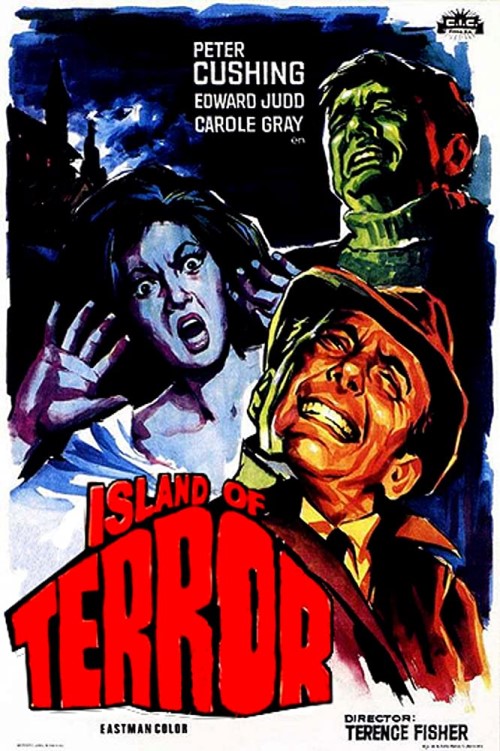
Review of Island of Terror (1966)

As promised, monsters and cheesy specials effects. Saturday night pizza and bad movie night with Svengoolie.
Plot:
On isolated Petrie Island off the Irish coast, Mrs. Bellows (Joyce Hemson) notices her husband Ian (Liam Gaffney) hasn’t come home. She contacts Constable John Harris (Sam Kydd) and asks him to go look for him.
Meanwhile, oncologist Dr. Lawrence Phillips (Peter Forbes-Robertson) is holed with his research team in a laboratory in a castle on the island. Dr. Phillips is hopeful they’re on the verge of discovering a cure for cancer.
Constable Harris finds what remains of Ian Bellows in a cave. There doesn’t appear to be a mark on him. He is, however, missing every bone in his body.
Suitably spooked, the good constable turns to physician Dr. Reginald Landers (Eddie Byrne), who is dumbfounded. Dr. Landers goes to the mainland for a specialist, Dr. Brian Stanley (Peter Cushing). Stanley further complicates things by seeking out brilliant Dr. David West (Edward Judd).
Stanley and Landers arrive at West’s place while West is entertaining a lady friend, Toni Merrill (Carole Gray). She volunteers the use of her daddy’s helicopter in return for the privilege of tagging along.
Once they reach the island, they learn the helicopter must fly back to the mainland, effectively stranding everyone there for several days.
What could go wrong?
By this time, farmers have started to lose livestock. The assembled doctors decide to contact the research team in the castle to seek their assistance. Stanley knows Phillips.
Unfortunately, the whole team is dead, deboned. It looks like there was a struggle.
Thoughts:
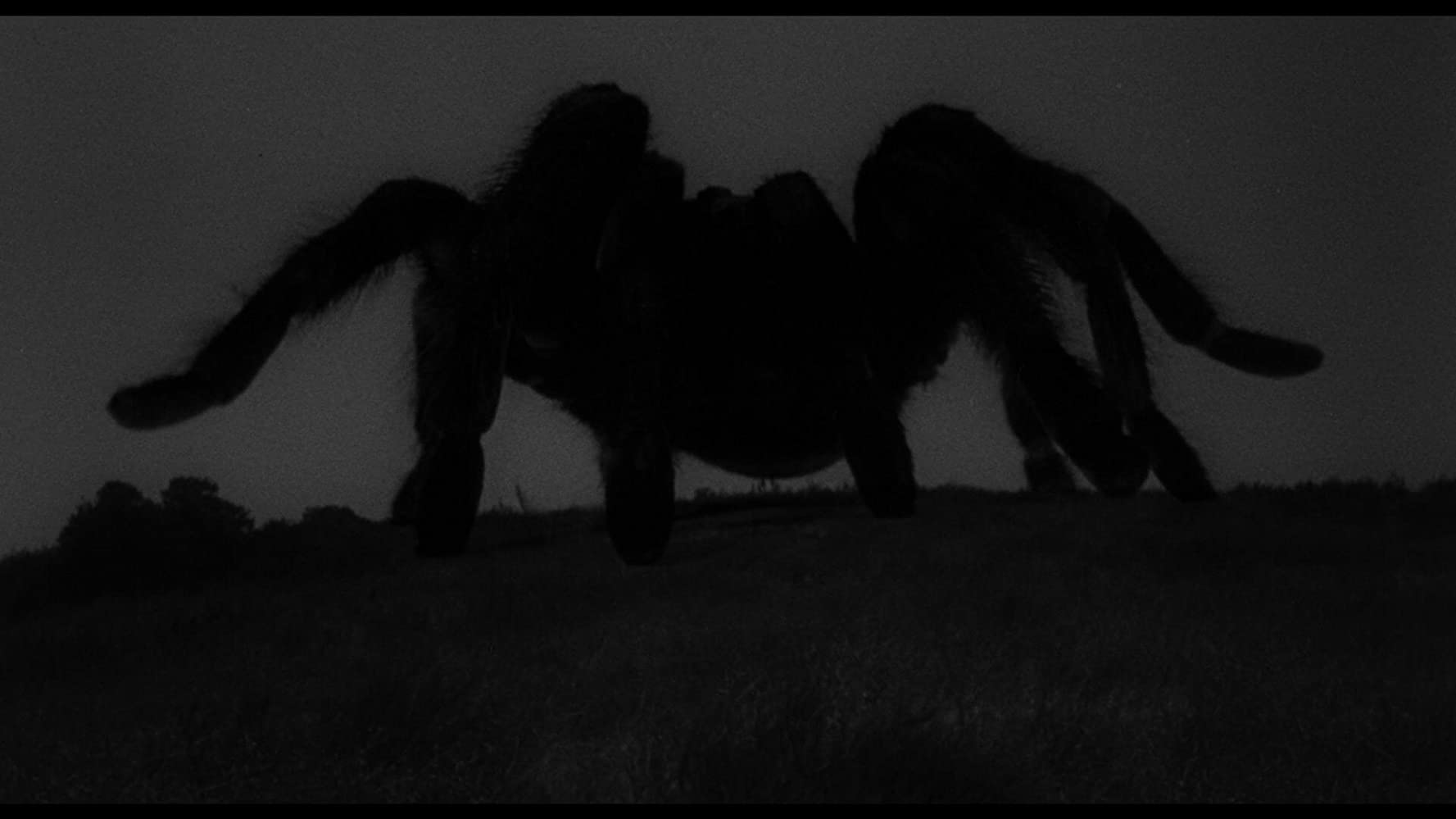
The monster accidentally created by the cancer research team is a silicon-based life form, originally designed to destroy cancer cells. Instead, it develops a taste for calcium phosphate. The monster bears an uncanny resemblance to the silicon-based rock monsters of “The Devil in the Dark” episode of the original Star Trek series, a ground-sweeping lump of amorphous lava-ish goo. The movie monsters, called “silicates,” differ in appearance by having a single tentacle to attack prey. The silicates are also nearly indestructible and reproduce by fission. Dr. Landers learns to his dismay that axes do nothing. Later, the viewer sees them brush off Molotov cocktails and even dynamite. They can climb trees—somehow.
I could find no connection between Star Trek and this movie. The only Petrie Island I could find was in Ontario, Canada. Unless the whole island immigrated, I’d hazard a guess the name is fictional. Nevertheless, it’s a good name, given the goings-on
This has a rather high body count for a sci-fi/horror flick. The discovery of poor Ian Bellows occurs early. It’s just a rubber suit with clothes, but Constable Harris’ reaction serves to add the horror. What can he tell poor Mrs. Harris? What could cause such a thing? Later, the viewer sees a sinister tentacle.
A scene late in the movie has the townspeople gathered in the city hall, awaiting the onslaught of the creatures. The important men of the village have told the villagers they will be safe here. Probably. The offensive measures they’ve worked against the creatures might take a while to take effect. All the usual horror movie happenings occur: glass breaks, silly women scream, those-who-didn’t-listen meet their well-deserved fate, and our heroes prevail, broken but unbowed. It was a lot of fun.
One fly in the ointment was the character of Toni Merrill, Dr. West’s girlfriend. We first see her wearing nothing but a man’s shirt. Oh, dear. What has been going on? No, not that. Clumsy Dr. West spilled wine on her dress, and it’s hanging in the bathroom to dry.
Later, she provides the helicopter that allows them to get to the island. She’s pretty useless once they arrive. Dr. West assigns the job of calming the villagers in the city hall, and she nurses Dr. Stanley when he’s wounded, but aside from that, she’s the stereotypical hysterical female in the face of danger, who imperils those around her. She clings to the lapels of the menfolk like a piece of lint. ARGH.
Overall, I enjoyed this movie notwithstanding its flaws. It was fun.
Title: Island of Terror (1966)
Directed by
Terence Fisher
Writing Credits
Edward Mann…(original story) (as Edward Andrew Mann) and
Al Ramsen…(original story) (as Allan Ramsen)
Edward Mann…(screenplay) (as Edward Andrew Mann) and
Al Ramsen…(screenplay) (as Allan Ramsen)
Cast (in credits order)
Peter Cushing…Dr. Brian Stanley
Edward Judd…Dr. David West
Carole Gray…Toni Merrill
Eddie Byrne…Dr. Reginald Landers
Sam Kydd…Constable John Harris
Released: February 1, 1967
Length: 1 hour, 29 minutes
Review of “On Tyranny: Twenty Lessons from the Twentieth Century” by Timothy Snyder

I’ll say first the title is a little misleading. It should be “Against Fascism.”
This is a quick read, some 130 pages in print, apparently intended in its size and format, for the reader to carry in a pocket or purse. The twenty chapters—twenty lessons—boil down to twenty “things to do to be a pain in the ass to Fascists that could actually slow them down.” (A noble endeavor, in my humble opinion.)
Its intended audience appears to be younger people, for whom names like “Mussolini,” “Tito,” and “Francisco Franco,” if they’ve heard of them at all, are little more than names that might ring a bell from a European history book.
The book does not pretend to educate about history or current events in the broad sense, though the author references events as examples of what can go wrong. To cite one case, he describes how the Nazis used the 1933 Reichstag (Parliament Building) Fire to oust their rival Communist Party members from Parliament and clamp down civil liberties. This is an earmark of Fascism: eliminating political rivals and tightening or suspending civil liberties.
“Who set the fire that night in Berlin?” asks Snyder. “We don’t know, and it doesn’t really matter. What matters is that this spectacular act of terror initiated the politics of emergency.”
The Reichstag Fire crisis was more complex than portrayed in the book. Snyder knows this, of course. His point is: beware those who use crises to seize power. Not a bad one at that.
While the book is not a rigorous history lesson, the author attempts to do something perhaps more important, that is, to motivate the readers to educate themselves and take what action they can.
Typical is lesson 11:
Investigate.
Figure things out for yourself. Spend more time with long articles. Subsidize investigative journalism by subscribing to print media. Realize that some of what is on the internet is there to harm you. Learn about sites that investigate propaganda campaigns (some of which come from abroad). Take responsibility for what you communicate with others.
For the old and jaded like myself, this just reads like common sense, and I don’t need anyone to tell me what to read, dagnabbit. I do this sort of stuff all the blessed time. But Snyder isn’t talking to me.
I do have to ask whom he is talking to, though. The engaged know these things already. Will the unengaged read what he has to say?
I hope so. You wouldn’t think we’d be talking about an authoritarian/fascist resurgence in the twenty-first century, but there they are again, like mold on the bathroom ceiling that you have to keep scraping, bleaching, and painting over. If you ignore it, it will only grow, and the roof will come crashing down.
Bio:
According to his blurb, author Timothy Snyder is Housum Professor of History at Yale University and a permanent fellow at the Institute for Human Sciences. He received his doctorate from the University of Oxford in 1997, where he was a British Marshall Scholar. He has held fellowships in Paris, Vienna, and Warsaw, and an Academy Scholarship at Harvard.
His most recent work is Our Malady: Lesson on Liberty from a Hospital Bed.
Title: On Tyranny: Twenty Lessons from the Twentieth Century
Author: Timothy Snyder
First published: 2017
Review of “Kings of the Universe” by Chris Dean

Plot:
Chancellor Dunt has called a meeting with the xenobiologist Andha to discuss a species the Imperium wiped out more than a texacycle earlier, specifically, Homo sapiens. The Imperium is the only power left. Andha doesn’t think much of Homo sapiens. They named their planet “Dirt.” Who does that? And they look like… sea sponges.
Nevertheless, Dunt is seeking Andha’s expertise. Some artifacts have recently been identified as belonging to H. sapiens. It seems they were quite the inventive bunch. Could Andha possibly figure out what these things were for? One item is of particular interest.
Thoughts:
The meeting between Dunt and Andha, although exaggerated, read like so many meetings I’ve sat through it was scary. I don’t recall many with tentacles or eyestalks, moving around, but if I closed my eyes—
After an abrupt scene change, it’s not immediately clear was part one has to do with part two. The mystery is solved up by the time the reader reaches the last line, however.
What holds the reader’s attention is this mystery: what is this object? Why is it important, if indeed, it is important?
None of the characters comes across sympathetic, as quirky and striking as they are. The description of the room where Dunt and Andha meet is brief and off-kilter enough to alert the reader they’re not in Kansas anymore.
While the ending was not a surprise, this was a fun little tale.
Bio:
According to the author’s blurb, Chris Dean travels the American West as a truck driver and adores Yellowstone, the Klamath, and anyplace the sequoias brush the sky. A Chicago native, Chris currently resides in Iowa.
This writer’s work has appeared in Bards and Sages, Page & Spine, and other places.
“Kings of the Universe” can be read here.
Title: “Kings of the Universe”
Author: Chris Dean
First published: Theme of Absence, October 2, 2020
Review of “The Judas Goat” by K.S. O’Neill

Plot:
This visitor tells the story of the Judas goat. It’s not the goat’s fault. It knows no more about radio collars than it does about God or quantum physics. It just knows that it likes to be with other goats.
The goats are invasive on the Galapagos. As bright as men are, they can’t eradicate them. The Judas goat helps.
People like to be with people, too, across the great expanse of space.
Thoughts:
Reading the story got me wondering if Judas goats were real. They are, but not exactly as depicted in the story.
The author’s take on it is more layered. Simply being around other goats brings destruction down on the whole group, but only because goats are destroying the habitat of native species.
While I can’t say I was surprised by the ending of this sad little story, it engaged me to the end. It also brought my attention to something I didn’t know about.
Bio:
Author K.S. O’Neill has had at least four other pieces published in Daily Science Fiction. In a blurb that accompanied earlier work, he said he lives with his lovely wife, the writer Joy Kennedy-O’Neill, on the Texas coast, where he teaches math at a small college.
“The Judas Goat” can be read here.
Title: The Judas Goat
Author: K.S. O’Neill
First published: Daily Science Fiction, September 28, 2020
Review of “Son of Dracula” (1943)

Saturday pizza and bad movie night with Svengoolie. Yum
Plot:
Katherine Caldwell (Louise Allbritton) is teased by her family and long-time beau, Frank Stanley (Robert Paige), about her interest in the metaphysical and all things occult. During a trip abroad, she met Count Alucard (Lon Chaney Jr.) and has invited him to visit her family home of Dark Oak Plantation in Louisiana.
When the day of his arrival comes, his baggage—including two extremely heavy, long boxes—appears on the train, but there is nary a sign of the Count. Katherine asks the servants to put the Count’s things in the guesthouse. She throws a successful reception for the Count, despite the no-show guest of honor. Katherine herself is dismayed. As Frank consoles her, she tells him that whatever she does, it’s all for him.
Later that evening, her father, the Colonel (George Irving), dies of a heart attack. Count Alucard arrives at the door. The servant informs him of the death in the family and that “the family is not receiving.”
The Count roars: “Announce me!”
Upon the reading of the will—not the one that’s been in lawyer’s office, but a more recent one—it’s learned rather than splitting everything, Katherine will inherit Dark Oaks, and her sister Claire (Evelyn Ankers) will inherit everything else. Katherine won’t have to worry about paying the servants because they took off the night the Colonel died, and the Count arrived.
By the way, isn’t that Count hanging around a lot? He and Katherine call on the justice of the peace in the middle of the night. When a distraught Frank visits them, he demands that Katherine annul the marriage. The Count begins to choke him and hurls him into a corner. Frank pulls out a gun and shoots him repeatedly, while Katherine hides behind him. The Count is unfazed. Katherine falls to the ground, dead.
Thoughts:
What does Count Alucard have to do with the Count Dracula the movie title? He kept the same rank, and spelled the name backward. Apparently, he’s deep undercover.
Lon Chaney Jr. plays a menacing vampire. When Frank or various town dignitaries come to check on Katherine’s welfare, he tells them he’s now master of Dark Oaks in tones that brook no argument. He’ll bully anyone, not just servants.
The special effects might strike the 2020 viewer as hokey, but for 1943, they were striking. A bat transforms into Alucard on screen. Alucard dissolves into mist and back again, once even interrupting a conversation the learned Hungarian Professor Lazlo (J. Edward Bromberg) is having describing the abilities and vulnerabilities of vampires. Whip out that pocket cross, Professor!
In many ways, this is an abbreviated retelling of the novel Dracula set in Louisiana of the 1940s without all those interminable letters and diaries. The eeriness of the bayou with its moss-draped trees adds a sinister atmosphere (even if it’s a sound stage) as effectively as any Transylvanian woodland.
Everyone is concerned for Katherine, or Kay as her friends call her. She seems to have come under undue influence of this… Count. Who is he? The Hungarian consulate knows nothing of him. He’s an imposter. But is Kay as innocent as she looks? Frank turns himself into the police for killing her. She’s later seen alive. The authorities then find her quite dead, in a coffin in a mausoleum. Frank’s goose appears to be cooked. Or maybe he’s nuts. He seems to talk to himself in two voices in his jail cell.
Two of the actors who played servants were a brother and sister of Hattie McDaniel, the first black actress to win an Academy Award. (Gone with the Wind). Brother Sam was the lucky servant who opened the door to Count Alucard and sister Ettie was Sarah, a maid to Doctor Harry Brewster (Frank Craven). There just weren’t a lot of roles open to black actors in the 40s.
And hey, there was a war going on. The movie ends with a request to buy war bonds.
While there were some silly things in this movie, and some ooppsies (a hall mirror catches the vampire’s reflection!), this was an enjoyable telling of the tale.
Title: Son of Dracula (1943)
Directed by
Robert Siodmak
Writing Credits
Eric Taylor…(screenplay)
Curt Siodmak…(original story) (as Curtis Siodmak)
Cast (in credits order)
Robert Paige…Frank Stanley
Louise Allbritton…Katherine Caldwell
Evelyn Ankers…Claire Caldwell
Frank Craven…Doctor Harry Brewster
J. Edward Bromberg…Professor Lazlo
Released: November 5, 1943
Length: 1 hour, 20 minutes
Review of “To Many Happy Returns” by Christopher Cosmos

Plot:
Helen lives alone in a small town and hears ghosts all the time. The ghosts are everywhere. She’s sure there are more ghosts than living people. Helping the ghosts move on has become her job.
She and three other people have formed a group. They an LLC and t-shirts that read “Michigamua Paranormal Society.” The townspeople call them “ghost-hunters” and snicker, but that’s not what they are.
One day, her phone rings. She knows it’s the call she’s been expecting. Is she up for this? This isn’t a job.
Thoughts:
The ending is not a surprise, but the t-shirts and the LLC are nice touches.
Offsetting this is the mood of the piece: sad and dreamy. After recounting some of the odd places she’s found ghosts—“an out-of-order tanning salon, a family restaurant, some of the too-many churches”—Helen asks, “Why are there so many there, at the high school?”
The author paints a picture of departed loved ones all around us, just beyond our ability to see and hear. A few sensitive people can reach them. At the same time, something keeps the departed from reaching their final destination. They need help to move on. This makes for a lot of tension and sadness beneath the workaday world.
A sense of isolation also runs through the piece. Everyone is on their own. They may cooperate with other people, but only for mutual benefit for the moment.
Having said all that, I have to admit that I didn’t quite get on the train with Helen. I understood what she was doing—and by the end, understood why—but felt I was watching her rather than I was with her.
This is not a bad story. I wish I’d made a better connection to it.
Bio:
According to his blurb, author Christopher Cosmos was raised in the Midwest and attended the University of Michigan as the recipient of a Chick Evans Scholarship. He’s an author and Black List-screenwriter whose debut novel, Once We Were Here, is set to be published by Arcade and Simon & Schuster on October 28th, 2020. The book is currently available for pre-order, and more information can be found at http://www.christophercosmos.com.
“To Many Happy Returns” can be read here.
Title: “To Many Happy Returns”
Author: Christopher Cosmos
First published: Theme of Absence, September 25, 2020
Review of “The Snow Creature” (1954)

As hot as it’s been lately, it was nice to see some snow, even it was artificial and older than I am. A late entry in to Saturday pizza and bad movie review:
Plot:
Botanist Frank Parrish (Paul Langton) and photographer Peter Wells (Leslie Denison) leave for an expedition to the Himalaya region to explore and document the little-known plant life of the area. They hire ten Sherpas who are, Frank Parrish assures the viewer in narration, “much like human mules under the weight of our heavy supplies.” One of the human mules, Subra (Teru Shimada), even speaks English. Just before he leaves with the expedition, he exchanges an affectionate good-bye with his wife Tara and gives her a good-luck token.
As the men climb higher, the terrain gets rougher. Wells fights the weather with a little nip from a hip flask. As it turns out, one of the essential pieces of equipment is a case of booze to make sure his flask stays full. That can’t be light carrying. At least he shares a nip with Subra.
While she’s out gathering firewood, Tara is kidnapped by a large creature (Lock Martin: uncredited and unverified per IMDB) who looks rather like a werewolf, or perhaps fuzzy mummy. Subra’s brother (Rollin Moriyama) and a few men from the village head up the mountain to find him and let him know what’s happened.
When Subra approaches Parrish and Wells about his wife’s kidnapping, they discount his story of the yeti. Besides, theirs isn’t a hunting party. They’re studying plants.
Under cover of darkness, Subra seizes the company’s firearms. He also relieves the personal weapons of Parrish and Wells of their bullets.
Subra’s mama didn’t raise no fool.
The scientific expedition becomes a hunting party. All they find of Tara is the necklace that Subra gave her before they parted.
The yeti is tracked to a series of caves (whose mysterious lighting is never explained). Understandably, Subra wants to kill the yeti with its mate and child. Parrish has other ideas. They could make a fortune. He apparently didn’t see the end of King Kong.
After some wrangling, they manage to get the yeti into a deep-freezer-sized refrigerator unit and bring him to Los Angles, where (oh, irony) there seems to be an immigration snag. Is the yeti a snow-man or an animal? Is he here legally? While the immigration department sorts the matter out, the yeti must stay locked in his refrigerator in the warehouse with other contraband.
What could possibly go wrong?
Thoughts:
In many ways, this movie is King Kong. A group goes out to explore some exotic locale and brings back an unknown creature which they then exhibit to disastrous results. (Really? A botanical mission to the Himalayas?) Instead of the South Pacific, this movie looks to the Himalayas, which would have been in the public imagination because of the 1953 ascension of Everest by New Zealander Edmund Hillary and Sherpa Tenzing Norgay.
The viewer never sees the yeti in full light. Nevertheless, one would be hard-pressed to see it as a snow-man, abominable or otherwise. The immigration people don’t bother trying to talk to him to decide whether he’s human. Guess their interpreter is out to lunch.
The Westerners treat the Sherpas’ concern for Tara with disdain and dismiss the idea of the yeti as a boogeyman until they think about making money from it. Back at the police station at the city of Shekar at the foot of the mountain range, Subra apologizes abjectly for his (understandable) mutiny. Parrish and Wells decline to press charges but express no condolences on the loss of his wife. Cold bastards. But hey, they’re gonna be rich.
A rather striking aspect of the movie is that the Sherpas speak Japanese. At the police station in Shekar, Inspector Karma (Robert Kino) picks up the phone and barks, “Hai!” Nor is his the only “Hai!” in the movie. The dialogue is recognizably Japanese, even to a non-speaker such as myself. My guess is the producers chose the language because several actors were native Japanese. It might have been convenient for them, but I found it jarring as a viewer.
Overall, while the movie had its entertaining moments, I don’t think I’d watch this one again.
Title: The Snow Creature 1954
Directed by
W. Lee Wilder
Writing Credits
Myles Wilder…(story and screenplay)
Cast (in credits order)
Paul Langton…Dr. Frank Parrish
Leslie Denison…Peter Wells
Teru Shimada…Subra
Rollin Moriyama…Leva
Robert Kino…Insp. Karma
Released: November 1954
Length: I hour, 9 minutes
Review of “Intergalactic Negotiations” by Joshua Fagan
Plot:
The reader isn’t told what the narrator’s title or job is. He (?) is a scientist with a whiteboard and a lab coat who has had training in diplomacy and experience in negotiating agreements with extraterrestrial species. The first rule of diplomacy, as a professor told him, is to know what the other party wants—better than they do. Once you know what they want, you can drive a hard bargain.
The professor’s advice had served him well over the years. That is, until the Plumarans came along. They’d taken specialized objects from other planets. No one could speak their language or had a clue where they came from. Now they were destroying historic landmarks—the Empire State Building, the Eiffel Tower—until they got what they came to earth for.
Thoughts:
This is sparsely told. The reader learns little about the narrator. Aside from the whiteboard, there’s almost no scene-setting. All we know about the Plumarans—aside from their lousy temper, of course—is that they have tentacles. The scarcity of details matters little because it’s all a lead-up to a single punchline at the end of the story.
There’s always the risk of such a thing falling flat, but not here. This is cute. While War and Peace may not feel threatened, at least this gets a high chuckle rating.
This was cute.
The story can be read here.
Bio:
According to his blurb, Joshua Fagan started writing science fiction because he was tired of waiting for the future. His favorite stories mix the futuristic and the mundane, the world to come with the world that is. He also appreciates a nice dollop of humor in his sci-fi, because the future isn’t going to be less weird than the present. When he’s not writing interstellar strangeness, he travels the world and eats too much seafood. His work has been published in a variety of publications, including 365 Tomorrows and Plum Tree Tavern. This is his second published story in Daily Science Fiction.
Title: “Intergalactic Negotiations”
Author: Joshua Fagan
First published: Daily Science Fiction, September 21, 2020