
This is this Saturday night’s pizza and bad movie offering. We’d seen this before but barely remembered it. Many things—and actors appeared in other movies.
Plot:
It’s not Dracula’s house. It’s the seaside castle-like estate of one saintly Dr. Franz Edelman (Onslow Stevens) outside the (fictional) village of Visaria. One night a large bat flies outside the windows of Dr. Edelman’s home. Outside the bedroom of the sleeping Nurse Miliza Morelle (Martha O’Driscoll), the bat takes the shape of a man in formal wear and a top hat: Count Dracula (John Carradine). He stands gazing at her, peeping tom-style.
He walks down an external staircase and enters a sitting room through an unlocked door. (It may be a castle, but they do need better security). Dracula startles and chases off a cat, waking a dozing Dr. Edelman (Onslow Stevens).
Edelman, rightly so, asks who the intruder is. It’s five o’clock in the morning.
Dracula introduces himself as “Baron Latos.” (Moving up in the world, are we?) and apologizes for appearing like this. He’s come to the doctor for help. He doesn’t want to be a vampire anymore.
In a later scene, while Edelman is giving Dracula a transfusion, Larry Talbot (Lon Chaney Jr) comes in. It’s nearly a full moon. He wants the doctor’s help. He doesn’t want to be a werewolf anymore.
Thoughts:
This old movie was so full of melodrama, improbability, and silly dialogue that it was fun. The altruistic doctor is growing a particular type of mold (…like penicillin, still something of a novelty at the time?) that would help soften bones and maybe facilitate surgery on deformities like the hunchback his nurse Nina (Jane Adams) suffers from? It may also be helpful for werewolves, but it will take a while.
When Talbot leaps off a cliff into the sea in despair, Edelman has himself lowered over the side at low tide to see whether he may have been washed into one of the many caves. Not only does he find Talbot—in his hairy form and without a scratch on him—in the cave, but he also finds something else that will trigger his scientific curiosity. At first, he resists temptation, but what’s a monster movie without a mad scientist?
Visaria, the nearby village, was also home to the experiments of the infamous Dr. Neimann, who brought the Frankenstein monster back to life. Visaria could be in Switzerland, Austria, or Germany—someplace where guys wear lederhosen and drink beer out of steins and women wear braids and dirndls. Johann Q. Public is sick and tired of the Frankenstein monster killing people and trashing their town.
One of the strong points of this movie is the cinematography. The use of light and shadow is artfully—but not always subtly—done. The camera also uses flowers and barred windows to hint at prison. It was a visual treat.
I enjoyed this movie. With his baritone voice and height, John Carradine makes a creepy, menacing vampire. Even if his thin frame doesn’t telegraph an ability to beat an enemy into the ground, his scowl will make anyone think twice. Just don’t step into the sunlight, there, Baron, er, Count.
I realize not everyone will enjoy this. It is over the top, but it was also fun.
This can be watched here.
Title: House of Dracula (1945)
Directed by
Erle C. Kenton
Writing Credits
Edward T. Lowe Jr….(original screenplay) (as Edward T. Lowe)
Dwight V. Babcock…(story) (uncredited)
George Bricker…(story) (uncredited)
Cast (in credits order)
Lon Chaney Jr…Lawrence Talbot / The Wolf Man (as Lon Chaney)
John Carradine…Dracula / Baron Latos
Martha O’Driscoll…Miliza Morelle
Lionel Atwill…Police Inspector Holtz
Onslow Stevens…Dr. Franz Edlemann
Released: 1945
Length: 1 hour, seven minutes
Books for the Library #15
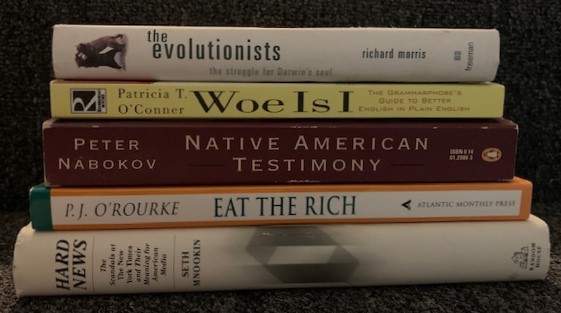
This is my next group of books for donation. With this bunch, another milestone—I’ve cleared off another shelf! YIPPEE! Hey, I take my victories where I can. I hope these guys find happy homes.

The Stuff: This examines in painful detail the 2002-2003 plagiarism and fabrication scandal involving New York Times reporter Jayson Blair. An internal investigation found Blair plagiarized material from reporters at other papers and claimed to have been in cities interviewing people when he was not. The New York Times ran a 7000-word front-page story about their internal investigation of the matter in May 2003. Blair, as well as two editors, resigned over the matter. The egregiousness of Blair’s conduct is an issue, as is race because Blair is black. The authoritarian managerial style of Executive Editor Howell Raines is also an issue. He was warned about Blair but ignored warnings, as had others.
This is a sad, painful but necessary autopsy of the scandal.
Bio: Seth Mnookin (b. 1972) is a Professor of Science Writing and the Director of the Graduate Program in Science Writing at MIT, according to the blog for his most recent book, The Panic Virus. He is a board member of the National Association of Science Writers, and from 2004 to 2018, he was a contributing editor at Vanity Fair. He has written articles for The New Yorker, Wired, The New York Times, The Washington Post, The Boston Globe, Spin, Slate, and Salon.com. His other books include Feeding the Monster: How Money, Smarts, and Nerve Took a Team to the Top (2006), about the Red Sox; and The Panic Virus: a True Story of Medicine, Science, and Fear (2011), about the vaccine/autism controversy. Additionally, Mnookin has written about his struggle with heroin addiction.
Title: Hard News: The Scandals at The New York Times and Their Meaning for American Media
Author: Seth Mnookin (b. 1972)
First published: 2004
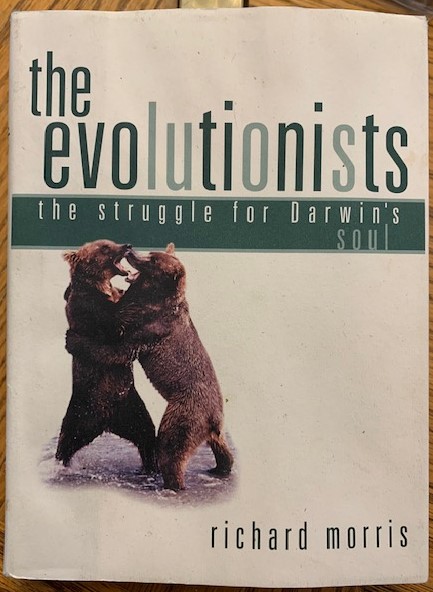
The Stuff: This digest-sized book begins with a review of fossil evidence for the theory of evolution. It is not anti-creationist per se but assumes the reader accepts, as do most reputable scientists, evolution as fact. It describes some controversies within the scientific community regarding the theory itself. To do that, it must describe the theory—for example, lay out what natural selection means. Genetics was not understood in Darwin’s day. Author Morris reviews all this with as neutral an eye as possible.
Morris gives a selected bibliography toward the back with many renowned writers such as E. O. Wilson, (surprise) Richard Dawkins, and Steven Pinker. I enjoyed reading this but got a sense of underlying sadness.
Bio: Richard Morris (1939-2003) earned a Ph. D in physics from the University of Nevada. From San Francisco, he published a small avant-garde poetry magazine, Camels Coming, beginning in the mid-60s. He also published poetry, fiction, and drama. In later life, he turned to writing about science. Among his twenty or so books are Light: From Genesis to Modern Physics (1979), The Big Questions: Probing the Promise and Limits of Science (2002), and the posthumously published The Last Sorcerers: The Path from Alchemy to the Periodic Table (2003).
Title: The Evolutions: The Struggle for Darwin’s Soul
Author: Richard Morris (1939-2003)
First published: 2001

The Stuff: This is a series of oral history testimonies from natives, almost exclusively from north of the Mexican border, of their encounters with European settlers and, later, Americans. Each section opens with a brief introduction describing who the speaker is and other relevant information. The selections stretch back to the seventeenth century. There is humor but also much sadness. It covers not only the treaties but relates (complete with misspellings) the experience of a child in foster care.
This is a deeply moving and profoundly sad book.
Bio: Peter Nabokov (b. 1940) holds a Ph. D in anthropology from Berkeley. He is now professor at UCLA. His other books include Sacred Geography: Reflections and Sources on Environment/Religion (1989), American Indians and Yellowstone National Park: A Documentary Overview (with Lawrence Loendorf) 2002, and A Forest of Time: American Indian Ways of History (2002).
Title: Native American Testimony: a Chronicle of Indian-White Relations From Prophecy to the Present
Editor: Peter Nabokov (b.1940)
First published: 1992
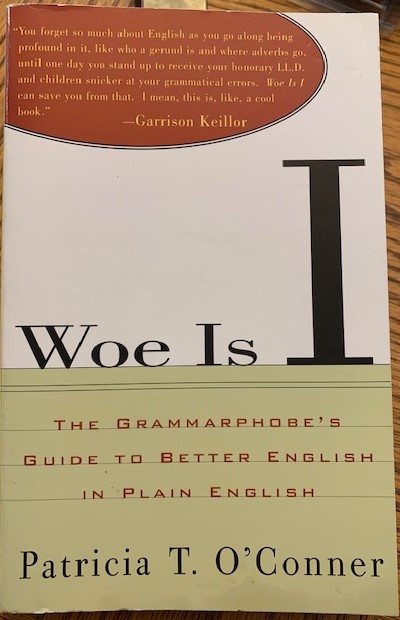
The Stuff: O’Conner discusses grammar, laying out all the tired rules of English textbooks, but does so with a lightness and sense of humor that reading her work has none of the feel of an English textbook. This is evident even in the chapter titles: “Plurals Before Swine: Blunders with Numbers” and “Verbal Abuse: Words on the Endangered List.” However, this is not Grammar Lite. She examines not only topics like there/they’re/their (p14) but also the use of the word “shall” (p. 188) and the semicolon (p 139). It is brief, with only 204 pages, and includes a glossary.
Bio: Patricia T. O’Conner (b. 1949) is a former editor at the New York Times Book Review. In addition to her books, she writes blogs and has written columns and appeared as a guest on radios, all having to do with language. She graduated in 1971 from Grinnell College in Iowa with a B.A. in philosophy. Her books include Words Fail Me: What Everyone Who Writes Should Know About Writing (1999) and You Send Me: Getting It Right When You Write Online (with her husband, Stewart Kellerman) (2002).
Title: Woe is I: The Grammarphobe’s Guide to Better English in Plain English
Author: Patricia T. O’Conner (b. 1949)
First published: 1996
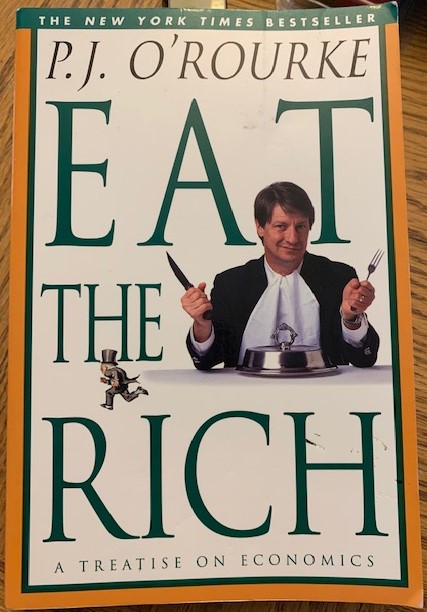
The Stuff: The author posits one central question in his first chapter: “Why do some places prosper and thrive while others just suck?” He quickly ticks off a list: not a matter of brains, education, natural resources, culture, civilization, government, or hard work. Nor are economics textbooks helpful. Even their precedents are snoozers: “The Wealth of Nations, Das Kapital, and The General Theory of Whatchmacallit were impressive works and looked swell on my bookshelf, but they put me to sleep faster than the economic news of the 70s had.”
He decides then to travel to different countries where the economies were either failing or prospering under different systems: 1) “good capitalism” in the United States, 2) “bad capitalism” in Albania, 3) “good socialism” in Sweden, and 4) “bad socialism” in Cuba. He also travels to Russia, Tanzania, Hong Kong, and Shanghai.
Did he arrive at The Answer? Nah. He offers some insight, but he went into the fray with preconceived notions and saw things that confirmed his ideas. It’s something of an interesting semi-gonzo journalistic travelogue, but this was a disappointment for me.
Bio: Patrick Jake O’Rourke (1947-2022) was an American libertarian political satirist and journalist, writing for such periodicals as The Atlantic Monthly, The American Spectator, and The Weekly Standard, and has been published in many others. He also wrote a column for a while for the Daily Beast and was a frequent panelist on NPR’s Wait Wait… Don’t Tell Me! Though in later life, he called himself a conservative libertarian, he was a self-proclaimed “hippie” when younger. He wrote about twenty books. Among his best known are Parliament of Whores and the current book.
Title: Eat the Rich: a Treatise on Economics
Author: P. J. O’Rourke (1947-2022)
First published: 1998
Review of “Fantastic Beasts: The Secrets of Dumbledore” (2022)
Last night, we watched this for our Saturday night pizza and bad movie offering. The pizza and wine were good.
Plot:
In 1932, “Magizoologist” Newton “Newt” Scamander (Eddie Redmayne) tracks a beast known as a qilin in the jungles of China. She gives birth. The newborn looks something like a fawn with long mustaches and a razorback. It purrs when it’s happy. It can see into a person’s soul
Out of nowhere, three people appear. They kill the mother and chase Newt, who tries to protect the baby. He is knocked unconscious. The bad’uns, led by Creedence Barebone (Ezra Miller), disappear with the orphan qilin.
Newt revives and returns to apologize to the dead mother. He finds another living baby, which he puts into his briefcase.
In the meantime, Albus Dumbledore (Jude Law) meets with an erstwhile lover, Gellert Grindelwald (Mads Mikkelsen). Grindelwald stands at the moment accused of various and sundry crimes. He also stands for election to the Supreme Mugwump International Confederation of Wizards (ICW). He must be cleared of those pesky criminal charges before doing so.
Later, the present Mugwump, Anton Vogel (Oliver Masucci), is happy to clear the villain without a trial or an apparent reason, despite a warning from Dumbledore. But this is Germany in the 1930s, so we all know where this is going, right?
In an earlier scene, Creedence brought the first qilin to Grindelwald, who explained that because the qilin can see into a person’s soul, they can judge a worthy ruler. They will bow down in front of such a one. Grindelwald isn’t playing any odds, though. He slits the qilin’s throat and, in a pool of blood, sees his old flame Dumbledore gathering friends around him in a way that could defeat him.
When they were young and in love, Dumbledore and Grindelwald swore a blood oath. Dumbledore has what looks like an old-fashioned pendant. Inside contains a drop of each of their blood. They cannot fight each other without suffering magical and painful consequences. However, Dumbledore can recruit others.
Thoughts:
This is the third installment in an expected series of five Fantastic Beasts films and the eleventh in the Wizarding World film series, which includes, of course, Harry Potter. The first two are Fantastic Beasts and Where to Find Them (2016), and Fantastic Beasts: The Crimes of Grindelwald (2018). The character of Newt Scamander is the central (…maybe…) to the series, as he finds and deals with fantastical beasts of various kinds. He has about him at all times an animated twig and a platypus.
The animation of the movie is top-notch, whether it was crab people or waves on the ocean. CGI filled the film, and it was entertaining. I have no complaints there.
However, the story gave the viewer the feeling of a retread. We’ve been here before. The bad’uns open a briefcase that they expect to hold the qilin only to find pastries. The pastries multiply at an enormous rate, threatening the lives and limbs of the bad’uns, just as the disturbed treasure did in Gringotts bank.
A couple of things remain unexplained. How does the spy planted in Grindelwald’s camp survive the legilimens’ (mind reader’s) scan? Does he recover the memory of his lost sister? Or he’s happy to give it all up for the cause?
Some questions regarding the identity of Creedence Barebone are answered. Imagine the chagrin of Grindelwald: he wanted to be Supreme Mugwump but instead gets to watch the qilin pick his old boyfriend—who turns down the job! Is there any doubt Grindelwald is a crazy ex? What did Dumbledore ever see in him?
This is not a bad movie, but it is bland and something of a re-run. If you’ve enjoyed the franchise, watching this to keep up with the overarching story should be enjoyable.
There are political inferences, of course. I hesitate to spell them out, but I saw a parallel to 1930s Germany and Grindelwald’s calling for the destruction of the non-magical world in the past. Perhaps others might draw additional inferences.
This is too recent to be available for free download, but it is available to buy or rent online. We got ours from the library. The only extra on the DVD was people talking about going back to Hogwarts. Not exactly enlightening.
Title: Fantastic Beasts: The Secrets of Dumbledore (2022)
Directed by
David Yates…(directed by)
Writing Credits
J.K. Rowling…(screenplay by) &
Steve Kloves…(screenplay by)
J.K. Rowling…(based upon a screenplay by)
Cast (in credits order)
Jude Law…Albus Dumbledore
Cara Mahoney…Waitress
Mads Mikkelsen…Gellert Grindelwald
Eddie Redmayne…Newt Scamander
Katherine Waterston…Tina Goldstein
Released: 2022
Length: 2 hours, 22 minutes
Rated: PG-13
Books for the Library #14
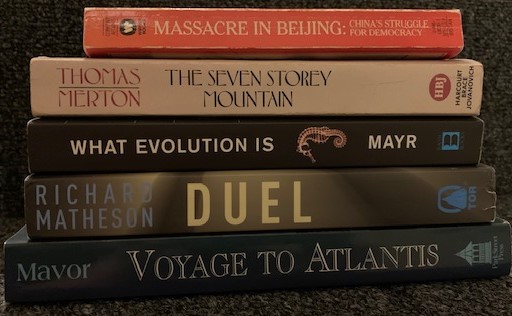
This is the next group of books set aside for donation to the local library. I’ll be dropping this set off on September 15. If anyone wants any of these between then and now, let me know, and I’ll get it to you. As always, re-reading these books brings back happy memories. I hope they find good homes.

The Stuff: This is a collection of eighteen horror short stories, published originally in various magazines between 1950 and 1971. They include the title story “Duel,” which was made into a movie in 1971 about an eighteen-wheeler menacing a driver on the interstate. Other stories of note are: “Little Girl Lost,” which became a Twilight Zone episode; “Born of Man and Woman,” Matheson’s first professionally published story and not for the faint of heart; and “Steel,” which also became a Twilight Zone episode, albeit with a different ending.
As with all collections, these can be uneven, and not everyone enjoys horror, but these are good tales. The book came to me by way of my friend Tracy with the explicit request that once I finished it, I should donate it. So, Tracy, this book goes to the donation bin after a bit of a delay. Thanks for your generosity.
Bio: Richard Burton Matheson (1926 – 2013) was an American author and screenwriter. He is best known for his 1954 novel, I am Legend, adapted for film three times: in 1964 as The Last Man on Earth, in 1971 as The Omega Man. and in 2007 as I am Legend. He also wrote the stories—and sometimes the scripts—behind many of the original Twilight Zone shows, including “Terror at 30,000 Feet” and “Little Girl Lost.”
Title: Duel
Author: Richard Matheson (1926-2013)
First published: 2003
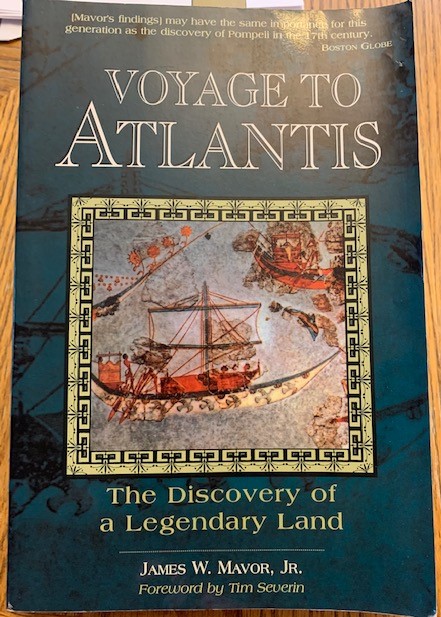
The Stuff: Mavor discusses archaeological digs on present-day Santorini, one of the Cyclades islands in the Aegean Sea. In the 16th century BCE, a volcanic eruption devastated the island. The ancients then referred to it as “Thera.” Early in the book, he recounts discussing the theory that this island, the Minoan civilization, and the catastrophe that befell it survive as distant memories in the stories of Atlantis. The primary proponent of the theory was Angelo G. Galanopoulos, whose book, Atlantis: The Truth Behind the Legend, came out the same year as Mavor’s.
Mavor’s book is replete with black-and-white photos of landscape, digs and finds, and line-drawn maps. This is interesting, but hardly all one can learn. Asking to track down the source of a legend is a rather tall order, however.
Bio: James Watt Mavor, Jr. (1923-2006) is described in the book blurb as an “oceanographic engineer” long associated with the Woods Hole Oceanographic Institution of Massachusetts. In World War II, he served in the Navy. He was one of the designers of Alvin, a deep-diving research submarine, and the author of The Sacred Landscape of New England’s Native Civilization, in addition to the present book.
Title: Voyage to Atlantis: The Discovery of a Legendary Land
Author: James W. Mavor, Jr. (1923-2006)
First published: 1969
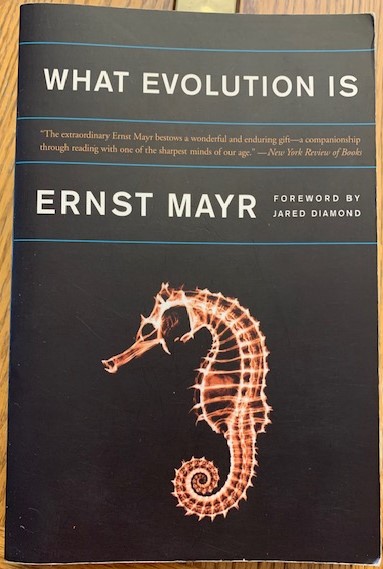
The Stuff: “Evolution is the most profound and powerful idea to have been conceived in the last two centuries,” begins Mayr’s foreward. Many chapter titles posit questions: “In What Kind of World Do We Live?” and “What is the Evidence for Evolution?” The book is laid out like a textbook, organized by topics—but with no quizzes or chapter summaries. The breadth and depth of the non-technical information are astounding. Black-and-white illustrations abound. The book concludes with that modern phenomenon, a list of FAQs.
This is not a light read to the non-specialist such as myself, but one that is interesting and worth the time and energy needed to get through it.
Bio: Ernst Mayr (1904-2005) was a German-American evolutionary biologist. He specialized in the study of birds. In his 1942 book, Systematics and the Origin of Species, he defined “species” as a group of individuals that can breed among themselves but not with others regardless of whether they look alike, which is the definition still in use. At the time of the writing of the above book (at 97!), he was Professor Emeritus in the Museum of Comparative Zoology at Harvard University.
Title: What Evolution Is
Author: Ernst Mayr (1904-2005)
First published: 2001

The Stuff: This is an autobiography undertaken when the writer was in his early 30s. He describes his childhood, his family, and his schooling. During the summer before he was to start classes at Columbia University, Merton visited Rome. There, he saw frescoes in the ancient shrines that, he writes, he first felt compelled to discover the person called Christ: “And thus, without knowing anything about it, I became a pilgrim.”
The book’s title is taken from Dante’s depiction of purgatory as a seven-story mountain that souls must climb to obtain paradise.
I read this years ago at the recommendation of a friend. Merton writes captivatingly, but I don’t think I could read it now. I’m too much of a heathen.
After the invention of this here internet thingy, I learned things I couldn’t know about Merton when I first read the book. He exhibited symptoms of depression and anxiety—hardly moral failings—that add sadness and poignancy to his life story. While undergoing back surgery, he fell in love with a student nurse. He wrote of the affair in his diary, identifying the nurse only as “M.” This, too, strikes me as sad.
Bio: Thomas Merton (1915-1968) was a Trappist monk, writer, and social activist. Born in western France to artist parents, he converted to Catholicism and studied at Cambridge University in the UK and Columbia University in New York. He taught for a while and entered a monastery, where he began writing and eventually met international spiritual leaders.
Title: The Seven Storey Mountain
Author: Thomas Merton (1915-1968)
First published: 1948

The Stuff: This is a chronological account, written by the editor of Time magazine, of the events around the Tiananmen Square pro-democracy movement that began in April 1989 and ended in a massacre in June the same year. Estimates of deaths vary from several hundred to thousands. The death of Hu Yaobang following a heart attack brought about the protests. Hu had been a long-time Party official and General Secretary from 1982 to 1987, though forced to resign because his reformist tendencies, favored by students, did not sit well with other Party officials.
In light of the recent Hong Kong protests and suppression, this seems more timely than ever. However, my copy—which I bought and read not long after the tragedy—is a paperback with yellowed pages. While it’s still perfectly legible, it will end up on the dime rack at the library bookstore.
Title: Massacre in Beijing: China’s Struggle for Democracy
Edited by Donald Morrison
First published: 1989
Review of “What’s So Bad About Feeling Good?” (1968
For our Saturday pizza and bad movie, we chose one the dearly beloved recalled seeing in part some years ago. It wasn’t all that good, but it was lighthearted.
Plot:
A Greek ship remains in quarantine in New York harbor because most of the crew is sick. You wouldn’t know it by looking at them. The captain, who usually rants and raves, is dancing. The crew blames a toucan they have in a jerry-rigged cage. When the authorities come to confiscate the bird, it flies away. No surprise.
He finds a group of bohemian/hippie artists and musicians who view life as dreadful and depressing. Pete (George Peppard) is a former advertising executive who sits in front of canvases. (“It says nothing,” he says of one black and white masterpiece. After adding a few dabs of black ink, he announces, “Now it says something.”) Liz, (Mary Tyler Moore), his old lady, performs a song, “Life is Blue, Black, and Gray.” Immediately, she’s told, “That’s terrible.”
The toucan comes in to steal grapes and infects Pete, who wakes up the next morning (as opposed to the next afternoon), shaves his beard, and smiles.
The virus makes people happy. The downside is they stop buying booze and cigarettes, with fewer taxes flowing into city coffers. This becomes not just a city problem but a national problem. New York City mayor (John McMartin) leaps into action when told people might be too happy to vote. He arranges a press conference, advising people of the virus and offers face masks free to any who ask.
The U.S. President sends in his aide, the officious J. Gardner Monroe (Dom DeLuise), who arrives in New York wearing a space suit helmet. His assistant, Murgatroyd (George Furth ), wears a gas mask and wipes his boss’s bubble for him. They will capture that bird, even if it means shutting off New York City from the rest of the world.
Meanwhile, the hippies are happy. Pete and Liz are going to actually get married, along with a lot of other happy New Yorkers.
Thoughts:
This is a silly, lighthearted, and not entirely credible comedy. It was fun, but watching it after the covid pandemic meant shaking off some powerful ghosts. The mayor of New York City (…or governor of the state of New York) going on t.v. to discuss a breakout of a new virus? And wearing face masks? The lockdown?
*shudder*
And the cost to the government of people behaving differently? That the government has a vested interest in people’s self-medication through booze and tobacco? OUCH.
Some silly and outrageous things are not meant to be believed.
The movie is based on a 1943 novel I Am Thinking of My Darling by Vincent McHugh, which was favorably reviewed in the New York Times.
Unfortunately, the movie is difficult to find. The dearly beloved bought it after a prolonged search. I could not find it streaming anywhere, not even for pay.
Title: What’s So Bad About Feeling Good? (1968)
Directed by
George Seaton
Writing Credits (in alphabetical order)
Bill Danch…(writer) (uncredited)
Vincent McHugh…(story “I Am Thinking of My Darling”)
Tedd Pierce…(writer)
Robert Pirosh…(writer)
George Seaton…(writer)
Cast (in credits order)
George Peppard…Pete
Mary Tyler Moore…Liz
Don Stroud…Barney
Susan Saint James…Aida
Dom DeLuise…J. Gardner Monroe
Released: 1968
Length: 1 hour, 34 minutes
Spring Clean Books #13
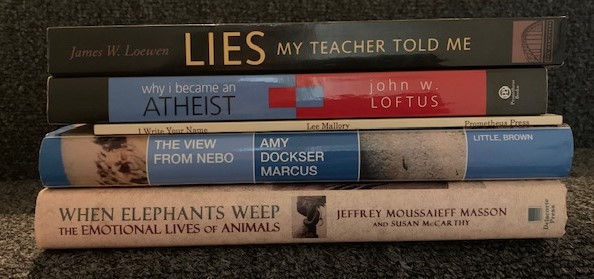
This is my next batch of books for donation, lucky #13. As always, lots of fond memories. I hope these guys find happy homes.
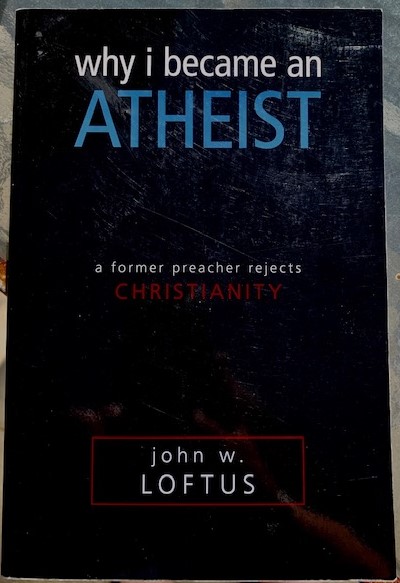
The Stuff: The memoir/autobiography is relatively short. Loftus describes himself as one to throw himself into things wholeheartedly. He got into trouble as a teenager but found God and later became a preacher, teaching apologetics. Unfortunately, he had an affair. The fallout from the affair increased his already growing doubts about Christianity.
This story occupies about fifteen pages. The rest of the book is spent on anti-apologetics, examining biblical texts and philosophical arguments about Christianity. He doesn’t ridicule so much as expose. Nevertheless, this makes for thick, heavy reading.
Bio John Wayne Loftus (b. 1954) is an American atheist author and former ordained minister. He’s written at least thirteen books on atheism and Christian philosophy. One of his books, The Outsider Test for Faith: How to Know Which Religion Is True (2013), recommends approaching religion as an outsider to evaluate its merit. That is, apply the same degree of skepticism to your own religion as you would to the other guy’s.
Title: Why I Became an Atheist: A Former Preacher Rejects Christianity
Author: John W. Loftus (b. 1954)
First published: 2008
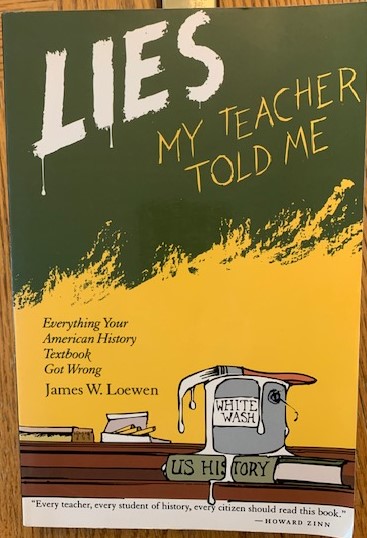
The Stuff: Despite being fascinated with history for as long as I can remember, I was bored to tears with the subject in high school. I think this book explains my boredom in part. Loewen is right when he talks about history textbooks dwelling on the dramatic and the superficial and the need for heroes and villains. The problem is reality is more nuanced. Facts don’t lend themselves to such schemes.
Loewen looks at the “real” importance of Columbus, the treatment of natives by Europeans, and the experience of black in the United States as opposed to what the textbooks tell students, the Civil War and Reconstruction. It is sad and eye-opening.
He also frankly states textbooks “make students stupid.” Given how little many people seem to understand our history, he may have a point. However, textbooks have improved over the 50s and 60s.
The book was reissued in 2005, 2008, and 2018, so my 1995 copy is way behind the times but still a worthy read.
Bio: James William Loewen (1942-2021) was an American sociologist, historian, author, and racial justice activist. He taught history at Tougaloo College, a historically black liberal arts school in Mississippi, and later taught sociology at the University of Vermont. This is his best-known work. He also co-wrote a Mississippi state history textbook, Mississippi: Conflict and Change (1974), which the Mississippi Textbook Purchasing Board rejected even though the book won the Lillian Smith Book Award for Best Southern Nonfiction in 1975. Loewen filed suit and prevailed.
Title: Lies My Teacher Told Me: Everything Your American History Textbook Got Wrong
Author: James W. Loewen (1946-2021)
First published: 1995
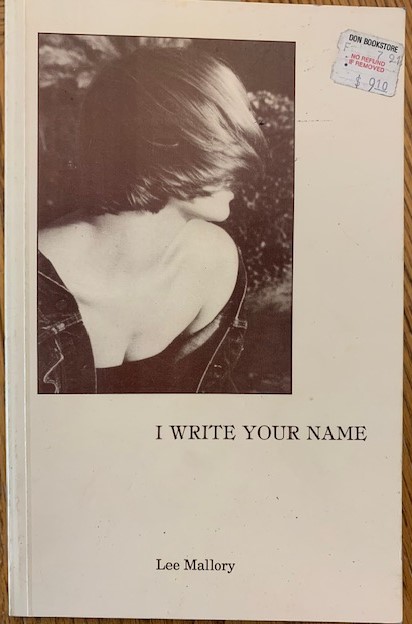
The Stuff: This is a slim chapbook of poetry and a few black-and-white photos used as a textbook in one of the author’s course with a limited press run of 500. Most of the poems are short, one-page free verse affairs, often written in second person. A recurring person talked to and about is the Lady in Red.
Bio: Lee Mallory (b. 1946) is an American poet, editor, and academic. His father and stepfather were both in the military, so he grew up abroad. He himself served in the Army. Long ago, but not so far away, I took a course or two he taught at Santa Ana College. He is now retired. He hosted poetry readings for students and others. Oddly enough, the Orange County Register had a write-up this morning about his current poetry reading: Meet Lee Mallory, O.C.’s poetry man – Orange County Register (ocregister.com)
Title: I Write Your Name
Author: Lee Mallory (b. 1946)
First published: 1990
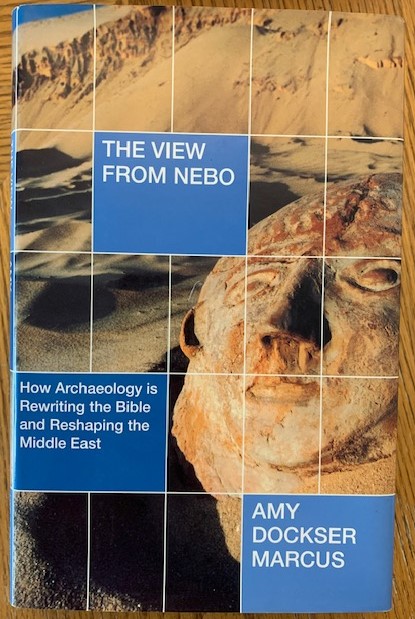
The Stuff: Taken from articles written in the 1990s while the author was living in Tel Aviv and covering the Arab-Israeli conflict for the Wall Street Journal, this reexamines the biblical narrative from Genesis and compares it to what modern archaeology has been uncovering. The strength of the book lies not in its discussion of how current archaeology does not support the old Bible stories. Rather, the picture of history emerging from archaeology is fascinating and worthy of study by itself.
To offer one easy example, the Bible teaches the children of Israel were long held as slaves in Egypt. Because of this, a tradition arose that the pyramids were built by Hebrew slaves. This was dubious all along. The pyramid-building continued for centuries. As it turns out, the builders were craftsmen, not slaves.
Bio: Amy Dockser Marcus (b. 1965) is a health and science reporter for the Wall Street Journal based in Boston. She has spent time in Tel Aviv covering the Arab-Israeli conflict and worked for Money magazine. In 2005, she was awarded a Pulitzer Prize for Beat Reporting for a series of articles about cancer survivors and the health care system. Her two books are based on articles from her reporting in the Middle East.
Title: The View from Nebo: How Archaeology is Changing the Bible and Reshaping the Middle East
Author: Amy Dockser Marcus (b. 1965)
First published: 2000
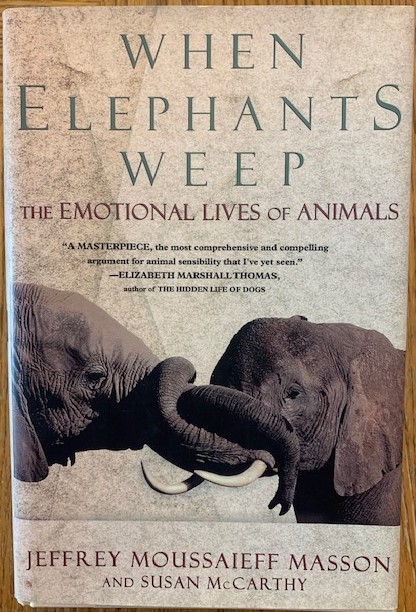
The Stuff: Masson acknowledges what most of us who have been around animals know: animals experience emotions. He is careful to explain that they are not humans but animals. For example, he tells a story that could have ended badly for him through his own poor judgment. In his conclusion, he asks, What are the implications for living with beings who feel?
I confess this was a little hard to reread. After having just put a cat down, I have to wonder—as Masson does about his aging dog—do they feel nostalgic? I know my cat didn’t remember being a kitten, but did he, as he aged, remember happier times? Being able to jump the block wall and sit atop it, washing his paws and driving the neighbors’ dog crazy? Or was it enough that he could sleep on the sofa between me and my husband? Impossible to know.
Title: When Elephants Weep: The Emotional Lives of Animals
Authors: Jeffrey Moussaieff Masson (b. 1941) holds a Ph.D. from Harvard in Sanskrit and trained as a psychoanalyst. After studying Freud’s papers, he rejected much of what Freud had written, and oh, my, the fuss that did kick up. He is a vegan and an animal rights activist.
Susan McCarthy holds degrees in biology and journalism, writes regularly for Salon.com, and has contributed to Best American Science Writing, Parade, The Guardian, WIRED, Smithsonian magazine, and Outside. She lives in San Francisco.
First published: 1995
Review of “Arsenic and Old Lace” (1944)
It’s Halloween, 1941, in New York. Mortimer Brewster (Cary Grant), a drama critic and author of such books as Marriage, a Fraud and a Failure, waits in a long line with the girl literally next door, Elaine Harper (Pricilla Lane). A sign above them reads “marriage licenses.” A couple of gentlemen of the fourth estate notice him and try to get pictures.
Meanwhile, back home in Brooklyn at the Brewster home, elderly Aunt Abby (Josephine Hull) entertains the Reverend Harper (Grant Mitchell), Elaine’s dad. Mortimer’s brother, Teddy Brewster (John Alexander), plays the piano. He yells, “Charge!” and runs up the stairs, convinced he is President Teddy Roosevelt.
After Reverend Harper leaves, Aunt Martha (Jean Adair) comes home. They tell Teddy he’s going to Panama to “dig another lock for the canal.” This delights Teddy. The two sisters also seem delighted, sharing some secret. They are about to open the window seat when they see Elaine looking in the window. She winks at them. That can only mean—she and Mortimer have gone and gotten married! Well, this changes things!
Mortimer is telling his aunts about a play he’s recently seen—a murder mystery—“When the curtain goes up, the first thing you see is a dead body.” On cue, he opens the window seat. At first, he suspects his delusional brother Teddy, who has just gone down the cellar with a shovel.
But his aunts tell him, oh, no. Teddy had nothing to do with Mr. Hogkins winding up in the window seat. They have their own recipe for elderberry wine for lonely, elderly men.
Thoughts:
This is one of the weirdest mass murder movies you’ll ever see. Two sweet elderly ladies—who give repaired toys to police charities—poison old men because they think it’s kinder than letting them live lonely lives. They have their standards, though. They refuse to let a foreigner be buried with a Methodist.
There are a lot of in-jokes. Arsenic and Old Lace was originally a play with Boris Karloff as sinister Brewster brother Jonathan. It ran from 1941 to 1946. In the movie, the character Jonathan (Raymond Massey) becomes enraged when told that he looks like Boris Karloff.
Many of the jokes stand up. This is farce and quite silly. Grant overacts but does so deliberately. The corpses are never shown, but they don’t need to be. The strength of the story comes from Mortimer’s realization that his sweet aunts are mass murderers. Later, his long-lost brother, Jonathan, returns. The police are looking for him. There is serious menace from Jonathan, but there’s also farce.
One of the inspirations for the story is thought to have been the real-life murders committed around 1907-1916 in a nursing home run by Amy Archer-Gilligan. She was charged with five killings, convicted of one, and sentenced to death. At a second trial, she pleaded insanity and was again convicted but sentenced to life imprisonment.
While the style of the movie is dated and the subject matter rather gruesome, this is a fun and funny flick. The fun is in the irony. Mortimer is trying to protect his aunts and Teddy but also trying to keep them from committing more harm. He’s also worried about going nuts himself. He tells his new bride, “Insanity runs in my family. It practically gallops.”
There are no booms and certainly no boobs, but this is a lot of fun.
The movie can be watched here:
Title: Arsenic and Old Lace (1944)
Directed by
Frank Capra
Writing Credits
Julius J. Epstein…(screen play) and
Philip G. Epstein…(screen play)
Joseph Kesselring…(play)
Cast (in credits order)
Cary Grant…Mortimer Brewster
Priscilla Lane…Elaine Harper
Raymond Massey…Jonathan Brewster
Jack Carson… O’Hara
Edward Everett Horton…Mr. Witherspoon
Peter Lorre…Dr. Einstein
Released: 1944
Length: 1 hour, 58 minutes
Five Books for Donation Resumed
I’ve decided to take up my five-books-a-week donation to the local library. I think it got derailed a while back when I came down with pneumonia. I never got my act back together. I intend to post this on August 25 and donate the books on September 1. If anyone wants any of these books, let me know before September 1, and I’ll try to get one to you.
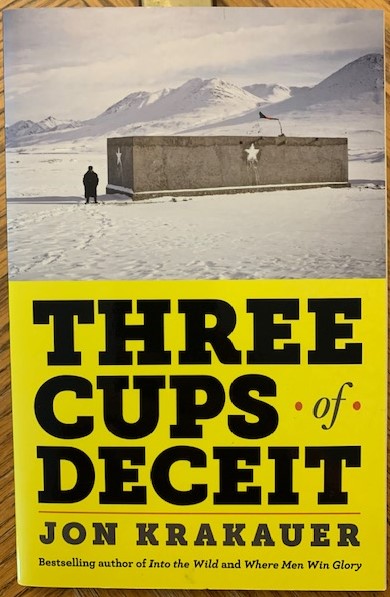
The Stuff: The title refers to a book by Krakauer’s fellow mountaineer, Greg Mortenson, Three Cups of Tea. In Mortenson’s book, he claims that he started a charity to build schools in remote areas of Pakistan and Afghanistan to repay villagers who befriended him after he got lost descending K2 in Pakistan.
This short (<100 pages) work says most of Mortenson’s stories are fabrications, and the finances of the charitable organization that he founded, the Central Asia Institute (CAI), are in a tangle. Was any school built at all? Were those buildings that were built used as schools?
I read Mortenson’s original books and swallowed them hook, line, and sinker. After reading this, I was angry. As is often the case, the truth lies somewhere in between. The attorney general of Montana wrote of the controversy:
“Our investigation centered on whether CAI’s officers and directors satisfied their legal duties with regard to Mortenson’s books and speaking engagements, and in managing the financial and operational affairs of the organization. We concluded that the board of directors failed to fulfill some of its important responsibilities in governing the nonprofit charity. Further, Mortenson failed to fulfill his responsibilities as executive director and as a member of the board.
Despite policies that committed him to do so, Mortenson failed to make contributions to CAI equal to the royalties he earned on the books the organization purchased. Nor did he and CAI devise an equitable way to split the costs to advertise and promote the book, as required by his 2008 employment agreement. Mortenson also accepted travel fees from event sponsors while CAI was paying his travel costs. Moreover, he had significant lapses in judgment resulting in money donated to CAI being spent on personal items such as charter flights for family vacations, clothing, and internet downloads.”
2012_0405_FINAL-REPORT-FOR-DISTRIBUTION.pdf (dojmt.gov)
Bio: Jon Krakauer (b. 1954) is an American writer and mountaineer. He wrote for Outside magazine and has written several nonfiction books, including Eiger Dreams, Into the Wild, and Into Thin Air. The last was written for Outside magazine and took place during the disastrous 1996 Everest ascent. His books have not been without controversy.
Title: Three Cups of Deceit
Author: Jon Krakauer (b. 1954)
First published: 2011

The stuff: This is a nonfiction work describing the role astronomers and those who read portents in the skies played in ancient societies. The author describes the worldview of peoples as diverse as ancient China to the prehistoric Americas. This heavy, hardback book is illustrated throughout with black-and-white drawings and photographs, many original to the author. “Astronomical knowledge confers power,” Krupp writes in his introduction. “The calendar must be kept. The omens must be read. The ceremonies must be performed.”
This is not a technical book, but it can get a little dry for the layperson. Nevertheless, this was an interesting and rewarding read. May it find a good home.
Bio: Edwin Charles Krupp (b. 1944) has been the director of the Griffith Observatory in Los Angeles since 1976 and taught at El Camino College, USC, and UCLA. His area of expertise is archeoastronomy, the astronomy of ancient cultures. He has written books for adults and children in addition to academic works.
Title: Skywatchers, Shamans, & Kings: Astronomy and the Archaeology of Power
Author: E. C. Krupp (b. 1944)
First published: 1997
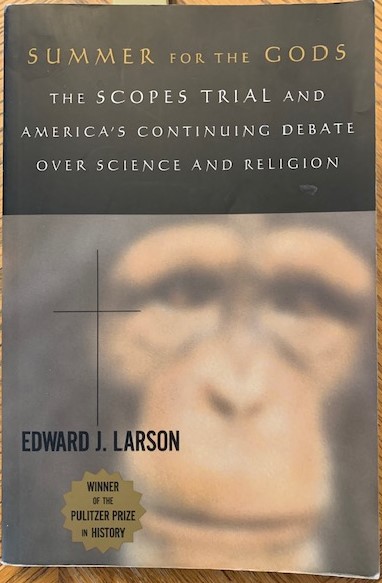
The stuff: This is a nonfiction work examining the 1925 Scopes trial regarding the teaching of evolution in Tennessee. In the popular imagination, the trial was settled as depicted in Inherit the Wind. (Produced in 1960, the play was not about the Scopes trial as much as it was a metaphor about McCarthyism.)
Real life was more complex. John Scopes, the history teacher charged with violating the Butler Act (which forbade teaching evolution), was convicted and fined $100—a bit more money in 1925 than in 2022. Author Larson sees the trial not as resolving the issue of science and religion but as an opening shot in a battle that continues under different guises. Instead of forbidding evolution, fundamentalists may try to include aspects of “creationism” such as “intelligent design” or “teaching the controversy” in public school curricula, for example.
This book was awarded a Pulitzer Prize in history.
I found this an interesting, if sad, read. However, it has the ugliest and most off-topic cover—an out-of-focus close-up of a chimpanzee’s face. It’s hard to look.
Bio: Edward J. Larson (b. 1953) is an American historian and legal scholar. Currently a professor at Pepperdine University, he formerly held a professorship at the University of Georgia. He makes frequent television appearances on outlets such as NPR and PBS. His articles have been published in Nature, Scientific American, The Nation, American History, Time, and various academic history and law journals.
Title: Summer for the Gods: The Scopes Trial and America’s Continuing Debate Over Science and Religion
Author: Edward J. Larson (b. 1953)
First published: 1997

The Stuff: Leakey begins his discussion by referring to Darwin’s arguments about the origins of humans. Some of them—humans originated in Africa—have held up well for statements made without fossil remains. Others, not so well. Leakey emphasizes humans’ unusual bipedalism and the development of large brains and language. While the book misses out on some DNA developments of the last decade or so, it is a concise, accessible discussion of human origins.
Bio: Richard Erskine Frere Leakey (1944-2022) was a Kenyan paleoanthropologist, conservationist, and politician. He was the son of renowned paleoanthropologists, Louis and Mary Leakey. Leakey and his team discovered an unprecedented 1.5-million-year-old skeleton dubbed the Turkana Boy. Leakey lost both legs as a result of a plane crash in 1993 and wrote such books (in addition to the present work) as One Life: An Autobiography (1983), The Sixth Extinction (with Roger Lewin) (1995), and Wildlife Wars: My Fight to Save Africa’s Natural Treasures (with Virginia Morell) (2001).
Title: The Origin of Humankind
Author: Richard Leakey (1944-2022)
First published: 1994
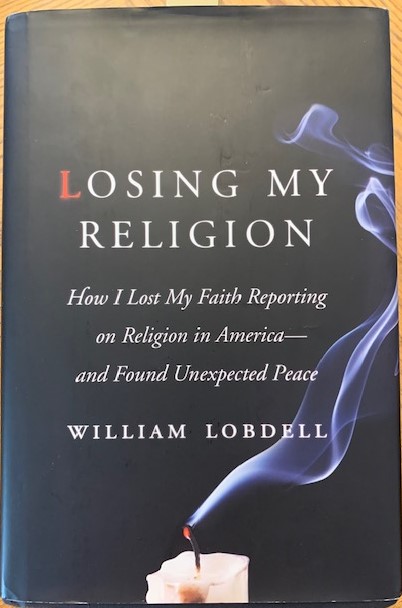
The Stuff: This is a memoir about losing religious faith and building a life afterward. Lobdell writes that at 27, he had made a mess of his life. A friend advised him he needed God. He became a Christian, started a family, and got married. Things are sometimes complicated. With patience and some finagling, he landed his dream job: writing a religion column for the Los Angeles Times. But there were scandals. When he and his wife were about to convert to Catholicism, the priest sex abuse scandal broke. The memoir is honest and heartbreaking. The material can be hard to read emotionally, but it is candid and important.
Bio: William Lobdell: I couldn’t find much current bio info on the author. His LinkedIn profile listed him as the content manager of Pacific Funds. He seems to have been active—at least for a while—with the Center for Inquiry, a skeptic organization. He is (or was) a visiting faculty member at UC Irvine but was not listed on the UCI directory when I checked. He wrote the “Getting Religion” column for the Orange County edition of the Los Angeles Times from 1998 to 2008 and was a journalist for about 25 years. This is the only book I could find published by this author.
Title: How I lost My faith Reporting Religion in America—and Found Unexpected Peace
Author: William Lobdell
First published: 2009
Review of “Cry Wilderness” (1987)
SHORT REVIEW: RUN AWAY!!!
Longer review:
For our Saturday night pizza and bad movie, we picked one Mystery Science Theater that may have actually improved the viewing experience. This one is just nonsense. Or fine family PG-rated viewing, however you want to look at it.
Plot:
On a school trip, Paul Cooper (Eric Foster) wanders away from the group of boys with red ties. When his teacher Mr. Douglas (Navarre Perry), finds him, he’s standing by an exhibit of something like a tall ape/man. Paul tells his teacher that he’s seen him. He’s seen Bigfoot. Mr. Douglas tells him not to lie and threatens discipline.
Later, when Paul is in his dormitory bed, he hears someone calling. Why, it’s Bigfoot (Tom Folkes)! Or maybe it’s a vision. An odd red glow surrounds everything. Bigfoot tells Paul to come home. His father is in grave danger.
Mr. Douglas at first busts Paul before he can run away, but he runs away anyway. A trucker (Guy Bass) gives him a ride but doesn’t ask where a kid Paul’s age is going. Paul is probably no more than eleven or so.
He wanders through the woods somewhere in northern California/western Nevada until he stumbles across his dad, a forest ranger (Maurice Grandmaison), who pulls a gun on him, not expecting him. Dad lays down the law. Paul is going back to school on Monday. Doesn’t he ask what the kid is doing wandering around the woods?
Paul also stumbles across a pair of boots, which turn out to be on the feet of his dad’s friend Jim (John Tallman), a Native American who (I kid you not) wears blush all over his face. The amount of blush varies from scene to scene.
They all laugh. They laugh a lot. Inappropriately. They walk by a succession of wild critters like a fox with a collar on its neck. They stop laughing when they get to Dad’s cabin and find the door open. Who’s been here? Could it be Bigfoot? Could it be something worse?
Selection B—something worse. A hunter with exceptionally bad table manners is here to eliminate whatever’s been killing the wildlife. (Uh… there are bear in them thare woods? Think they might be doing some ‘a that there killin’? Eh, never mind) The hunter is keen to bag him a Bigfoot, and he gets wind that the boy might know a thing or two.
Thoughts:
The strong point of this little flick is not the script. Nor the acting. Nor the special effects. Bigfoot doesn’t have gloves. The movie has wannabe echoes of Harry and the Hendersons (1987) and E.T. the Extra-Terrestrial (1982) but adds nothing unique.
There are some lovely location shots from around Mono Lake, California, and the Devil’s Postpile. These are both otherworldly and breathtaking areas.
It’s hokum with cute animals.
There might be an explanation. In Backstory 2: interviews with screenwriters of the 1940s and 1950s, Patrick McGilligan records writer/screenwriter Philip Yordan saying this about the movie:
The distributor, who had done Sasquatch [1978], which cost maybe $150,000 and made over $4 million profit, says to me, “Give me a picture about Bigfoot, and I’ll make millions.” So I sat down and wrote a picture. He says, “No, no, no, you don’t understand. You got scenes in the beginning that will scare the audience. It’s for kids. So I had to take out all the scary scenes. Bigfoot couldn’t be threatening; he had to be nice. No blood, no violence, no sex, no bad language. I said, “You really want a picture about nothing!” He says, “That’s it! Now you’ve got it! Nothing! I want nothing!” I said, “That’s the most difficult thing to write.” Well, the picture is about nothing, if you sit through it, which I don’t know if you can.
So there. This stinker is incomprehensible, insulting, and bad not because the writer, actors, or director were incompetent but because the people who paid for it wanted it to stink. Yeah, makes no sense to me, either.
Title: Cry Wilderness (1987)
Directed by
Jay Schlossberg-Cohen
Writing Credits
Philip Yordan…(original story)
Philip Yordan…(screenplay)
Cast (in credits order)
Eric Foster…Paul Cooper
Maurice Grandmaison…Will Cooper
John Tallman…Jim
Griffin Casey…Morgan Hicks
Faith Clift…Dr. Helen Foster
Navarre Perry…Mr. Douglas
Released: 1987
Length: 1 hour, 33 minutes
Rated: PG
Review of “At the Earth’s Core” (1977)
Svengoolie was a rerun once again, so we went to Mystery Science Theater for this gem, an adaptation of an Edgar Rice Burroughs work.
Plot:
Against a backdrop of Victorian Great Britain, scientist Dr. Abner Perry (Peter Cushing) oversees the building of a giant earth-boring machine, “the iron mole.” Accompanying him on its test run through some Welsh hills is former student David Innes (Doug McClure), who has financed the venture.
The local people come to watch the demonstration, along with the press and a marching band. First contact between drill and hillside produces sparks and smoke and jostles our heroes around in their leather-upholstered swivel chairs. The crowd applauds.
As soon as Perry and Innes are underground, things go wrong. First, the borer heads down rather than straight ahead through the mountain. Our heroes have no control. On an analog indicator, the crew watches as the machine digs through the earth’s crust and the upper mantle. They faint from the heat. The machine keeps boring through the lower mantle and skirting the earth’s core. When Perry and Innes revive, they find frost covering their instruments and their persons. The ice outside the ship becomes water—they’re in an underground lake. They find themselves on land. The ship halts and goes dark. Innes strikes a match and lights a cigar, providing the only light inside the “mole.”
“Total power failure,” says Perry. “How very disappointing. It must have been the water. I didn’t allow for that contingency. I’ll just get my umbrella. The weather seems so changeable.”
They exit the machine and find themselves in a jungle.
“This can’t be the other side of the hill—unless it’s changed dramatically,” Perry tells the younger man.
There is no attempt to explain the outside light source. Perry immediately recognizes some of the plant species. He’s only seen fossilized form.
They come to understand they’re not on the earth but in it. Their explorations are interrupted by a giant parrot/eagle stomping through the jungle. Our heroes flee. Perry even tries to shoo it away with his umbrella.
The real trouble starts when they’re rescued, however. Beings that resemble apes with slicked-backed hair drag Perry and Innes to a group of humans, chained together, making their way to the city of the Mahars as slaves.
Thoughts:
From the opening shots of gentlemen in 19th-century garb holding planning specs to the marching band spoiling the publicity picture, I knew this would be a delightfully goofy flick. It did not disappoint. It has much in common with works like Jules Verne’s Journey to the Center of the Earth and The Time Machine.
The special effects are, um, quaint. That is, guys in pterodactyl costumes enslave humans by using telepathic powers. Their eyes light up when they’ve got their mojo working. They hang out on rocks with a bit of fog. They have a written language.
Guys in upright rhinoceros fight each other.
Innes falls for one of the slave women, the lovely Dia (Caroline Munro), but he offends her in some complicated culture-specific way, and she won’t talk to him anymore. Ah, yes. The course of true love never did run smooth, even if those people speak English. Maybe that British Empire went farther than even the British knew.
Our heroes wouldn’t be heroes if they didn’t liberate the oppressed from their oppressors—an idea that apparently didn’t cross their poor benighted minds until the plucky Brits arrived.
The best lines come from Peter Cushing’s character, Abner Perry. In defying the telepathic Mahar, he insists, “You cannot mesmerize me! I’m British!”
No one will confuse this with great cinematic art, but it is silly and doesn’t take itself too seriously. I enjoyed it.
The Academy of Science Fiction, Fantasy & Horror Films nominated At the Earth’s Core for its 1977 Golden Scroll Best Fantasy Film.
At the Earth’s Core can be watched here.
Title: At the Earth’s Core (1976)
Directed by
Kevin Connor
Writing Credits
Edgar Rice Burroughs…(based upon the novel by)
Milton Subotsky…(screenplay)
Cast (in credits order)
Doug McClure…David Innes
Peter Cushing…Dr. Abner Perry
Caroline Munro…Dia
Cy Grant…Ra
Godfrey James…Ghak
Sean Lynch…Hoojah
Released: 1976
Length: 1 hour, 29 minutes
Rated: PG
 Reviews of Old and New Stories. Mostly Old