
Svengoolie was yet again a rerun, a generically named Curse of Frankenstein, which I reviewed here: We tried another movie the dearly beloved saw a while ago. I remembered bits and pieces of it as well.
Plot:
In the year 2247, Trooper Jack Deth (Tim Thomerson) patrols the mean streets of Angel City, near sunken Los(t) Angeles. The opening sequences show our hero entering a café and ordering coffee.
“The real stuff?” the waitress asks. “That’ll cost you.” She disappears into the back room.
Deth asks a patron to show proof he’s not a trancer. The patron objects that he needs a warrant. Deth pulls a gun.
The patron, a large bear of a man, is not a trancer. However, the waitress, an older black woman, comes out of the back room with an ashen face, red eyes, and a bad attitude. She and Deth get into a knockdown-dragout. The non-trancer patron flees and hits a beacon outside the café, alerting the police.
After taking a few blows, Deth shoots the hapless waitress with a ray gun, killing her. She glows and leaves a person-sized burn mark on the floor. She has, in the parlance of the time, been “singed.”
The police arrive in a hover squad car. Out pops McNulty (Art LaFleur), who admonishes Deth over his private war on trancers and demands he return to his assignments. Deth throws his badge onto the ground and stomps off.
Later, when he is diving in the water around submerged Los(t) Angeles, recovering artifacts, McNulty returns. His former supervisor wants him to come with him to speak with the City Council.
Deth at first demurs. McNulty tells him the creator of the trancers, Whistler (Michael Stefani), has found a way to go back in time.
Deth believed he killed Whistler on one of the rim planets. Hearing he’s alive is disappointing, particularly since Whistler killed his wife.
Whistler is back in 1985 in the body of an ancestor, assassinating the ancestors of the City Council. There would be nothing to stand between him and taking over Angel City.
The remaining members of the Council want to send him back in time to stop Whistler as his ancestor. This requires keeping his body in stasis and injecting him with drugs. The antidote for return—one for him and one for Whistler—is secreted in the handle of his period .38 Special.
He agrees, with one exception. He uses his gun on the body of Whistler, destroying it. Whistler isn’t coming home, regardless of what happens.
The Council furnishes him with some information. His ancestor is a journalist. Whistler’s ancestor is a cop, of course, and with the power to psychically control people and make them into the zombie-like creatures known as trancers, beings neither dead nor alive and without a will of their own
Thoughts:
There are cute moments. Jack wakes up with a cute girl (Helen Hunt) whose name he doesn’t know. He’s supposed to get her to her job as a photographer for a mall Santa. The girl is no fool and realizes he isn‘t the same man she took a tumble with the night before. He told her he’s from L.A. but can’t find (let alone pronounce) Cahuenga Boulevard.
When she arrives at work—late—oh, the things that come over Saint Nick (Peter Schrum). That jolly old elf turns green and attacks Deth with a giant plastic candy cane while children scream and worried mothers hustle their munchkins out of harm’s way.
Mrs. Claus calls security, telling them, “We’ve got trouble at the North Pole!”
The sheer silliness of it is worth the price of admission.
Jack Deth himself brings to mind many of the old noir film detectives. No damsel in distress comes running up to his office with a tale of woe, but he is hard bitten, always backtalking his boss. He has a way with the ladies. At the same time, he mourns for his wife and will do all he can to get vengeance on her killer.
The plot is the weakest point, and the movie takes itself rather too seriously at points, but with the silliness, it’s a lot of fun. And it’s just the beginning of a small library of sequels.
The movie can be watch for free with commercials here:
Title: Trancesrs (1984)
Directed by
Charles Band
Writing Credits
Danny Bilson… (written by) and
Paul De Meo… (written by)
Cast (in credits order)
Tim Thomerson…Jack Deth
Helen Hunt…Leena
Michael Stefani…Whistler / Detective Weisling
Art LaFleur…McNulty (as Art La Fleur)
Telma Hopkins…Engineer Raines
Richard Herd…Chairman Spencer
Released: 1984
Length: 1 hour, 16 minutes
Rated: PG-13
Review of “Starcrash” (1978)
We ducked out on a bad rerun on Svengoolie and chose this gem, a color sci-fi Star Wars rip—er, Star Wars-inspired flick.
Plot:
The opening shots show the bottom of a white starship passing over the viewer. Where, oh, where has that appeared before? No crawl to set the action a long time ago in a galaxy far, far away, however. Aboard the ship, transparent red blobs attack people who are looking for the hiding place of the evil Count Zarth Arn. Three escape pods leave, but the ship itself is lost.
Meanwhile, smugglers Stella Star (Caroline Munroe) and Akton (Marjor Gortner) run afoul of the imperial patrol. Police Chief Thor (Robert Tessier) and robot sheriff Elle (Judd Hamilton, English dialogue voiced by Hamilton Camp). Our heroes escape into hyperspace. They come across a random derelict ship where they find one of the escape pod survivors. He is in bad shape and can tell them nothing, not even how he got on a ship from the escape pod.
The long arm of the law catches up with them. Much mustache twirling follows. Stella and Akton are tried for piracy (wait… aren’t they smugglers? Oh, it’s so confusing) and sentenced to separate prison labor colonies.
Interestingly, Stella keeps her bikini-ish costume in prison. Her labor involves dropping white beach balls into what looks like the nuclear reaction in the Batcave. She quickly stages an uprising; guards and inmates alike are killed. ‘Nuff of this prison stuff. Stella sprints off in her bikini and inappropriate footwear.
Outside, she finds… a starship—whaddya know. Thor and Elle stop her. And they take her to an orbiting spaceship where—whaddya know—Akton happens to be waiting. So that prison uprising was for nothing? All those people died for just a chance to go “Pew-pew-pew” with their funky weapons? They’re getting the band back together or something?
Wha—?
Oh, this will make sense now. The Emperor Palp—I mean, the Emperor (Christopher Plummer—in a role he probably didn’t ask his mom to watch) communicates by holograph. He’s heard good things about Stella’s piloting skills. (She’s a smuggler and a pirate?). He’s commissioning her to find his son, a victim of an attack by the evil Count Zarth Arn. The evil count has some fantastic weapon hidden in a secret planet. How does he keep a planet secret? The Emperor’s son was looking for this weapon when he disappeared.
Okay…
I’d ask what could go wrong, but I’m not sure there’s anything that makes sense. And Stella’s clothes keep getting weirder.
Thoughts:
We saw the Mystery Science Theater 3000 version of this. Maybe it makes more sense without the added commentary, but I have a hard time picturing it. For example, the spaceship our heroes travel in for most of the movie has two main round viewing ports with a wide separator between them, giving the impression they were traveling through space looking out through a giant ape’s skull. Stella flies/swims between spaceships Superman style, with one fist raised, untethered. Some characters have random powers, such as being about to shoot lasers out of their eyes. This trait is never explained. However, a giant animated amazon statue with prominent boobs does not shoot lasers either out of its eyes or its boobs. What appears to be an uncomplicated wound to the upper arm proves fatal.
The outfits Stella and other women wore—like the uniforms of the amazon warriors who attack her and Elle—might remind the viewer of the clean parts of “adult” films. And, frankly, so did the dialogue. Just the same, there is no sex.
The special effects are… special. I can forgive that. Sometimes they’re more enjoyable than the big-bucks special effects. I can’t forgive plots that don’t make sense, nonsensical dialogue, and too many moments of “Wha—?”
Of course, the good guys win. And the bad guy goes down in a humiliating defeat, shaking his fist amid smoke and sparks while his underlings flee. Just can’t get good minions these days.
Yeah, I’d give this one a wide berth.
If, for some reason, you wish to see this movie, it can be watched here.
Title: Starcrash (1978)
Directed by
Luigi Cozzi…(as Lewis Coates)
Writing Credits
Luigi Cozzi…(screenplay) (as Lewis Coates) &
Nat Wachsberger…(screenplay)
R.A. Dillon…(additional dialogue)
Cast (in credits order)
Marjoe Gortner…Akton
Caroline Munro…Stella Star
Christopher Plummer…The Emperor
David Hasselhoff…Prince Simon
Robert Tessier…Chief Thor
Joe Spinell…Count Zarth Arn
Released: 1978
Length: 1 hour, 32 minutes
Rated: PG
Gremlin: In Memoriam
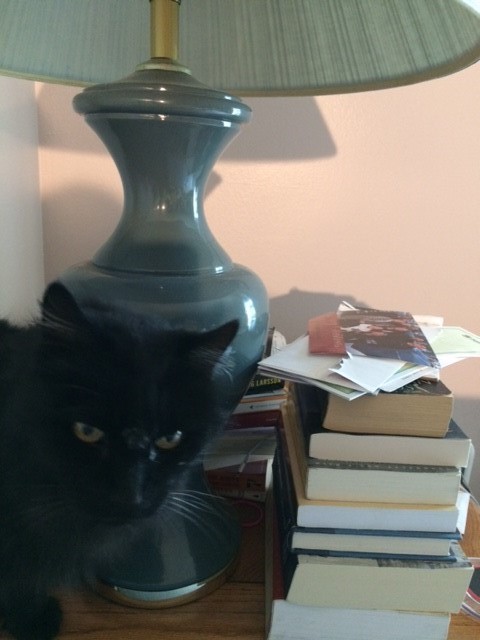
Disclaimer: A eulogy for a cat is perhaps a bit self-indulgent. Gremlin has been gone a week. I miss him very much and probably will for a long time. I ask anyone who isn’t into cats or animals is general to skip this. Thank you.
“Would you like his ashes?” the receptionist asked.
“No. Ashes are ashes.” I didn’t say what I wanted to say: Give me back my cat.
I’d just watched the vet carry Gremlin—or what had been Gremlin—away wrapped in a blanket, his head bobbing, his eyes only slits, his tongue poking out between his teeth.
“I feel the same way you do,” the receptionist said. She asked for my credit card. It would be easier than performing the transaction at the front counter.
After she left with the card, I told my husband, “I didn’t even think to ask how much this will cost.”
“It’s not like you have a choice,” he said.
“No.”
Give me back my cat.
I clutched the jacket I’d wrapped around Gremlin for this last ride to the vet. I wasn’t going to put him in a carrier. He hated the carrier. He’d been in kidney failure for about five years but had remained happy and sassy. True, the block wall fence had grown mysteriously taller with time, but for most of the nineteen years he’d been with me, it had proved no obstacle. Little stood in his way since he was a kitten so small he had to claw his way up to the couch.
He’d lost weight fast the last couple of weeks. That last morning when I went to feed him, he didn’t come out of the doghouse he slept in. I thought he might already be gone, but he sat up and lumbered out. He wandered around his enclosure. He was blind. He hadn’t been the day before. I picked him up and set him down by bushes where he liked to spray. He walked in unsteady circles by my feet.
He didn’t appear to be in pain, but he wasn’t eliminating. There was nothing in the litter box. His organs weren’t working. Add to this the blindness—
I wouldn’t put an animal down simply for being blind, but Gremlin’s blindness came from detached retinas due to hypertension because his kidneys weren’t working. They were never going to work.
“Talk me out of it,” I told my husband after I showed him how Gremlin walked.
“I don’t think I can,” he said.
My husband held him while I took a shower.
“He’s just been purring away,” he told me when I returned.
I held him while my husband took a shower. I called for the appointment. Nothing was open until 2:30, so for those hours, we talked to Gremlin. I told him he was loved.
I fed him and gave him some water. He ate a little and drank some. I took him outside and let him feel the sun.
I remembered this kitten who chewed our fingers when he first arrived and kneaded the back of my head in the middle of the night with very sharp little claws, who purred loudly next to me on the pillow. I remembered the kitten who ran out of his hiding place behind the bookcase to greet me when I came home from work. I remembered the cat who made it impossible to wrap presents because wrapping paper is a cat toy. I remembered the cat who played with the yo-yo my husband dangled before him. I remembered the cat who sat on the block wall washing his paws, ignoring the neighbors’ dog going nuts barking at him. I remember the cat who delighting in tearing up newspaper. I remembered the cat who cried every morning for breakfast as if he hadn’t been fed for a week. I remembered the cat who slept on the couch between me and my husband, one paw touching each of us, as if he didn’t want us to leave. I remembered the cat who pawed my husband’s shoulder because he wasn’t done receiving attention.
That morning, the cat curled up next to me on the couch, sleeping, content.

I kept you safe from coyotes and cars. I kept you—mostly—out of the wind, the rain, and the hot sun. I could not keep your kidneys from dying. But I kept you from suffering needlessly.
And when we came home with an empty jacket, I had no words. My husband hugged me and said, “I miss him, too.”
To the well-meaning receptionist: Fuck your ashes, trying to separate more of my money from me.
I want my cat back.
Review of “The Life and Times of Le Bronco von der Löwenhöhle”
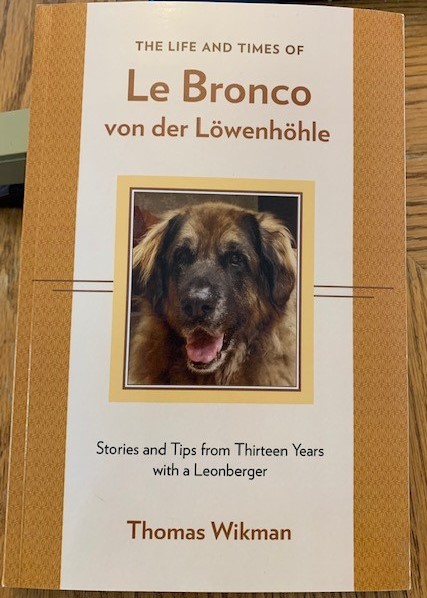
Long before I read this lovely tribute, I read and enjoyed Bronco’s adventures. Bronco was, without doubt, the goodest boy of them all—just like every dog.
Full disclosure: the author, Thomas Wikman, and I go back some years to a now-defunct writing site, Epinions. I have enjoyed his book reviews and letters to the editor for years.
That is not to say that the book is without surprises. For example, I didn’t know Thomas didn’t grow up with dogs. He has always come across as knowledgeable regarding animals. I assumed he’d been playing catch with four-footed beasts for as long as he could stand on two feet. I grew up with dogs. To me, a house without an animal isn’t a home.
Bronco was a Leonberger, a breed I’d never heard of before. It is an unusual breed in North America. Having originated in the 19th century in Germany, it remains more common in Europe. They are huge dogs, with the males weighing between 120 and 170 pounds and the females 100 and 135 pounds. They are similar to St. Bernards and are known for their gentle dispositions. This was the case for Bronco.
The author relates amusing stories about Bronco and the other dogs he and his family own(ed), which are entertaining. The tales serve more than to entertain, however. They show the family learning, though these are never mere didactic tools.
For example, the author relates that while he was talking with a trainer, Bronco kept poking him in the leg with his (sizeable) paw. The author ignored him because he was in the middle of a conversation. Bronco didn’t give up but bit his rear end—not hard enough to do damage, but hard enough to cause pain. Again, I stress the size of the dog. The author writes:
“I turned around, and there stood Bronco, looking at me with his happy eyes and wagging his tail as if he were completely innocent. I forgave him immediately.”
Rather than go off on the dog or slap him—as people might—he wisely asked the trainer why the dog acted like that. The trainer responded that Bronco wanted his attention but had to learn that he was not the one in charge and shouldn’t behave like that.
The love and caring the author and his family show for their dogs comes through on every page. It is not mere sentiment. He acknowledges that caring for animals is work and, at times, expensive. The dogs are walked, they’re cared for, and trained.
And the pictures! A photo of the cutest puppy on the planet—just like all the other puppies on the planet—when Bronco first arrived at about three months, and a photo of Bronco sitting on the lap of Thomas’ wife, Claudia. You have to take Thomas’ word for it because you can barely see any human in the picture. In addition to the photos, there are charming color drawings by Naomi Rosenblatt depicting some of the cutest and funniest incidents in the book. She also draws touching tributes to the dogs when they leave.
At the end of the book is a history of the Leonberger breed, including statistics, health concerns, and breed standards. This section also discusses the work of the Leonberger Health Foundation International, whose “mission is to improve the life, health, and longevity of the Leonberger,” according to its website.
The author and his stories of Bronco and the family’s other dogs are a reminder of how much animals enrich our lives. They are informative as well. I think any animal-lover will enjoy this—even if a Leonberger is not in your future.
The author is donating his proceeds from the sale of this book to the Leonberger Health Foundation International.
Title: The Life and Times of Le Bronco von der Löwenhöhle
Author: Thomas Wikman
First published: 2022
Available in print:
- Amazon.com
- Barnes & Noble
In kindle: - Amazon.com
Review of “The Lady from Shanghai” (1947)
Svengoolie was, alas! a rerun yet again, so we watched a noir for Saturday pizza and bad movie night. This little flick has Orson Welles speaking an (occasional) brogue and allowing himself to be lured into a circle of unpleasant people after a pretty girl winks at him.
Plot:
“When I start out to make a fool of myself, there’s very little can stop me,” begins the voiceover with a shot of a boat going under the Brooklyn Bridge. Michael O’Hara sets his eyes on a beautiful woman in a horse-drawn carriage in Central Park and offers her a cigarette. “But once I’d seen her, once I’d seen her, I was not in my right mind for some time,” the voiceover tells the viewer.
The voiceover is read by Orson Welles in the character of Michael O’Hara, an Irish merchant marine in the United States. The object of his adoration is Elsa Bannister (Rita Hayworth).
Once the carriage is out of view, thieves descend upon it. Elsa screams. A regular donnybrook arises between Michael and the three attackers, with the three bad’uns lying on the ground, groaning. Elsa and the driver are fine.
For no clear reason, Michael strands the driver and takes the reins of the carriage back to Elsa’s car, where he learns that Elsa is Mrs. Bannister. Bummer that. She offers him a job on her yacht. He declines.
Not as dumb as he looks.
The next day, Mr. Bannister (Everett Sloane) comes to the seaman’s hiring hall, where Michael has come for work on departing ships. Bannister offers him the job in gratitude for saving his wife.
Against his better judgment, Michael accepts the job.
It’s an unhappy cast and crew. Michael senses Elsa’s unhappiness. The two of them could run away together, except he has no money. Things go from bad to worse when they pick up Bannister’s law partner, George Grisby (Glenn Anders). Grisby offers Michael $5000—a lot of money in 1947—to sign a confession saying he killed Grisby. Grisby will then disappear. No body, no murder conviction (which was how the law read at the time). Michael sees the money as a chance to start over again with Elsa.
What could go wrong?
Thoughts:
This was based on the 1938 novel If I Die Before I Wake by Sherwood King. It also portrays a hapless main character getting caught up in the machinations of unpleasant and unscrupulous people with money.
Elsa wants to leave her husband, but he won’t let her. He hints that he used something in her past in China to coerce her into marriage. She lived and worked in dubious places. She may have worked as an entertainer, for she sings the movie’s signature song, “Please Don’t Kiss Me” (dubbed by an uncredited Anita Ellis). She may have worked as a working girl—which of course, didn’t exist, and if they did, they wouldn’t get a mention in a respectable movie.
The plot can get a little confusing. (“Now, who’s he again?”) Orson Welles talks a lot. A lot. Few scenes are without his face in them. Those nifty little twists and turns, unpleasant people, and femmes fatale appear, but this is Orson’s baby.
An amusing courtroom scene is followed by a chase through San Francisco’s Chinatown. I missed this, but when Elsa Bannister buys a ticket at a Chinese theater, the cashier greets her by saying, “Konnichiwa!” a Japanese greeting.
The most bizarre scene of the film is the final shootout, which takes place in a fun park hall of mirrors. It plays with the viewer’s sense of reality: Is this a dream?
Overall, I liked this movie. However, it would have been better if there had been less Orson Welles.
The movie can be watched here.
Title: The Lady from Shanghai (1947)
Directed by
Orson Welles…(uncredited)
Writing Credits
Sherwood King…(story based on a novel by)
Orson Welles…(screenplay)
William Castle…(uncredited)
Charles Lederer…(uncredited)
Fletcher Markle…(uncredited)
Cast (in credits order)
Rita Hayworth…Elsa Bannister
Orson Welles…Michael O’Hara
Everett Sloane…Arthur Bannister
Glenn Anders…George Grisby
Ted de Corsia…Sidney Broome (as Ted De Corsia)
Released: 1947
Length: 1 hour, 27 minutes
Review of “Shaun of the Dead” (2004)
To complete the trilogy, we end where it all started, Shaun of the Dead. It makes a whole lot more sense to anyone who has ever worked in retail.
Plot:
Shaun (Simon Pegg) is a twenty-nine-year-old electronics salesman by day. He spends the rest of his time playing video games with his friend, Ed (Nick Frost), or drinking at the local pub, the Winchester. This particular night, Shaun’s girlfriend, Liz (Kate Ashfield), complains to him they’re always at the Winchester, and he’s doing nothing with his life. They should do something else. Forming a chorus in agreement are her friends Dianne (Lucy Davis) and David (Dylan Moran). In the background, Shaun’s slacker friend, Ed, plays video games. Some of the dialogue is timed for deliberate misinterpretation.
The opening credits roll over scenes of people going about their daily jobs: cashiers, retail workers fetching carts (“trolleys” in the local parlance), picking up leaves, everyone behaving mechanically…
At home, Shaun sits down to play a video game with Ed until Ed reminds him he has to go to work. A third roommate, Pete (Peter Serafinowicz), lectures Shaun about letting Ed continue to freeload.
On his way to work, Shaun ignores headlines and weird occurrences—the homeless man trying to eat pigeons, the odd, shambling walk so many people in the street seem to have adopted.
After a humiliating day at work, he returns home. Ed points to a girl in the backyard (“garden,” the locals call it). She’s standing perfectly still, with her head cocked at an odd angle. Shaun and Ed conclude she’s drunk—until she falls onto a piece of metal that pierces her back and protrudes through her stomach. It takes her a couple of seconds, but she gets back up and heads toward our heroes.
Shaun and Ed decide to try to kill her by throwing household objects at her: including Shaun’s vinyl records. They then break into the shed. Shaun emerges armed with a cricket bat, Ed with a shovel, and they proceed to kill zombies.
Thoughts:
This was a lot of fun. I first saw it back in the day. It’s bloody and gory, well deserving of its R rating. Not for kiddies. In addition to the never-ending swearfest, there are more than a few bloody and gory scenes. One, in particular, is not gory per se but would be emotionally difficult for kidlets.
All that aside, this is funny. Shaun promises to make reservations at a restaurant for a date with Liz. Of course, it slips his mind for reasons having nothing to do with a zombie apocalypse. Liz dumps him. He shows up at her place with flowers he bought for his mother.
Shaun decides to hole up in the Winchester, but when he and his cohorts get within range of it, they find it surrounded by zombies. They must go undercover, that is, as zombies. Liz’s friend Dianne gives acting lessons. (“Nice vocals.”)
Killing the zombies—sometimes with a car—has a video game quality. Bashing people’s brains with a cricket bat or shovel is no less graphic.
Nothing is perfect. There are a few unfortunate racial references in the dialogue.
Beyond the title, which hints at Dawn of the Dead (1978 and 2004), this film borrows a line from the iconic Night of the Living Dead (1968). The intent is threatening but presented in such a clownish way that it’s funny.
I didn’t enjoy the film quite as much the second time around as I did the first, but it’s still amusing and enjoyable.
Shaun of the Dead won numerous film awards, including the 2005 Saturn Award for Best Horror Film from the Academy of Science Fiction, Fantasy & Horror Films; tied with Eternal Sunshine of the Spotless Mind for the 2004 Best Screenplay in Bram Stoker Awards; and the 2004 Best Screenplay in the British Independent Film Awards.
This below-average-joe becomes a hero tale makes for an enjoyable little flick, but it is not one for the kiddies or the squeamish.
Title: Shaun of the Dead (2004)
Directed by
Edgar Wright
Writing Credits
Simon Pegg…(written by) and
Edgar Wright…(written by)
Cast (in credits order)
Simon Pegg…Shaun
Kate Ashfield…Liz
Nick Frost…Ed
Lucy Davis…Dianne
Dylan Moran…David
Nicola Cunningham…Mary
Released: 2004
Length: 1 hour, 39 minutes
Rated: R
Review of “World’s End” (2013)
This is the last of the Three Flavours Cornetto trilogy movies, directed by Edgar Wright and written by Wright and Simon Pegg. The first two are the zombie movie Shaun of the Dead (2004) and the parody cop buddy movie Hot Fuzz (2007). Not much is said about ice cream in this one, but a lot is said about beer.
Plot:
Gary King (Simon Pegg) opens the movie recalling an “epic” pub crawl he and four school friends fell just short of completing at seventeen along the Golden Mile of their hometown of Newton Haven: twelve pubs beginning with the First Post and ending with (of course) the World’s End.
“In the end,” he tells the viewer, “we blew off the last three pubs and headed for the hills. As I sat up there, blood on my knuckles, beer down my shirt, sick on my shoes, knowing in my heart life would never feel this good again.”
“And you know, it never was.” The scene reveals King in a group therapy session. He grins. He now has an idea.
In the following few scenes, he contacts his old friends, Peter Page (Eddie Marsan), who now works for his father at a luxury car dealership; Steven Prince (Paddy Considine), a construction manager; Oliver “O-Man” Chamberlain (Martin Freeman), a real estate agent; and Andy Knightley (Nick Frost), Gary’s closest friend and a corporate lawyer. In each case, he lies and tells the person that everyone else has agreed to meet and try to complete the pub crawl they failed twenty-three years earlier. Most ask, “Even Andy?” To which King replies with the bald-faced lie, “Of course!”
Andy has been a teetotaler since he and King were in a car accident years earlier.
After some mishaps, they all reach Newport Haven, Gary dragging his half-willing friends. It’s been a while. The barkeeps no longer recognize them, except one at the Famous Cock, where Gary was barred long ago. At another pub, Pete encounters a man who bullied him in school. The man doesn’t recognize him. This upsets Pete—adding insult to injury from all the beatings in school—the man doesn’t even remember him.
In the restroom, Gary talks to a teenager who doesn’t respond. This irritates Gary to the point of physical confrontation. Gary knocks the teenager’s head off—it’s a mannequin—a robot that bleeds blue blood.
All of which leads to all five friends squaring off in the “gents” with a group of… teenage robots that bleed blue blood and shed body parts like Barbie dolls.
WTF, indeed.
Thoughts:
First, this does not stand up to the first two movies. There is a desperate sadness about Gary’s character, trying to recapture the one glorious night of his youth. It can’t be done; you are not the same person, and your hometown is not the same place. Toward the end of the movie, it’s revealed he’s recently survived a suicide attempt. He’s an alcoholic about forty years old.
Gary tells Andy: “It never got better than that night! That was supposed to be the beginning of my life! All that promise and fucking optimism! That feeling that we could take on the whole universe! It was a big lie! Nothing happened!”
Not to say there aren’t genuinely funny moments. Oliver’s sister Sam (Rosamund Pike) joins the bunch at one point. Both Gary and Steven have a thing for her. Gary, wanting to reenact a sexual encounter they once had in the disabled restroom, follows Sam to the ladies’ restroom. As one might expect, he gets his fact slapped. Later in the film, after they’ve talked for a bit, Gary says, sounding not at all like Humphrey Bogart, “I guess we’ll always have the disableds’.” Tacky and inappropriate, but quite funny, it also speaks to growing up a bit.
And the pubs? They all look the same. All corporate-owned, trying to look traditional. Uh-huh.
Things get weird toward the end of the movie. However, I think it’s safe to say that Gary finds his purpose after all.
World’s End won the Empire Awards (UK) Best British Film Award in 2014. Its director, Edgar Wright, was nominated for Best Director. World’ End also won a 2013 Golden Schmoe Award—Best Line of the Year”—for its riveting discussion of the meaning of the phrase “WTF.”
I have mixed feelings about this movie. I can’t say that it was bad. It certainly had its moments, but there was an underlying sadness that the other flicks didn’t have.
There is no explicit sex, but there is a lot of violence profanity and potty talk. It’s funny, but not one for the kidlets, I’m afraid.
Title: World’s End (2013)
Directed by
Edgar Wright
Writing Credits
Simon Pegg…(written by) &
Edgar Wright…written by)
Cast (in credits order)
Thomas Law…Young Gary
Zachary Bailess…Young Andy
Jasper Levine…Young Steven
James Tarpey…Young Peter
Luke Bromley…Young Oliver
Sophie Evans…Becky Salt
Released: 2013
Length: 1 hour, 49 minutes
Rated: R
Review of “Hot Fuzz” (2007)
We chose something from this century for our Saturday night pizza and bad movie. We do that once in a while, especially when Svengoolie is a rerun. This particular masterpiece is a sendup of cop buddy movies with a British flare. If you’re watching from this side of the pond, I recommend subtitles.
Plot:
Nicholas Angel (Simon Pegg) is such a good cop with such a high arrest record that he makes the rest of the London Police Force look bad. As a reward, he receives a promotion, whether he wants it or not, and a transfer to the countryside village of Sandford, which has virtually no crime and has been the winner of the Village of the Year for several years.
Recognizing the newcomer, the villagers greet Angel before he even reports to his first shift. At the pub (he drinks cranberry juice), he notices underage kids drinking and chases them out. The proprietors, Bernard and Joyce Cooper (Eric Mason and Billie Whitelaw), admit they realize the kids were underage, but if they’re all in their place drinking and socializing, they can’t be causing trouble someplace else, can they? It’s all for the greater good.
But Angel isn’t done. On his way out of the pub, he stops an obviously drunk young man from getting in his car. He drags him down to the station—once he finds out where it is—and asks the desk sergeant to throw him in the drunk tank for the night.
Imagine his surprise the next morning at work when he asks about “the inebriate” in the drunk tank and finds the cell empty. Not only is the cell empty, but “the inebriate” is his partner, PC Danny Butterman (Nick Frost)—and Danny is the son of the boss, Inspector Frank Butterman (Jim Broadbent).
The boss gives Angel a short tour of the station. Angel is appalled. None of his coworkers seem to care at all about their work. The tour concludes in an upper room marked “N.W.A.,” the Neighborhood Watch Association. Perhaps I read too much into the initials.
Aside from that, the civilian liaison, Tom Weaver (Edward Woodward), complains to the captain about a group of boys in hoodies and a “living statue” (Graham Low), a street performer painted bronze.
The inspector assures him it will all be taken care of.
On patrol, Angel and Butterman stop a couple, Martin Blower and Eve Draper (Lucy Punch and David Threlfall), flying down the road significantly over the speed limit. A smarmy Blower says they’re late for an “homage” to Shakespeare’s Romeo and Juliet while Eve plays with her hair. Of course, Angel and Butterman have to attend and witness the execrable performance.
Later, a knock comes on Blower’s dressing room door, where he and Eve are smooching and drinking champagne. When Blower opens it, a figure wearing a hooded cape appears with an ax. Blood splatters all over the door.
Angel is later notified of a terrible traffic accident (“Collison,” he corrects the officer on scene). The deceased are the actor Blower and the leading lady, Eve Draper. It must have been some accident; their heads are sitting in the middle of the road.
Angel wonders…
Thoughts:
All the motifs of a cop buddy movie are here and are played with, as is the idea of the perfect English village. The language is not for the kiddies, and there are some gory scenes, but it is all presented with a lot of humor, horror, and silliness.
PC Butterman is a fan of action movies. While his partner chases a shoplifter through a store, he blithely examines a display of DVDs.
Following the bloody scene where Blower and Eve are killed and their heads left on the road, the viewer sees Angel’s phone ring. He sits up in bed and answers it. “Yeah?” he says. “Decaffeinated?”
Inappropriate, perhaps, but also quite funny. I admit, it takes a certain dark sense of humor to laugh at this, but there is a certain clownishness.
For example, when answering a complaint about a farmer who has trimmed someone else’s hedges, Angel and Butterman take Saxon, the K-9, along. They don’t need the dog, but they need the handler, PC Bob Walker (Karl Johnson), who alone can interpret the accent of farmer Arthur Webley (David Bradley). Because Walker is slightly less unintelligible than Webley, Butterman will translate his mutterings to Angel.
Mr. Webley, it turns out, has a large arsenal of unregistered weaponry, including a mine, presumably left from WWII. How he got it to his shed is not discussed. They seize the arsenal, and now the evidence room has something other than dust on its shelves.
Cate Blanchett and Peter Jackson make cameo appearances.
Hot Fuzz won the 2008 Empire Awards for Best Comedy. It also won the (UK) 2007 National Movie Awards for Best Comedy.
The final scenes, the obligatory buddy cop shootout sequence, is as absurd as it is bloody. It’s worth the price of admission all by itself. Yes, Sergeant Angel rides a white horse to face down the bad guys.
This was a lot of fun.
Because the movie is so recent, I couldn’t find it available for free download.
Title: Hot Fuzz (2007)
Directed by
Edgar Wright
Writing Credits
Edgar Wright…(written by) &
Simon Pegg…(written by)
Cast (in credits order)
Simon Pegg…Nicholas Angel
Martin Freeman…Met Sergeant
Bill Nighy…Met Chief Inspector
Robert Popper…’Not’ Janine
Joe Cornish…Bob
Released: 2007
Length: 2 hours, 1 minute
Rated: R
Review of “Frankenstein 1970” (1958)
Our Saturday pizza and bad movie was a return to an old friend, both in monster and actor. Svengoolie didn’t disappoint.
Plot:
The opening scene of this black-and-white flick shows a young blond woman, Carolyn Hayes (Jana Lund), pursued by a lumbering man whose face is not shown (Mike Lane). The young woman backs into a pond. The lumbering man holds her head under—for a while. The viewer hears someone yell, “Cut!”
And still, the man holds the hapless young woman under. The actor playing the monster, Hans Himmler, doesn’t speak English. Someone has to translate.
He releases the actress, who emerges coughing with some sort of vegetation in her hair.
The director, an obnoxious Douglas Row (Don “Red” Barry), has words with his assistant, who happens to be his ex-wife, Judy Stevens (Charlotte Austin). They’re making a film at Castle Frankenstein to commemorate the 230th anniversary of the original monster.
Inside the castle, Baron Victor Frankenstein (Boris Karloff) grouses with his friend, Wilhelm Gottfried (Rudolph Anders), his financial advisor, about letting those movie folk onto his property. Wilhelm reminds him he’s strapped for cash. The Baron keeps buying laboratory equipment, like that nuclear reactor, which people in 1958 apparently expected to be available for the discerning consumer by 1970.
Later, chummy, loud-mouthed Director Row fixes himself drinks, puts his arm over the Baron’s shoulder (earning his hand a dirty look), and asks about shooting some film in the Baron’s family crypt. After all, it’s conveniently located downstairs… He passes the Baron some cash. It’s a deal.
But there’s more downstairs than the director bargained for.
Thoughts:
This was released in 1958 but set in 1970. The character of Victor Frankenstein, the last of his line, tortured by the Nazis, has scars on his face. These scars change from scene to scene.
Karloff is at his hammiest here, and there are some unintentionally amusing scenes.
At one point, Wilhelm, well acquainted with the Frankenstein family history, inquires what the Baron needs with all that laboratory equipment. There’s more. “What business do you have with the coroner?” he asks. Uh-oh. Wilhelm sees the same look on the Baron’s face the Baron’s mom might have seen when she turned the kitchen light on one night to find her boy’s hand in the cookie jar.
How does one dispose of… extra parts? The powers that be deemed the sound of grinding machinery too gruesome, so they substituted the sound of a toilet flushing.
The writers also gave the ardent fan a scene that pays tribute to the Son of Frankenstein and that Young Frankenstein would later use.
The actors in the movie-within-the-movie have their own dramas going on. The obnoxious director makes eyes at the leading lady and taunts his ex-wife. She rolls her eyes and collects her paycheck.
The film was shot in eight days. It is hardly a masterpiece, but it is a lot of fun. I liked it.
The movie can be watched here:
Title: Frankenstein 1970 (1958)
Directed by
Howard W. Koch
Writing Credits (in alphabetical order)
Richard H. Landau…(screenplay) (as Richard Landau)
Charles A. Moses…(story)
Aubrey Schenck…(story)
Mary Shelley…(characters) (uncredited)
George Worthing Yates…(screenplay)
Cast (in credits order)
Boris Karloff…Baron Victor von Frankenstein
Tom Duggan…Mike Shaw
Jana Lund…Carolyn Hayes
Don “Red” Barry…Douglas Row (as Donald Barry)
Charlotte Austin…Judy Stevens
Released: 1958
Length: 1 hour, 23 minutes
Review of “Dr. Strangelove or: How I Learned to Stop Worrying and Love the Bomb” (1964)
Svengoolie was a rerun again this week, so we borrowed Dr. Strangelove, a movie I hadn’t seen all the way through before. I first saw bits and pieces of it as a kid, back in the days when the ending was a possibility. Doomsday machine? Yeah.
Plot:
At (fictional) Burpelson Air Force Base, Brigadier General Jack D. Ripper (Sterling Hayden) calls his second-in-command, Group Capt. Lionel Mandrake (Peter Sellers) to let him know he’s received orders. “We’re in a shooting war. I want you to transmit plan R to the wing.” He further orders that the base be sealed and all private radios be confiscated.
He’s lying. When Mandrake realizes the Soviets have not attacked and life carries on outside pretty much as usual, he asks Ripper for the codes to recall the planes from attacking Russia. Ripper refuses, locks the two of them in the office, and tells him he plans to force the politicians into “total commitment.
“I can no longer sit back and allow Communist infiltration, Communist indoctrination, Communist subversion and the international Communist conspiracy to sap and impurify all of our precious bodily fluids.”
Upon reading a similar note, the assembled dignitaries in the Pentagon’s presidential “War Room” say, “We’re still trying to decide what he means by the last line.”
Aboard one of the B-52s that continually patrol the limits of US airspace with their nuclear payloads, the crew receives the go-code. After it’s confirmed, Maj. “King” Kong (Slim Pickens) opens the safe, retrieves his cowboy hat and the attack plans, and passes the packets to each person. The background music is the Civil War tune, “When Johnny Comes Marching Home.”
In the “War Room” at the Pentagon, Air Force General “Buck” Turgidson (George C. Scott) briefs President Merkin Muffley (Peter Sellers) on what’s just happened. The befuddled president finally understands the planes can’t be called back without the recall code, which only General Ripper has. The Soviet ambassador, Alexi de Sadesky (Peter Bull), explains the Doomsday machine, which will automatically trigger if the Soviet Union is attacked or if the bomb is tampered with. If it goes off, it will “destroy all human and animal life on earth,” and “an evil cloud of radioactivity … will encircle the earth for 93 years!”
The president asks the resident scientific expert if such a device is possible. Dr. Strangelove (Peter Sellers), a former Nazi, who now uses a wheelchair, rolls out. In so many words, he says, yes, it could happen.
The President calls Soviet Premier Dimitri Kissov, who is quite drunk.
Thoughts:
The black-and-white film opens with a statement scrolling across the screen, assuring the viewer that, according to the Air Force, their safeguards would prevent the events of this film from happening. It also says no real people are depicted in the movie. I don’t know. I gotta wonder about Bat Guano. He reminds me of an old boss—but that’s neither here nor there.
A voice-over speaks of rumors about the “ultimate weapon” being built by the Russians in a desolate place. The opening credits roll over shots of in-air jet refueling while 1930s-style romantic music plays in the background.
How’s that for setting the mood?
The black humor is delivered in understated scenes for much of the movie. The leaders quarrel and envision the post-apocalyptic world with ten beautiful women for each man. On the phone to the Russian premier (who never appears or is heard), President Muffley says things like, “How do you think I feel, Dimitri?” In the same call, he continues, “I’m very sorry… *All right*, you’re sorrier than I am, but I am as sorry as well… I am as sorry as you are, Dmitri! Don’t say that you’re more sorry than I am, because I’m capable of being just as sorry as you are… So we’re both sorry, all right?… All right.”
There are great lines:
Turgidson and Sadesky get into a fight when the ambassador starts taking clandestine photographs of the war room.
President Muffley reminds them to show some resect: “Gentlemen, you can’t fight in here! This is the War Room.”
In contrast to the men in the war room, frittering away their time, the men in the B-52 are determined to do their duty. They are convinced the Russians have already attacked the United States and wiped significant parts of it out.
Locked in a room with the increasingly unstable General Ripper, Captain Mandrake asks for the recall codes. “Don’t want to start a nuclear war unless we really have to, now, do we, Jack?”
There is also the character of Dr. Stranglelove himself, an ex-Nazi scientist who slips and calls the president “Mein Führer!” With an apparent will of its own, his right arm springs out occasionally as if it has just heard, “Sieg heil!” No one around him reacts as if this is anything out of the ordinary.
The movie is based on a 1958 novel titled Red Alert by Peter George. While most of the basic plot elements of the book and the film are the same, the ending is different, and the book does not contain the character of Dr. Strangelove. The book is also a serious work, while the movie is a farce and full of black humor.
I loved this movie. I will admit that it’s not everyone’s cup of tea, but I really enjoyed it. And with a despot in Russia threatening to release nukes if others don’t dance to his tune, it’s a reminder of the sheer insanity of the weapons and the arms race themselves.
From the New Yorker (yeah, you may hit a paywall)
Almost Everything in “Dr. Strangelove” Was True | The New Yorker
Title: Dr. Strangelove or: How I Learned to Stop Worrying and Love the Bomb (1964)
Directed by
Stanley Kubrick
Writing Credits
Stanley Kubrick…(screenplay) &
Terry Southern…(screenplay) &
Peter George…(screenplay)
Peter George…(based on the book: Red Alert by)
Cast (in credits order)
Peter Sellers…Group Capt. Lionel Mandrake / President Merkin Muffley / Dr. Strangelove
George C. Scott…Gen. “Buck” Turgidson
Sterling Hayden…Brig. Gen. Jack D. Ripper
Keenan Wynn…Col. “Bat” Guano
Slim Pickens…Maj. “King” Kong
Peter Bull…Russian Ambassador Alexi de Sadesky
James Earl Jones…Lt. Lothar Zogg
Released: 1964
Length: 1 hour, 34 minutes
Rated: PG
 Reviews of Old and New Stories. Mostly Old