
This is the second sequel to the 1958 classic The Fly. No original cast members appear, but the movie carries over concepts and the family name.
Plot:
The first thing the viewer sees is window glass breaking. A dark-haired woman (Carole Gray) crawls out the window wearing nothing more than her underwear. While the credits resolve from white globs (annoying), she runs behind trees on the grounds of what appears to be a large estate or… something. Once she gets through the gates, the camera focuses on a sign reading “Fournier Mental Hospital.”
Driving along in his car is Martin Delambre (George Baker). The woman appears ahead of him, running down the road…in her underwear. He stops to do the gentlemanly thing. He gives her a sweater.
After learning Delambre is headed for Montreal, the woman says Montreal is exactly where she wants to go. She introduces herself as Patricia Stanley. Her parents are deceased, and she has no family, friends, or money. She tells Delambre she worked for a writer. Because her boss’s husband—well—started paying her unwanted attention, she had to leave quickly. (Again, in her underwear?) He offers to help her go back for her things, but she quickly declines.
Has Martin picked up an ax murderer? Some psycho who will kill him in his sleep? Yeah, so you might think. While Pat is contemplating looking for a job, Martin calls home and and asks his butler, Tai (Burt Kwouk), to tell his father the new equipment will be ready in a week.
Delambre senior (Brian Donlevy) is not in the next room but in London with Martin’s brother, Albert (Michael Graham). Tai contacts them by shortwave radio. Albert scolds his father for not telling Martin the truth—he’s suffering from radiation burns after teleporting there from home. He also reminds his father about the accidents: “Judith, Samuels, and Dill.”
Meanwhile, back in Montreal, romance blossoms between Pat and Martin. It’s been a week, and she hasn’t started looking for a job. He has to cut one date short, though, when he is suddenly seized with belly pains. He assures her he’s not ill and refuses to go to a doctor. Later, the viewer sees him badly scarred, a syringe lying next to his bed.
So, they’re both hiding important secrets. What to do? Why—get married and bring the girl home to Papa, of course. Those crazy kids.
Thoughts:
In addition to The Fly, this movie borrows a little from Jane Eyre, Rebecca, Gaslight, and a handful of horror movies and books.
The Delambre clan, still living down the horror and scandal that occurred in Montreal some unspecified time earlier, have staked themselves out an estate in the wilds of Quebec that resembles a tropical mad scientist lair, including rattan chairs and birds in cages.
Before the nervous breakdown that sent her to the mental hospital, Pat was a concert pianist. She’s delighted to see a grand piano at her new home. Interestingly enough, Martin’s first wife also played piano…and she still does, if not as well as she used to. Oh, did Martin forget to mention her? Yeah, um…
It is fun to watch a steely Mrs. Danvers sort of housemaid in Wan (Yvette Rees–who is as Asian her name sounds) freeze out the poor new Mrs. Delambre. Pat seems confused at first. But she’s not an idiot. Even drugged, she understands someone is playing with her head. It takes her a while to figure out why.
On a side note, the call signs used when parties communicate between Quebec and London via shortwave are in the proper form for Canada and Great Britain. My dearly beloved looked them up; the one used for Great Britain has never been assigned. People accused someone using the Canadian sign used in the movie of selling bad ham gear, something that isn’t done.
Despite the exploitation (Really. Running away in your chonis? Couldn’t you have signed yourself out?) and the lack of ethics on the part of the Dealmbres, this was an entertaining film. Citizen Kane, it isn’t, but I enjoyed it.
I couldn’t find an English-language version of this as a free download, pero esta es la versión en español gratis with English subtitles:
Curse of the Fly (1965) – Español Latino – Película Completa – YouTube
Title: The Curse of the Fly (1965)
Directed by
Don Sharp
Writing Credits
Harry Spalding…(written by)
George Langelaan…(concept and characters) (uncredited)
Cast (in credits order)
Brian Donlevy…Henri Delambre
George Baker…Martin Delambre
Carole Gray…Patricia Stanley
Yvette Rees…Wan
Burt Kwouk…Tai
Released: 1965
Length: 1 hour, 26 minutes
Spring Cleaning Begins Part I
I’ve decided to close my amazon seller account down and gradually donate the one hundred twenty books left to the local library, five books a week until they’re gone. I’ll leave a short (for me) write-up before I donate the books as a way of saying goodbye. These are all books I read and, for the most part, loved over the years. It’s just that, well, I have a few books, and I don’t need them. I won’t reread most of them. Finding them a happy home is the next best thing.
There’s no theme; the books are arranged alphabetically, so I could find them easily when the odd order came in.
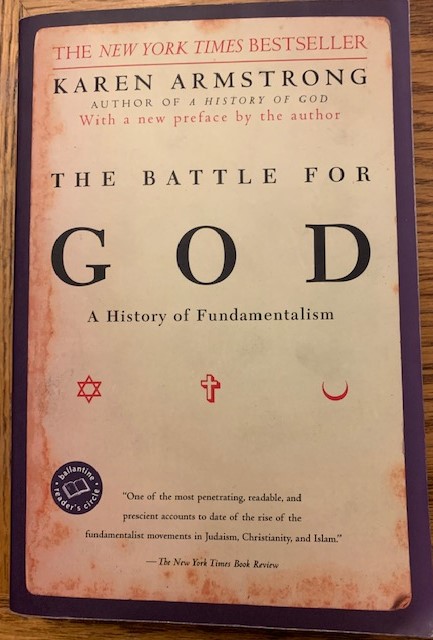
The Battle for God: A History of Fundamentalism by Karen Armstrong examines the rise of what the author calls “militant piety popularly known as fundamentalism” within every major religious tradition. This is despite the popular notion in the early and mid-20th century in western countries that religion would soon come to have no bearing on public life. She takes a long historical perspective, beginning with the late 15-century expulsion of Jews and Muslims from Spain, and continues with a preface written barely a month after the 9/11 attacks.
Her approach is neither forgiving nor damning but one that seeks understanding. Fundamentalism is not going away, she says. We should try to understand it.
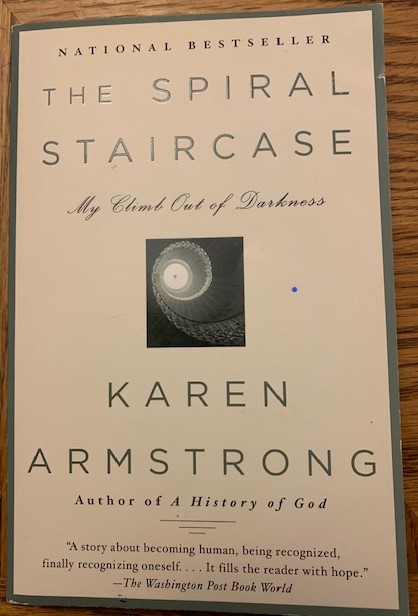
The Spiral Staircase: My Climb out of Darkness by Karen Armstrong is a memoir and sequel to the author’s first book, Through the Narrow Gate. The earlier book describes her seven years in a convent. She draws the present title from T.S. Eliot’s poem “Ash Wednesday,” which she quotes in full at the beginning of her text. While she discusses her time as a nun, most of the book depicts events after she leaves the convent and begins to rebuild her life.
Armstrong is seldom angry with anyone, despite suffering what is obviously abuse and neglect, particularly in the area of an undiagnosed medical condition. When she is angry, she is justified.
This is a deeply heartfelt memoir.
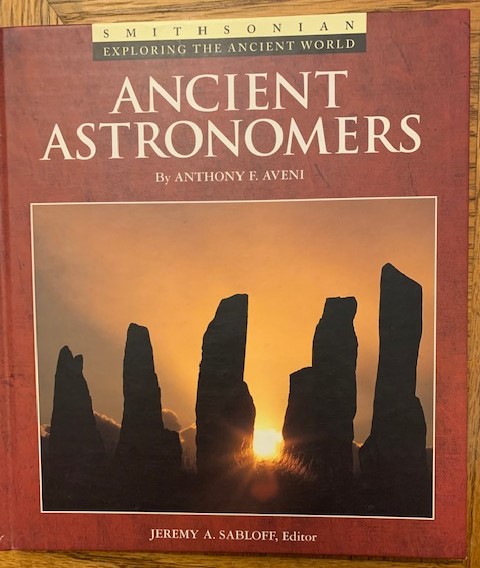
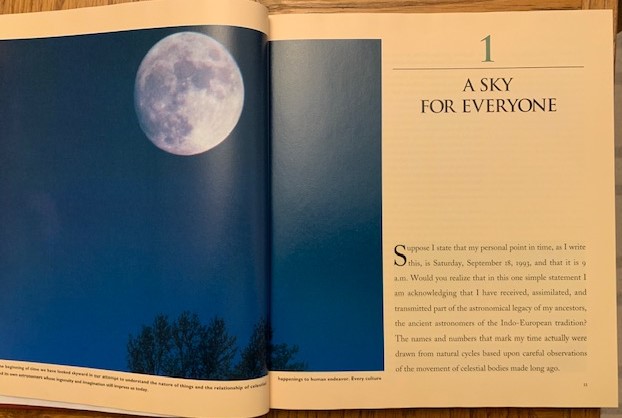
Ancient Astronomers by Anthony Aveni is a wonderfully illustrated hardback surveying astronomy in ancient and traditional societies, including Mesopotamia and Oceania. This is written for the interested layperson with no technical background.
I’m going to miss this book and its pretty pics. I hope it finds a good home.
The book is part of the Smithsonian Exploring the Ancient World Series.
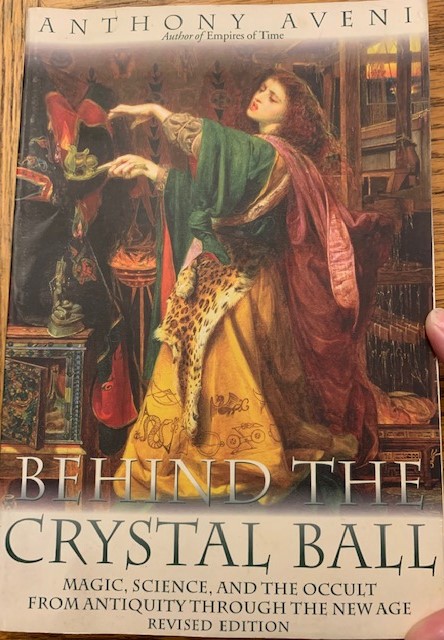
Behind the Crystal Ball: Magic, Science, and the Occult from Antiquity through the New Age by Anthony Aveni examines the role magic plays in society, from ancient ties to the present. His interest is not in debunking but in understanding what practitioners seek with it. The book is divided into chronological sections with a summary at the end of each section. If it sends chills because it sounds like a textbook, let me ease your mind. Few textbooks cover topics like hepatoscopy, Kabbalah, clairvoyance, alchemy, and spiritualism all in one volume.
It is a fun but not light read.
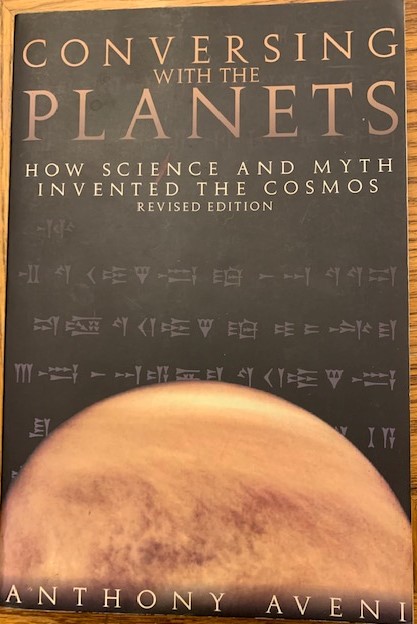
Conversing with the Planets: How Science and Myth Invented the Cosmos by Anthony Aveni is about the social function of astrology in pre-modern societies. As with his study of magic, the point is not to debunk it, but to ask, what are people seeking when they study astrology? In his preface to the revised edition, Aveni states, “People used astrologers in those days the way we use psychologists or counselors today—to weigh the balance, to help make choices, to move us off the dime so that we can make a decision about our lives.”
There is a certain subtle logic to it as Aveni discusses with respect to things like the phases of Venus—not with one’s love life or lottery numbers, but with things like seasons. Naked eyes astronomy was important, if not life-sustaining, to agrarian peoples.
Like the previous volume, it is a fun but not light read.
Bios:
Karen Armstrong (b. 1944) is a British author. At seventeen, in 1962, just as the Vatican II Council was getting underway, she entered a convent, an experience she wrote about in her book, Through the Narrow Gate (1981). She left the convent in 1969. She earned a degree in English literature from St. Anne’s College, Oxford, and taught at a girls’ school before becoming an author and a presenter of television documentaries.
Anthony Aveni (b. 1938) is an American anthropologist who trained as an astronomer. He is professor emeritus at Colgate University in Hamilton, NY. He specializes in archaeoastronomy, particularly that of ancient Latin America. He has written or edited some thirty-five books.
Final note: I’m going to miss these books. I enjoyed reading them years ago, but I’m not going to re-read them. I’ve had my amazon seller account since August of 2018, sold about seventy book and made about seventy dollars. In short, I contributed to Jeff Bezos sending himself and a few select friends into the edge of space. The local library can probably do something more constructive with whatever money they can glean from these books, and most importantly, the books will probably find happy homes.
Review of “Return of the Fly” (1959)
This is the black-and-white sequel to last week’s movie The Fly. We borrowed it too from our local library—and in the same collection, no less. Here, Philippe, the now-adult son of the unfortunate Andre Delambre from the first film, can’t leave well enough alone.
Plot:
The film opens with the funeral of Helene Delambre, the widow of Andre and the mother of Philippe (Brett Halsey). The voiceover is spoken by François Delambre (Vincent Price), Andre’s brother. A pushy reporter (Jack Daly) asks insulting questions about Andre Delambre’s death. Infuriated, Philippe grabs the man, but further violence is deterred by Inspector Beauchamp (John Sutton), who tells the reporter to cease such tactics.
“Inspector Beauchamp, you were part of that big cover-up, weren’t you? This is going to make nice reading, I promise you!” the report threatens and stomps off.
Later, in the car, Philippe asks his uncle François, “Why was Mother accused?”
François is reluctant, but after his nephew’s insistence, asks the driver to take them to the old foundry, Delambre Frères, and shows him the old lab. He explains to him his father’s work and the accident that made him half-human, half-fly, which led to his tragic, horrific death.
Philippe has been doing some research in the same field as his father. In fact, he has a lab set up in his grandfather’s mansion, which he plans to share with a prospective assistant, Alan Hinds (David Frankham). He also has a sweetheart, Cecile (Danielle De Metz), the daughter of the live-in maid.
Francois tells Philippe he will not help him with his experiments. He’s concerned about his nephew’s safety, and the business is nearly broke. After Philippe threatens to sell his interest, François agrees to stay and observe. He’s not pleased this former employee, Hinds, is now working with his nephew. Neither man knows Hinds’ secrets. To begin with, Hinds is not his real name. Returning to England might earn him a hanging, but that doesn’t mean he can’t do business in Montreal—with the right people.
Thoughts:
This is, in many ways, a rare bird, a sequel that surpasses the original. Like Andre and Helene in the original, Philippe is sympathetic. When we meet him, he is burying his mother. He’s also got a touch of youthful arrogance: His father was careless. He’ll be careful. At the same time, he wants to carry on his father’s work to vindicate it.
The viewer is aware of the Hinds’ intrigue—and ruthlessness—long before the characters are. They find out when lives are in peril. Philippe (understandably) can’t stand flies.
The movie wouldn’t be complete without some gore. A guinea pig suffers under an oppressive heel. They must have been fresh out of cats. Philippe, the victim of industrial espionage and a cruel trick, takes his vengeance out on those who hurt sought to destroy him.
While I enjoyed much of this film, I did not like (or believe) the forced, artificial ending. Nevertheless, this flick is worth a watch, but I would caution against having young children watch it because of the animal killing depicted. I didn’t particularly care for it myself.
Unfortunately, I could not find it available for free download.
Title: Return of the Fly (1959)
Directed by
Edward Bernds…(as Edward L. Bernds)
Writing Credits
Edward Bernds…(screenplay) (as Edward L. Bernds)
George Langelaan…(short story “The Fly”)
Cast (in credits order)
Vincent Price…Francois Delambre
Brett Halsey…Philippe Delambre
David Frankham…Ronald Holmes, alias Alan Hinds
John Sutton…Insp. Beecham
Dan Seymour…Max Barthold
Danielle De Metz…Cecile Bonnard
Released: 1959
Length: 1 hour, 20 minutes
Review of “The Fly” (1958)
We borrowed this week’s Saturday night pizza and bad movie offering from the library.
Plot:
This 1958 color horror film is based on a short story by George Langelaan, first published in June 1957 in Playboy—yes, that Playboy. I guess someone read the articles.
The movie opens with Gaston (an uncredited Torben Meyer), night watchman at Delambre Frères Electronics in Montreal, making his rounds. An alarm bell rings, and the sounds of a hydraulic press working follow, neither of which Gaston expects from a factory closed for the day. He hurries to the press. A well-heeled woman (Patricia Owens) sees him and flees. To his horror, he realizes blood is running down the sides of the press, and human remains lie to one side of it.
The scene then cuts to a ringing phone on a desk. A man (Vincent Price) answers it. He’s delighted to hear from Helene.
Calling him is the well-heeled woman who ran from the press. “Francois, I’ve killed Andre. I need your help.”
“Now look, I love you both,” he tells her, “but it’s late.”
He starts to take it a bit more seriously when she says, “Call the police and come quickly.”
He does as she asks. Things take an even graver turn when Gaston calls him to report a murder. Francois calls an acquaintance, Inspector Charas (Herbert Marshall), at the club where they’re both members.
Helene Delambre is polite and calm, talking to Inspector Charas as she admits to killing her husband Andre (David Hedison). She declines to tell him why she did such a thing but offers him coffee. However, the killing was not murder, for it was in accordance with Andre’s last wishes.
The Inspector asks to see Andre Delambre’s home laboratory only to find it in shambles. He arranges for a nurse for Helene. Helene nearly melts down when the nurse swats a fly. Once she knows it’s only a regular fly, she is relieved.
Thoughts:
Helene finally reveals what is bothering her and how she came to kill her beloved husband, telling her story in flashback. Her scientist husband, Andre, built a matter transporter machine. Everything goes wells; a plate they received as a wedding present transfers from one box to another in a separate room. However, the legend “Made in Japan” is reversed. Later, Delambre thinks he has solved the problem and (the bastard) entices the family cat, Dandelo, into the box with the saucer of milk. The saucer comes out fine. All that’s left of the cat is haunting little meow.
Who gets to explain to their son Phillipe (Charles Herbert) that Dandelo isn’t coming back?
What makes this all the more poignant is Francois’ declarations to the Inspector that his brother Andre and sister-in-law believe in the sanctity of life. They wouldn’t hurt anything, not even a fly.
Without laying too great a burden on the film, I will say that the idea of the sanctity of life arises–not in the sense of exacting a karmic debt, but posing a question about preserving life in the face of unbearable suffering.
The special effects are hokey from the vantage point of 2021 (nearly *GULP* 2022), but the flashing lights/neon/black routine while the transporter is up and running is impressive. I imagine watching that light show in a dark theater would be all the more so.
The acting, particularly of Vincent Price and Patricia Owens, is engaging and believable. I think the story itself would be more compelling if told linearly rather than in flashback. Nevertheless, this film is full of striking scenes, such as the multiple images of Helene’s screaming to simulate the Fly’s compound eye.
According to the IMDB, The Fly was nominated for a Hugo Best Dramatic Presentation in 1959. The screenplay was written by James Clavell, who also wrote the screenplay for The Great Escape (1963), the 1975 novel Shogun, and many other things. The author of the original story the movie was based on, George Langelaan, wrote a memoir, The Masks of War (1959), describing his time as a spy for the Allies. He parachuted into occupied France to make contact with the resistance but was captured, imprisoned, sentenced to death. He escaped and returned to England and later participated in the D-Day invasion. He received the French Croix de Guerre.
The Fly was remade in 1986. Both films have strengths and weaknesses. I like this for what it is.
I could not immediately find a copy of this available for download for free.
Title: The Fly (1958)
Directed by
Kurt Neumann
Writing Credits
James Clavell…(screenplay)
George Langelaan…(based on a story by)
Cast (in credits order)
David Hedison…Andre Delambre (as Al Hedison)
Patricia Owens…Helene Delambre
Vincent Price…François Delambre
Herbert Marshall…Insp. Charas
Kathleen Freeman…Emma
Released: 1958
Length: 1 hour, 34 minutes
Review of “Tension” (1949)
This is a slightly different take on our Saturday pizza and bad movie night, a noir from 1949.
Plot:
Lt. Collier Bonnabel (Barry Sullivan), standing outside the door to the homicide (“a fancy word for murder”) division, introduces himself to the viewer. He says the only way he knows to break homicide cases is tension. “Everybody has a breaking point.”
We are next introduced to Warren Quimby (Richard Basehart), the night pharmacist at an all-night drugstore, the kind of place (according to the narration supplied by Lt. Bonnabel) that will supply you “raisins and radios, paregoric and phonographs, vitamin capsules and cap pistols. They’ll serve you a cup of coffee, sell you a pack of cigarettes or a postage stamp, and in a pinch, they’ll even fill a prescription for you.”
Quimby doesn’t mind the long hours. He’s saving up to buy a nice house for Claire (Audrey Totter), the lovely wife whom he loves and who he’s sure loves him in return–until he comes home to find her packing. She’s moving in with a real man, Barney Deager (Lloyd Gough), where she can spend her time barbecuing on the beach in Malibu.
After getting his rear end handed to him in a short bout of fisticuffs with the man who stole his wife, Quimby devises a scheme. He’ll take on a new weekend identity and kill Deager. He succeeds in creating the new persona, perhaps too well.Isn’t he surprised when Mrs. Quimby comes back home with her luggage and announces that someone shot Deager.
Thoughts:
This has a lot of noir elements, particularly in the portrayal of the amoral Lt. Bonnabel. The lieutenant himself, as promised in the opening narrative, will do anything it takes to get suspects to break. At the very end, when the bad’un is shown up by an elaborate lie, one of the innocents points out that what Bonnabel said cannot be true. The lieutenant shrugs his shoulders and says setting ups the conditions he talked about would have been a lot of work.
Romance plays a large part in the narrative as well. Quimby loves his wife until she breaks his heart and humiliates him. Still, he wants her to return home to him. After this proves impossible, he meets Mary Chanler (Cyd Charisse), someone more worthy of him. Doesn’t this give him a further motive for murder?
The ending was not a surprise. As promised, Lt. Bonnabel used deception and just plain meanness to get to the bottom of things. He’s not the kind of guy you’d want over for dinner.
Richard Basehart would go on to play Ishmael in 1956 in Moby Dick. Apparently, that wasn’t enough of the sea, for he played Admiral Harriman Nelson in the television show, Voyage to the Bottom of the Sea (1964-1968).
Lt. Bonnabel’s junior officer, the guy who did the legwork, was Lt. Edgar Gonsales (William Conrad). Conrad would go on to narrate The Rocky and Bullwinkle Show and The Fugitive before he left the force and became a private detective in Cannon, Nero Wolfe, and Jake and the Fatman.
Director John (Jack) Berry was born Jak Szold in the Bronx, New York, the son of immigrant parents. Tension was the last film he directed in the United States before self-exile to Europe. He joined the Communist Party during the Spanish Civil War (1936-1939) and was blacklisted for refusing to cooperate with the House un-American Activities Committee.
Overall, I like this movie. I could not find it available for free download. We got our copy from the local library.
Title: Tension (1949)
Directed by
John Berry
Writing Credits
Allen Rivkin…(screen play)
John D. Klorer…(based on the story by) (as John Klorer)
John Berry…(uncredited)
Cast (in credits order)
Richard Basehart…Warren Quimby/Paul Sothern
Audrey Totter…Claire Quimby
Cyd Charisse…Mary Chanler
Barry Sullivan…Lt. Collier Bonnabel
Lloyd Gough…Barney Deager
Tom D’Andrea…Freddie
William Conrad…Lt. Edgar Gonsales
Released: 1949
Length: 1 hour, 39 minutes
Review of “The Devil’s Rain” (1975)
This is this week’s Saturday night pizza and bad movie offering. And, oh, brother, was this puppy a stinker.
Plot:
The opening credits roll over various shots of the weirder scenes from Hieronymus Bosch’s triptych altarpiece, The Garden of Earthly Delights. Bosch even gets a mention in those credits.
The viewer is treated to a glimpse of a gruesome crucifix and the sounds of thunder. Mrs. Preston (Ida Lupino) looks out a window into the pouring rain, worry on her face. Son Mark (William Shatner) arrives with a damp coat dry hat. Maybe he came in through the garage.
Mrs. Preston mentions a dream that always “starts with a storm… and then your father…”
Mark dismisses the idea.
A barking dog alerts the household to a visitor. (They leave to dog out in the rain?) Steve Preston (George Sawaya) stumbles into an entryway. His face appears covered in wax. His family looks at him in surprise but says nothing.
The elder Preston mumbles about the book and Corbis in the desert at Red Stone, a ghost town. “Give Corbis what belongs to him.”
He drops to the ground and, in front of his horrified family, mutters “in nomine satanis” before melting in the rain like a Nazi peeking into the Ark of the Covenant.
Mrs. Preston says, “That was not your father” and begs Mark to give Corbis the book. Mark agrees, but he’ll do so on his terms, which involves a gun. He takes the gun, retrieves the book from under the floorboards, and goes to his car in the nighttime and pouring rain. Here her finds a doll pinned to his steering wheel. A scream arises from the house, and lights flash on and off from upstairs windows.
Running back in, Mark finds ranch hand John (Woodrow Chambliss) strung up by his heels and bloodied. (“Corbis! Goddamn you!”). He cuts John down, goes upstairs to find his mother’s room in shambles. His mother is nowhere to be found. From under the same floorboards where he earlier retrieved the book, he now retrieves an amulet and goes back outside, where suddenly daylight has struck. The road is dry to the point his car kicks up dust as he drives away.
He tells John he’ll be back but has pretty much left the old man to fend for himself.
John mutters, “They have no faces…”
Thoughts:
This has got to be one of the most incomprehensible movies I’ve seen in a long time. There’s something about a book that an old apprentice of the devil, Jonathan Corbis (Ernest Borgnine), wants because it contains the signatures of those he’s convinced to since Puritan times to swear allegiance to Satan. These are the souls he holds in what looks like an oversized planter where it’s always raining. A viewing pane shows them wandering around crying like, well, the souls of the damned.
If the book gives Corbis so much power, passed down by generations of the Preston family for some four hundred years, you’d think someone somewhere along the line might think to destroy the book? What a good idea! A little kindling or gasoline and a match? Later, when a character brings the book from a safe place into a Satanist stronghold, no one says, “Bad plan, dude.”
Part of this is silly fun. Ernest Borgnine clearly enjoyed being the bad guy who scared the daylights out of all our heroes. There is some gore in the film. People—wax -people with blacked-out eyes—dissolve in the rain. (That’s not the devil’s rain, though.) When they’re shot, as a good number of them are, they bleed a stream of green blood and another of blue. Children may find it scary. I found it hokey.
Church of Satan founder Anton Lavey served as technical advisor and had a small part in the film. Another small—blink-and-you’ll-miss-him small—went to John Travolta as a young Satanist.
For her role, Ida Lupino won best supporting actress from Academy of Science Fiction, Fantasy & Horror Films in 1976.
I recommend avoiding this one. There may be a complete story in there somewhere, but I’m just not interested enough to go look for it.
This gem came be viewed on YouTube for free here. It’s even available for rent or purchase.
Title: The Devil’s Rain (1975)
Directed by
Robert Fuest
Writing Credits
Gabe Essoe…(written by) &
James Ashton…(written by) and
Gerald Hopman…(written by)
Cast:
Ernest Borgnine…Jonathan Corbis
Eddie Albert…Dr. Sam Richards
Ida Lupino…Mrs. Preston
William Shatner…Mark Preston
Keenan Wynn…Sheriff Owens
Tom Skerritt…Tom Preston
Released: 1975
Length: 1 hour, 26 minutes
Rated: PG
Review of “Perpetua’s Passion: The Death and Memory of a Young Roman Woman” by Joyce E. Salisbury

The use of the word “passion” in the title reflects an old meaning, that is, “suffering.” It’s often used religious terms, as in the present book.
Vibia Perpetua (c. 182- 203 CE) was a young noblewoman of Carthage (present-day Tunisia) in the Roman province of Africa, executed in the Carthage amphitheater after converting to Christianity. During her imprisonment, she wrote a first-person account of the days leading up to her death and recorded a series of vivid dreams. The diary was completed by an anonymous Christian who observed Perpetua’s death along with those of a slave named Felicitas and several others.
Author Joyce E. Salisbury writes, “I wanted to try to understand the mentality that would allow someone to walk confidently into an arena knowing that he or she would die violently.”
Salisbury’s book on Perpetua examines the diary in the context of Roman and Carthaginian history, society, and religion. Romans traditionally detested human sacrifice, but Carthaginians were said (…by the conquering Romans…) to have practiced it widely, particularly on infants. Salisbury uses this history—which only has to be believed to make the difference—as a framework to make martyrdom a viable path.
Perpetua’s father visits her in custody and tries to persuade her to renounce Christianity. He brings her infant to her as if to remind her the boy’s survival would be unlikely if she died. He begged her to renounce Christianity, but she remained firm.
“Would you call a lamp anything but a lamp? Neither can I call myself anything else but a Christian,” she tells him.
The diary does not mention Perpetua’s husband, but the reader is told she is “respectably married.”
Salisbury interprets Perpetua’s dreams as the young woman’s way of reconciling herself with her approaching death. None of the group fear death; it was the means of achieving glory. Indeed, near the end, one young man actually denounces himself as a Christian and joins the group.
Among the Christians of the classical and later the medieval world, the story was seen as inspirational. Perpetua and those with her were willing to sacrifice not only their lives, but give up their infants. In Perpetua’s case, she also defied her father, the pater familias, whom traditionally even adult children depended on and had to obey—all this in service of being a Christian.
The book is relatively short at 230 pages and is aimed at the general reader. It does not assume familiarity on the reader’s part with ancient Rome, Carthage, or early Christianity.
Author Joyce E. Salisbury is a retired professor of history from the University of Wisconsin, Green Bay, where she held the Frankenthal Professorship of Medieval History and Humanities.
I found this book interesting but mostly sad.
Title: Perpetua’s Passion: The Death and Memory of a Young Roman Woman
Author: Joyce E. Salisbury
Print Length: 231 pages
Originally published: 1997
Review of “Indestructible Man” (1956)
This is this week’s Saturday night pizza and bad movie offering.
Plot:
Told in flashback by the investigating detective, Lt. Dick Chasen (Max Showalter billed as Casey Adams), this depicts the last days of convicted criminal Charles “Butcher” Benton (Lon Chaney Jr.). Benton’s *cough* lawyer, Paul Lowe (Ross Elliott), breaks the news to him in San Quentin that his last appeal has been turned down. He’s going to the gas chamber the next day.
Benton is more angry than surprised. Lowe set the whole armored car robbery up (there’s a lawyer joke in here somewhere…). Benton blames Lowe for talking his two partners into turning state’s evidence and leaving him to twist in the wind. Lowe blames Benton for hiding the money—$600,000, a lot of money in 1956—and trying to keep it for himself. The boys got sore.
“What about Eva?” Lowe asks. “You tell me where the money is, and I’ll see she gets your share.”
“I’ve got a different idea,” Benton says. “I’m gonna kill you and Squeamy and Joe.”
Ungraciously, Lowe reminds him he will die the next day.
In a Los Angeles bar, Benton’s erstwhile associates Joe Marcellia (Ken Terrell) and Squeamy Ellis (Marvin Press), listen to a radio broadcast recounting the news of the execution.
Later that same day, Dr. Bradshaw (Robert Shayne), a “distinguished biochemist,” is getting ready to conduct an experiment that he hopes will lead to a cure for cancer. He’s had some success with laboratory animals. Now he needs a human. He and his assistant (an uncredited Joe Flynn, apparently retire from his naval service in the Pacific and Commander McHale…) run 287,000 volts through his body. I mean, why not?
To their surprise, his heart starts beatings. He starts breathing. Even more surprising, he’s immensely powerful. Hypodermic needles bend rather than penetrate his skin. Bullets have no effect on him. However, he’s unable to speak and walks with a shuffling gait.
Feeling a disturbance in Force, maybe, Lowe, Squeamy, and Joe…?
Thoughts:
This odd combination of horror and gangster flicks works, even if much of it is predictable. The viewer also cares about Benton. He got a raw deal. After he is brought back from the dead, and the body count starts adding up, it becomes harder to feel sympathy for him. The feeling is more of a tragedy that must play out, step by sad step. Does Benton regret any of his killings? Hard to say because he can’t talk. He communicates feelings with his eyes: anger, disappointment.
Lon Chaney was most famous for his werewolf roles (The Wolfman (1941), House of Dracula (1944), and Abbott and Costello Meet Frankenstein (1948)), but also play Dracula, a mummy, and the Frankenstein monster.
Using both gangster and horror/sci-fi tropes, the movie stays true to both genres. The detective narrates the tale, noting this one as “unusual,” but otherwise, he’s just an ordinary detective and Benton is just a usual criminal who happened upon unusual circumstances.
The film used Los Angeles locations often used in TV and movie, namely the famous Bradbury Building and the Angles Flight funicular railway. I didn’t grow up in the area and wasn’t around in 1956, but my dearly beloved, who did grow up in the area sometime later, loved the shots of old L.A. (“Bunker Hill” conjures up a whole different landscape for me.)
Indestructible Man is not a bad film. It is entertaining, if not surprising. I enjoyed it.
This can be watched on YouTube for free here.
Mystery Science Theater treatment
Title: Indestructible Man (1956)
Directed by Jack Pollexfen
Writing Credits
Vy Russell…(original screenplay) and
Sue Dwiggins…(original screenplay) (as Sue Bradford)
Cast
Lon Chaney Jr…Charles “Butcher” Benton (as Lon Chaney)
Max Showalter…Police Lt. Dick Chasen (as Casey Adams)
Marian Carr…Eva Martin (as Marion Carr)
Ross Elliott…Paul Lowe
Stuart Randall…Police Capt. John Lauder
Released: 1956
Length: 1 hour, 12 minutes
Review of “The Third Man” (1949)
This is this week’s Saturday night pizza and bad movie offering. The pizza and wine were good, and so was the movie, which we borrowed from the library.
Plot:
American writer Holly Martins (Joseph Cotton) arrives in post-war Vienna at the invitation of an old friend, Harry Lime (Orson Welles). Lime has promised Martins a job, something the author of westerns of middling success looks forward to. He’s rather surprised that Harry isn’t at the train station to meet him.
Post-war Vienna, like post-war Berlin, is divided into sectors, each controlled by the Allied Powers and the USSR: the American, the British, the French, and the Soviet Union. The Center of Vienna is under joint control. The black market flourishes.
Martins makes his way to Harry’s apartment, where the porter, Karl (Paul Hörbiger), who speaks a little English, tells him he’s fifteen minutes too late. Harry’s coffin has been taken away. He was knocked over by a truck and died instantly.
Martins goes to the funeral. He notices a beautiful woman (Alida Valli) grieving. As the ceremony concludes, a man in a British uniform approaches him, offers him a ride and a drink. He introduces himself as Maj. Calloway (Trevor Howard), a police officer in the British sector.
Over that drink, he tells Holly he’s glad Harry is dead. He was a racketeer and a murderer. Drunk and maudlin, Holly takes a swing at him but is knocked onto his rear by Sergeant Paine (Bernard Lee). The Sergeant apologizes and assures him he likes his books. Calloway then agrees to put Holly up in a nearby hotel and get him a ticket on a plane out of Vienna the next day.
Of course, Holly stays. He wonders about Harry’s death. A mutual friend, Baron Kurtz (Ernst Deutsch), tells him he and Harry were out walking. He was struck when he crossed the street to talk to a Romanian friend, Popescu (Siegfried Breuer). As he was dying, he left instructions for the welfare of Martins and his lover, Anna.
But, if he died immediately… He talks again to Karl, who tells him—against his wife’s wishes—three men carried Harry’s body to the side of the road, and he was killed instantly.
But there were only two men in the area, Kurtz and Popescu.
“Who was the third man?” Martins asks.
Thoughts:
This portrays the sadness and destruction of post-war Europe nicely. One gets a sense of nihilism, particularly in the character of Anna. She says at one point she is glad Harry is dead. She doesn’t love him, but he is part of her.
Holly seeks to do right. At first, he seeks justice for his friend. The theme of friendship runs through the movie, as does the idea of morality, of choosing the higher good over the expedient. The choices are not black and white but shades of gray.
One of the most famous scenes of the movie takes place between Lime and Martins as they ride the famous Ferris wheel in Vienna, the Wiener Riesenrad, located at this time in the Soviet-controlled sector. Where else would someone go if they were hiding from, say, the British authorities?
Watching the people on the ground below them, Lime tells Martins, “Look down there. Tell me. Would you really feel any pity if one of those dots stopped moving forever? If I offered you twenty thousand pounds for every dot that stopped, would you really, old man, tell me to keep my money, or would you calculate how many dots you could afford to spare? Free of income tax, old man. Free of income tax— the only way you can save money nowadays.”
Lime offers to cut Holly in on his racketeering business but doesn’t wait for an answer. He does, however, give Holly another speech. “Don’t be so gloomy. After all, it’s not that awful. Like the fella says, in Italy for thirty years under the Borgias they had warfare, terror, murder, and bloodshed, but they produced Michelangelo, Leonardo da Vinci, and the Renaissance. In Switzerland, they had brotherly love—they had five hundred years of democracy and peace, and what did that produce? The cuckoo clock. So long, Holly.”
For most of the movie, Martins is disregarded for writing westerns. Sgt. Paine admits to liking them. Many of the men pass them around. Still, the genre is the butt of jokes. And yet, the movie itself, particularly with its themes of friendship and betrayal, bears more than a passing resemblance to a western. This is most notable in its ending.
The film’s music was performed on a zither and written by a local Viennese musician, Anton Karas. Some people find it annoying, but it made Karas famous, much to his dismay.
In 1949, this film won the Grand Prize of the Festival at the Cannes Film Festival. In 1950, it won the National Board of Review (USA) Top Foreign Film NBR Award for Top Foreign Film. Also in 1950, Director Carol Reed was nominated for Outstanding Directorial Achievement in Motion Pictures by the Directors Guild of America. BAFTA awarded The Third Man Best British film and nominated it for Best Film from any source. The following year, it won an Oscar for best black-and-white cinematography and was nominated for Best Director (Carol Reed) and Best Film Editing (Oswald Hafenrichter).
I could not find this movie for free as a download, but if you can get it from your library, it’s definitely worth a look-see.
Title: The Third Man (1949)
Directed by
Carol Reed
Writing Credits
Graham Greene(by)
Graham Greene…(screenplay)
Orson Welles …(uncredited)
Alexander Korda…(story) (uncredited)
Carol Reed…(uncredited)
Cast:
Joseph Cotten…Holly Martins
Alida Valli…Anna Schmidt
Orson Welles…Harry Lime
Trevor Howard…Maj. Calloway
Paul Hörbiger…Karl (as Paul Hoerbiger)
Ernst Deutsch…Baron Kurtz
Released: 1949
Length: 1 hour, 33 minutes
Review of “The Ancient Mesopotamian City” by Marc Van De Mieroop

According to received wisdom, ancient Mesopotamia gave rise to not only the city as we know it but a specific type of city, one that lasted from approximately 3000 to 300 BCE in the Middle East. While cities appeared in places such as the Nile River Valley, nowhere does urbanism seem to play such an integral part of civilization as it does in Mesopotamia.
The Mesopotamian city is not a uniform institution but possesses a constellation of common traits with variations in Babylonia (southern) and Assyria (northern). Universally, the urban-dweller regarded the world outside as one of poverty and exile. Author Marc Van De Mieroop writes, (p. 42) “To an ancient Mesopotamian, city life was civilized life. The city was the seat of cultured life and non-urban life was uncultured.”
The book has eleven chapters, plus an introduction and a conclusion. Each chapter deals with a single subject such as “Feeding the Citizens” (Chapter 7), “Craft and Commerce” (Chapter 8), or “The Eclipse of the Ancient Mesopotamian City” (Chapter 11). Each chapter also concludes with a short bibliography in which Van De Mieroop discusses several source books. Along the way, the author describes what’s known of Mesopotamian religion, civic organization, and patriotism. It’s common to come across Mesopotamians with a name like “[The city of] Uruk preserves.” The book also contains a chronology and an index.
While Van De Mieroop’s writing may be too specialized for the casual reader, the interested reader will find it easy to read if replete with warnings that Mesopotamian history contains many gaping voids. Yet there is enough information for the author to tackle questions regarding how the temples functioned as administrative and distribution clearinghouses, and centers of worship, liturgy, and celebration; of the logistics of trade; getting food and clean water to the population; in addition to the workings of providing housing. Regarding the latter: apparently, there is no archaeological evidence for latrines in private residences, nor do there seem to be public facilities. One has to wonder about the river.
In the conclusion, Van De Mieroop writes at some length what amounts to an essay on epistemology. Overall it is abstract, taking on the thought of German sociologist Max Weber (1864-1920). This is primarily for academics.
On the off chance that someone is interested in reading this book, I suggest checking out the library or used books outlets. The prices at the usual places online are heart-stopping for both new and used copies. I’m not sure what I paid for my copy, but it was nothing approaching what they want for this now. IIRC, I got it through some history book club that has (ALAS!) no longer exists.
Bio:
According to his faculty page at Columbia University, Marc Van De Mieroop specializes in the history of the ancient Near East from the dawn of writing to the age of Alexander. He’s written numerous books. The latest is Philosophy before the Greeks. The Pursuit of Truth in Ancient Babylonia, published in 2015.
____
Book: The Ancient Mesopotamian City
Author: Marc Van De Mieroop (b. 1956)
Published: February 12, 1998
288 pages
 Reviews of Old and New Stories. Mostly Old