
This is this week’s Saturday night pizza and bad movie offering, a decent movie with a goofy-looking but punctual demon who seemed to pop out of some sort of firecracker explosion and liked to hang out in the trees.
Plot:
Professor Henry Harrington (Maurice Denham) drives through the dark woods to arrive at Lufford Hall, the home of Doctor Julian Karswell (Niall MacGinnis). He’s come to ask Karswell to “call it off.”
The clock strikes nine.
Karswell, who bears more than a passing resemblance to Mephistopheles, sends him on his way, promising to do all he can.
Harrington drives home. He’s parking his car when a sort of exploding cloud appears at the end of his driveway. Out of the cloud comes one of the goofiest demons you’ll ever see.
It’s the end of poor Mr. Harrington.
As his clock strikes ten, Dr. Karswell takes a newspaper off his desk and throws it into a fire. The headline reads: “Karswell Devil Cult Expose Promised at Scientists’ Convention.”
On a plane from the United States are Harrington’s niece, Joanna Harrington (Peggy Cummins), and John Holden (Dana Andrews). They have yet to meet. Holden is flying in for a parapsychology convention that was, in part, determined to expose Karswell as a fraud.
After he lands, he’s confused about why Dr. Harrington won’t answer his phone. He learns soon enough Dr. Harrington has passed away in a terrible car accident and attends his funeral, where he meets his niece.
Holden is a man of science. He doesn’t believe any of this demon or witchcraft stuff, and he’s here to prove it ain’t so.
Thoughts:
I rather liked this movie.
It opens with a nice shot of Stonehenge c. 1957, when there was much less traffic and much more tall grass. The narration talks about evil from the days of yore and so on.
Karswell’s creepiness is particularly well-done without crossing the line into camp. During one scene, Karswell is performing magic tricks at a children’s party. He is in stereotypical clown makeup. The viewer is already convinced the man is a threat and possibly a killer. Yet, he hands out candy to kidlets. Chilling. To add to the atmosphere, he summons a storm for Holden’s benefit that sends chairs flying and children scurrying.
In another scene, Karswell and Holden play hot potato with a cursed item that apparently sets a human up as demon bait. “You take it” “No, you take it.” Karswell refuses a cigarette, for example, because you never can tell. Those things could kill you.
There is a disturbing scene with a mental patient released to be hypnotized for the edification of the conference members (all guys, BTW). The family agreed, but the patient has been in a coma. It’s complicated.
According to IMDB, the movie exists in at least three version in English. The original British release is titled Night of the Demon. The American version is titled Curse of the Demon and is shorter, with some scenes deleted. The DVD versions often have both edited and restored versions in the US.
The Curse of the Demon is inspired by 1911 story by M. R. James, “Casting the Runes.”
In 1957, the Faro Island Film Festival nominated this film for a Golden Moon Award (best film).
A colorized version of the film can be watched here:
Title: The Curse of the Demon (1957)
Directed by
Jacques Tourneur
Writing Credits
Charles Bennett…(screenplay) and
Hal E. Chester…(screenplay)
M.R. James…(story “Casting the Runes”) (as Montague R. James)
Cy Endfield…(uncredited)
Cast (in credits order)
Dana Andrews…John Holden
Peggy Cummins…Joanna Harrington
Niall MacGinnis…Doctor Julian Karswell
Maurice Denham…Professor Henry Harrington
Athene Seyler…Mrs. Karswell
Liam Redmond…Mark O’Brien
Released: 1957
Length: 1 hour, 35 minutes
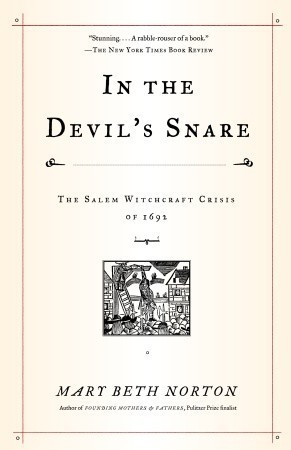
Review of “In the Devil’s Snare: The Salem Witchcraft Crisis of 1692”
The Stuff:
Author Mary Beth Norton, Professor Emerita at Cornell University, writes that the Salem witch crisis took place in the midst of another crisis—the devastation of the First and Second Indian Wars (King Philip’s War) of the late seventeenth century, which wreaked havoc. Traumatized refugees fled south.
While the “afflicted” people spoke of the devil as a “black man,” (a designation that did not mean the same thing in the seventeenth century that it does in the twenty first), they also described him as “tawny,” and looking like an “Indian.”
Because of the religious outlook of the colonists, they viewed the setbacks, losses of family, homes, and attacks as punishment from God. It was not a great leap to see God allowing the devil to torment them.
Thoughts:
Norton uses trial records (when available) and other public documents, and lays out the whole say, tragic business chronologically. It makes for some thick reading, particularly because she retains the original spelling and syntax when quoting the documents. Seventeenth-century spelling was variable and depended a lot on the degree of education of the writer.
A lot of the sensationalism the topic often falls prey to is avoided. However, it is also dry and does take a lot of effort to get through. One has to wonder, nevertheless, if the colonists and the special court (“Oyer and Terminer”) drawn up to try the witchcraft cases didn’t begin to wonder sooner about the “afflicted” who would go into fits when a particular person was being examined.
A hotly debated issue was “spectral evidence,” that is, that the specter of a witch appeared to torment a person often by pinch or sticking pins into their body. Could this really be the devil, taking on a form? Could he disguise himself as an innocent person? What about people who had bad reputations beforehand—those who squabbled with relatives? If a witch confessed (often under torture) to have seen Goody So-and-So and the witch’s sabbath, could anyone believe her?—but why would she lie?
To twenty-first-century readers, these questions sound arcane, if not nonsensical, but people died while the colonists sorted out this stuff.
The book follows a lot of people, some of whom have the same name, and it can get difficult to keep everyone straight. Norton is usually clear about which Ann Putnum she is talking about, for example.
A few colorful people stand out, not for signing the devil’s book or anything like that, but for being all too human. For example, Captain John Alden, who, it was said, was an “Old Indian trader.” “The Indians have a saying that Mr Alden is a good Man, & loves Indian very well for Beavers,” one man said.
When he brought the Wabanaki and French goods to trade, Captain Alden found a fellow Englishman being held prisoner. The prisoner asked Alden to ransom him. The prison later related Alden said, “he came to Trade & not to redeem Captives.”
Pretty cold. The good people of Salem (not the ex-prisoner) accused him of being a witch.
The ex-prisoner probably just thought he was a miserable SOB.
While the book is definitely worth a read, I have to warn that it will take time and dedication.
Title: In the Devil’s Snare
Author: Mary Beth Norton
First published: 2002
Review of “Puss in Boots: The Last Wish” 2022
This was a different sort of Saturday night pizza and bad movie fare for us. The dearly beloved took a recommendation from The Critical Drinker (more on him at a later date), who spoke highly of the flick.
Plot:
The opening scenes tell a fairy tale about a star that fell to earth, scorching a forest and creating a Dark Forest. At the center of the Dark Forest is a Wishing Star, waiting to grant single wish to the first person who finds it.
Puss in Boots is busy doing is usual swashbuckling and performing for the local people, a modest little number with lyrics asking, “Who is your favorite fearless hero?”
The return of the governor (Bernardo De Paula) puts an end to la fiesta. Puss in Boots is an outlaw. The viewer is shown the poster in case there’s any doubt. In the process of escaping from the governor’s forces, Puss in Boots sets off fireworks, waking the sleeping giant of Del Mar.
Not to worry—much. Puss dispatches the giant. While he’s taking his bows, a great bell crushes him.
He receives the bad news from the village doctor/barber (Anthony Mendez) that he died. But he has nine lives, right? He’s down to his last one. The doctor gives him the address of cat fancier Mama Luna (Da’Vine Joy Randolph) where he can retire.
While he sits in a tavern, downing some leche and telling himself he’s not ready to be anyone’s lap cat, a bounty hunter/wolf (Wagner Moura) approaches him with a wanted poster.
The ensuing fight is different from anything Puss has known before. A blade touches him and draws blood for the first time. He loses his sword and becomes afraid. He runs away by quite undignified means. After deciding he’s no longer worthy of being Puss in Boots, he buries his clothes and seeks sanctuary at Mama Luna’s.
Not all is peace and tranquility, of course, but what little there is shatters when the crime family of Goldilocks (Florence Pugh) and the Three Bears (Ray Winstone, Olivia Colman, and Samson Kayo) attack the house, looking for Puss in Boots. They want to hire him to steal the Map to the Wishing Star from Jack Horner (John Mulaney), a wealthy man who runs a going pie concern.
It occurs to Puss that he could steal the map and wish for his nine lives back. He could be Puss in Boots once again.
However, an old flame of his, Kitty Softpaws (Salma Hayek), also wants the map.
And the chase is on.
Thoughts:
I have good things to say about this flick. It’s fun. It tells a story. Puss in Boots grows and changes. He figures out that the bounty hunter is Death. He will lose to him one day. In the meantime, he evaluates his life.
The animation is solid. The viewer knows it’s animation. It does not try to imitate real life. When Puss feels fear, the fur on his legs (arms?) rises. His heartbeat quickens, and his eyes widen.
Later in the Dark Forest, when it’s not dark but magical, the animation is wonderful and the colors rich without being overpowering.
Some of the characters speak a few Spanish phrases. Spanish lyrics are worked in The Doors’ song “This is the End.” My Spanish, to be charitable, is limited, and I didn’t catch everything, but I didn’t see the use of Spanish as a barrier to the English-speaking viewer.
Cliches appear in the film. I’d be surprised if none did. The overly cheerful sidekick Puss didn’t ask for and at first treats miserably ends up being something of a savior. Other relationships are more nuanced, however, something unexpected in a children’s movie. Mama Luna and the cats in her home get short shrift, however.
Because it’s a kiddie flick, the bathroom humor abounds.
The character of the wolf/Death may be a little heavy for smaller children. He is terrifying. It’s the first (maybe second) thing to frighten Puss in Boots.
The Last Wish received nominations for best animated film from Academy Awards and BAFTA. It also got nominations from many city and regional critics groups, as well as nods from groups like the NAACP and GALECA, the Society of LGBTQ Entertainment Critics.
I enjoyed this.
Puss in Boots: The Last Wish is too recent to be available for free download.
Title: Puss in Boots: The Last Wish (2022)
Directed by
Joel Crawford…(directed by)
Januel Mercado…(co-director) (as Januel P. Mercado)
Writing Credits
Paul Fisher…(screenplay by) and
Tommy Swerdlow…(screenplay by)
Tommy Swerdlow…(story by) and
Tom Wheeler…(story by)
Etan Cohen…(additional screenplay material by)
Cast (in credits order)
Antonio Banderas…Puss in Boots (voice)
Salma Hayek…Kitty Softpaws (voice) (as Salma Hayek Pinault)
Harvey Guillén…Perrito (voice)
Florence Pugh…Goldilocks (voice)
Olivia Colman…Mama Bear (voice)
Released: 2022
Length: 1 hour 42 minutes
Review of “The Thing with Two Heads” (1972)
This was our Saturday pizza and bad movie offering. Garlic pizza. Yum. But, aside from that, I remembered watching this flick on something called broadcast television back in the day. It’s one of those movies that’s so bad it’s almost good.
Plot:
Brilliant surgeon and icky racist Maxwell Kirshner (Ray Milland) is dying but wants his superior intellect to live on—you know, for the good of humanity. To that end, he’s been experimenting with transplanting heads on gorillas. (The punchline is too easy. I—must—resist.) His method of grafting a new head on is to temporarily leave the body with two heads until the new one takes, then cut the old one off. Dr. Kirshner describes this to his pal, Dr. Philip Desmond (Roger Perry), who accepts the absurdity (x-rays included) with a straight face and a gasp or two of wonder.
An emergency occurs when the gorilla subject makes up both of its minds to escape. After emptying out a crowded bodega, it enjoys two bananas at once, leading to its recapture.
Dr. Kirshner’s health takes a turn for the worse. His medical team scours whatever places one might for a patient whose body is healthy but whose head is injured beyond repair. Nope, no cancer. Out of desperation, they turn to death row with an offer for those about to die. Donate your body to science? You’ll still die, but you’ll miss the electric chair. Hmmm… oddly no takers until—
Jack Moss (Roosevelt “Rosey” Grier), a large black man, has always maintained his innocence. Today is his date with Old Sparky. As he’s being strapped in and the minister is reading to him from the good book, he smiles and says, “You know, I’d like to donate my body to science.”
The authorities take him to Kirshner’s house (where he has a suitable mad scientist lab set up). There, the surgical team operates.
Kirshner wakes up first. He feels good. His arms feel stronger than they have years. He brings his hand up with some effort and realizes something’s different.
“Is this a joke?” he demands of Desmond.
He’s not half as disappointed as Moss is, who, declining to be sedated, escapes custody. Most of the rest of the movie involves destroying police vehicles on a motocross course.
Thoughts:
While the special effects are hokey at best, the movie presents several great visuals, such as a two-headed gorilla with banana smeared over both muzzles looking up in disappointment when it realizes it’s busted. Not to mention the visual of a two-headed gorilla running down a nice suburban street, chased in a van by Dr. Desmond and his associate.
Our heroes run into a motocross field. One driver abandons his bike in panic. Our heroes then steal the bike, and one thing leads to another. Eleven cops chase them—which is absurd in itself. We watch in slow motion as each car dies a painful death. While this scene goes on longer than necessary, it is silly and produces a snicker or two.
Hating Dr. Kirshner is easy. He’s not only a racist, turning down the services of skilled Dr. Fred Williams (Don Marshall) at his hospital because Williams is black, but repeatedly saying belittling and insulting things to the black people around him. (“Is that all you people think about?”). In one scene, Kirshner promises Williams a position, saying he knows he’s a fine doctor.
“All I have to do is cut off [Jack’s] head,” Dr. Williams says.
So, you were expecting Williams to agree before figuring that out?
The movie is silly and doesn’t take itself too seriously outside of one aspect: its withering view of white supremacy. At the same time, poor falsely-accused Jack might escape the electric chair, he commits a number of crimes that could land him in hot water: flight from custody, assault, assault on an officer, car thief, and assault with a deadly weapon, to name a few. At the end of the movie, he hasn’t cleared his name. Perhaps the writers didn’t want to cut the motocross scenes short to take the time to do that.
It’s a goofy movie with an absurd premise. I guess I shouldn’t look too closely for logic.
An album titled The Thing with Two Heads: Music Inspired by, was released in 1972. It included songs from the movie and others, such as “Take My Hand” by Sammy Davis, Jr. and “O Happy Day” by The Mike Curb Congregation.
The movie can be watched on YouTube here.
Title: The Thing with Two Heads (1972)
Directed by
Lee Frost
Writing Credits
Lee Frost…(screenplay) &
Wes Bishop…(screenplay) and
James Gordon White…(screenplay)
Lee Frost…(story) and
Wes Bishop…(story)
Cast (in credits order)
Ray Milland…Maxwell Kirshner
Roosevelt Grier…Jack Moss (as “Rosey” Grier)
Don Marshall…Dr. Fred Williams
Roger Perry…Dr. Philip Desmond
Chelsea Brown…Lila
Released: 1972
Length: 1 hour, 31 minutes
Rated: PG
Review of “War of the Worlds” (2005)
Svengoolie showed The Ghost and Mr. Chicken this week. We gave it a pass. Regular readers of this blog (both of you) may be surprised that there is a movie too cheesy for me. Truth is, I saw it a couple of years ago and didn’t see the need to watch it again. Ever.
Plot:
Divorced dockworker from Bayonne, New Jersey, Ray Ferrier (Tom Cruise), heads home from work to find his ex-wife Mary Ann (Miranda Otto) has been waiting half an hour to drop off their kids. He’ll have them for the weekend while pregnant Mary Ann and her present husband, Tim (David Alan Basche), visit Mary Ann’s parents in Boston.
Sixteen-ish Robbie (Justin Chatwin) doesn’t want to be there. Ten-year-old Rachel (Dakota Fanning) loves daddy, but she’s tired. To escape the tensions, Ray takes a nap. When he wakes, he finds unlicensed Robbie has taken his prized Mustang for a spin, and Rachel, following his curt suggestion to order out, eating something from a health food store he finds inedible.
Outside, a weird, ominous storm cloud is forming. The neighbors have noticed, too. Wild lightning strikes the ground. Rachel gets nervous, but Ray says, “That’s pretty cool, huh?”
They have to flee inside. After trying nearly every switch in the house, Ray concludes the power is off. All the cars have stopped, and all electronics have failed. His cell phone is dead. Ray tells Rachel to stay put and goes to look for Robbie. Robbie is on his way home; he left the Mustang where it died. His father tells him to look after his little sister and walks to the city center.
A crowd has gathered around a hole in the middle of an intersection, with police telling everyone to get back. Ray touches a piece of the pavement. It’s cold. With much noise and shaking of the ground, a giant three-legged machine emerges from the hole and emits a sound something like a cross between a trumpeting elephant and foghorn. It releases heat rays that incinerate anyone unlucky enough to be caught by them. People scatter. The machine marches on.
Ray runs home. He packs up his kids and runs to an auto mechanic friend (Lenny Venito) whom he’d earlier advised to replace a solenoid on a minivan. He steals the minivan, trying to convince the friend to join them. When the mechanic refuses, Ray leaves, watching as the man is incinerated.
He’s going to find the kids’ mom and safety and spend the rest of the movie escaping death and destruction by the skin of his teeth.
Thoughts:
The opening scenes feature adapted quotes from H. G. Wells’ novel, giving the movie the same sense of foreboding the book opens with (in part):
“No one would have believed in the early years of the twenty-first century that our world was being watched by intelligences greater than our own; that as men busied themselves about their various concerns, they observed and studied the way a man with a microscope might scrutinize the creatures that swarm and multiply in a drop of water…”
It also ends with an altered quote from Wells.
Nice touches.
Overall, on the one hand, the special effects are spectacular. They must have blown a couple of minds in the theater. I imagine the seat beneath you buzzed a bit when the Martian machines thudded down the streets of hapless Bayonne.
On the other, average-Joe Ray seems singled out to escape over and over the certain death so many citizens experienced. Some of it is blind luck. Ray and his children have just squeezed onto a ferry that launches, leaving thousands on the bank vulnerable to attack by multiple machines. Joke’s on them. A machine emerges from the river, capsizing the ferry. Ray and his children survive when so many don’t.
On the other hand, some of it is—as much as I hate invoking this cliché—a bit of Gary Stu, that is, a (male) character who is flawless* and has more knowledge and capabilities than he should. For example, when the mechanic can’t get a van to start, Ray, who is not a mechanic, tells him to change out the solenoid. Lo and behold. It starts. This is the van that Ray later drives off in.
Out of all the people around—including the military, whose job it is to watch these things—only Ray notices birds landing on the Martian machines and understands the implication that their force fields are down, leaving them vulnerable to weapons.
The movie is violent, as expected. The violence is, at times, graphic. Hard to make a movie based on this book without violence.
There are some insider jokes, as well. When Martians enter a basement where Ray, the kids, and a loaner named Harlan Ogilvy (Tim Robbins) are hiding, one of them plays with a bicycle wheel. In Wells’ book, the Martians have not developed the wheel.
The movie won three Academy Awards having to do with sound and special effects in 2006.
I have mixed feelings about this movie. I can’t say this one scared me as much as the 1953 version. I was much younger when I saw the earlier one for the first time. The scene where the alien revealed itself and vaporized the three men as they called, “We’re friends!” got to me as a kid.
Yet, for all the excitement, danger, and stunning special effects, I didn’t care for the 2005 version as much as I wanted to. It’s far from a bad movie. I was hoping, I guess, for a little more depth in the storytelling and a little less, for lack of a better word, melodrama.
This is one you have to pay to see, alas.
*Originally “Mary Sue,” a character from parody Star Trek fanfiction, who is flawless and capable of everything, knows everything and often dies at the end.
Title: War of the Worlds (2005)
Directed by
Steven Spielberg
Writing Credits (WGA)
Josh Friedman..(screenplay) and
David Koepp…(screenplay)
H.G. Wells…(novel)
Cast (in credits order)
Tom Cruise…Ray Ferrier
Dakota Fanning…Rachel Ferrier
Miranda Otto…Mary Ann
Justin Chatwin…Robbie
Tim Robbins…Harlan Ogilvy
Released: 2005
Length: 1 hour, 56 minutes
Rated: PG-13
Review of “Blacula” (1972)
I’d long heard of our Saturday pizza and bad movie feature but had never seen it. We watched it with Svengoolie, who issued several warnings for explicit scenes and “stereotypes.” The violence isn’t the-top for a horror film, but it’s definitely not one for the kiddies.
Plot:
In 1780, lightning streaks across the sky, and thunder rolls across the hills outside Castle Dracula while Count Dracula (Charles Macaulay) entertains Prince Mamuwalde (William Marshall) and his wife Luva (Vonetta McGee) from… somewhere in Africa. Mamuwalde seeks diplomatic relations with Europe and, as it turns out, the cessation of the slave trade. Dracula is dumbfounded, but that doesn’t keep him from showing his white supremacist leanings.
The men get into a fight. Dracula bites the prince, turning him into a vampire. “You shall pay, black prince,” he tells him. “I curse you with my name. You shall be Blacula, a vampire like myself.” He then seals him in a coffin in a secret room with Luva, who will presumably starve to death.
After the interminable credits, it’s a lovely, sunny day in 1972 in Transylvania. Two gay antique dealers, Bobby McCoy (Ted Harris) and Billy Shaffer (Rick Metzler), come to Castle Dracula to buy items, dickering with the real estate agent (Eric Brotherson). When they ask about secret passages, they find the secret room where Mamuwalde and Luva were imprisoned. A couple of additional coffins seemed to have appeared.
It’s perfect. They’ll take the coffin back to L.A. with them.
While they’re unpacking things at the warehouse, Billy cuts his arm seriously enough to draw blood. Bobby tends to his wound, telling the young man to calm down. He has already opened Mamuwalde’s coffin. With the two fuss over Billy’s arm, Mamuwalde arises. He’s hungry. The two put up a good fight, but—
At Bobby’s funeral, Mamuwalde sees a woman that looks just like his wife. He follows her and scares the living daylights out of her. She drops her purse.
Thoughts:
On one level, this vampire story borrows a lot from the old mummy movies. On another, there is a lot of subtext. First, it’s a love story. Mumuwalde wants to turn the woman he finds in the present (now called Tina), but won’t do it without her consent. What a gentleman.
Tina doesn’t remember him, but she is charmed but him, especially after he returns the purse she dropped. She introduces him to her sister, Michelle (Denise Nicholas), and her sister’s boyfriend, Dr. Gordon Thomas (Thalmus Rasulala), the latter of who happens to be a cop.
After seeing all the odd deaths lately, Gordon starts to wonder about a supernatural connection. He reads and reluctantly comes to believe a vampire is responsible for the deaths.
Rather strikingly, this speaks to people outside the mainstream. First, there is the interracial same-sex couple. The viewer knows they are a couple not because they say so but because of their stereotypically exaggerated mannerisms and affected voices. This provides an attempt at humor, especially in Billy’s near hysterics over cutting himself at the warehouse. (“I’m bleeding to death!” he says at one point. The viewer, watching the vampire close in on him, thinks, “Not yet, anyway.”)
In the present, the limp-wristed, eye-brow arching, and octave-jumping voices of the two might be looked at as in bad taste. Such domestic arrangements are almost routine. In 1972, same-sex households were scandalous—so kudos for dealing with the topic.
At the beginning of the movie, when Dracula is hosting Mamuwalde, several tropes arise that herald back to the time of segregation. While these are not the point of the film, they are there. When Gordon asks the (black) mortician handling the funeral preparations for (black) Bobby McCoy if he’s also handling the funeral arrangements for (white) Billy Shaffer, the mortician replies, “I don’t get a lot of white people here.”
This is also what’s known as a blaxploitation film, a term coined by Junius Griffin, the president of the Beverly Hills–Hollywood NAACP branch. (What would we do without the Internet?). It referred to films popular in the 1970s that generally depicted crime and violence as a way of life for black people and communities, perpetuating white stereotypes about black people. Not to say that this film says vampirism is a big problem among black communities.
The film has a high body count. There was some humor and absurdity. Nevertheless, the movie leaves me with several questions. How did Luva, who starved to death in the 18th century in central Europe, make it to 20th-century Los Angeles? How did Mamualde adapt so well to the modern world after nearly two hundred years of being out of the loop? Traffic doesn’t freak him out, nor do electric lights or (one presumes) the many wonders of indoor plumbing. Where did he learn English? Why didn’t his clothes—or his joints—disintegrate from time in the coffin?
Yeah, nitpick.
This isn’t one I’d see again. I enjoyed it, but it is definitely in the all-right category.
Blacula won the 1973 Golden Scroll Award from the Academy of Science Fiction, Fantasy & Horror Films for the Best Horror Film.
The movie can be watched here free with ads.
Title: Blacula (1972)
Directed by
William Crain…(directed by)
Writing Credits
Joan Torres…(screenplay) and
Raymond Koenig…(screenplay)
Cast (in credits order)
William Marshall…Blacula / Mamuwalde
Vonetta McGee…Tina / Luva
Denise Nicholas…Michelle
Thalmus Rasulala…Dr. Gordon Thomas
Gordon Pinsent…Lt. Jack Peters
Released: 1972
Length: 1 hour, 33 minutes
Rated: PG
Review of “Destroy All Monsters” (1968)
This is our pizza and bad movie offering for this week, one that squeezes just about every Japanese monster into a single flick.
Plot:
By 1999, the United Nations Scientific Committee (UNSC) has established an exploratory base on the moon. Spacecraft come and go between earth and the moon daily.
Why, the rocket ship Moonlight SY-3 is blasting off now, piloted by Captain Katsuo Yamabe (Akira Kubo). He and his crew of five are dressed in yellow space suits and helmets that bring to mind the minions from Despicable Me.
Meanwhile, on one of the Ogasawara Islands (a real place), an underwater base has been established for the study of marine life. On land, all of Earth’s monsters have been collected and live on an island called Monsterland.
What could go wrong? It’s not what you think. You’ll have to wait for Jurassic Park for that.
As a heliocopter flies over the island, the narrator names Godzilla, Rodan, Angilius (?), Mothra, and Gorosaurus. Later, other monsters will show up.
Dr. Otani (Yoshio Tsuchiya) shows newbie Kyoko Manabe (Yukiko Kobayashi) around the underground station, telling her her job will be to help him study the monsters. He calls them “cute.”
She receives a call from her sweetheart, Captain Yamabe, and is surprised to hear he’s on the moon. Their call is interrupted. Yamabe is unable to raise the base on Ogasawara again.
Emergency alerts sound on Ogasawara station. A yellowish-orangish gas seeps in through the door, knocking out the researchers. The same gas appears above ground, knocking out the monsters.
While Dr. Yoshido (Jun Tazaki) at the UNSC meeting in Tokyo is trying to raise the suddenly (and ominously) silent Ogasawara Island, a bulletin comes in that Rodan is attacking Moscow—but Rodan is supposed to be confined to Monsterland. What has happened? The UNSC orders Captain Yamabe back from the moon to investigate what’s happening on at Monsterland.
They arrive (in record time) to find the monsters gone and the researchers alive but acting oddly. The researchers ask for the “cooperation” of Yamabe and his crew and introduce them to the Kilaak Queen (Kyôko Ai), an alien who controls the minds of the researchers and the monsters. She appears in a white sequined hood and cloak that made me think she was about to peel it off and jump into a pool for a musical number with Ethel Merman. (Kids, ask your grandparents.)
Unless the earth people cooperate, the Queen says, the monsters will continue to destroy the major cities: Gorosaurus (or maybe Baragon?) takes down the Arc de Triomphe, Mothra destroys Beijing, Manda flattens London, Godzilla fries the UN. Why isn’t anyone attacking Tokyo, despite its proximity to Monsterland? Uh-oh. They’re saving the best for last…
Thoughts:
There’s a whole lot to cram into one little movie—eleven different monsters, plus a three-headed monster from space, invading aliens who want to take over the earth, alien-controlled humans, a rocket ship that travels to and from the moon as if the satellite were no farther away than Peoria, and so much more.
It was fun to watch the monsters destroy different models, sometimes with fire and sometimes with their feet or by other destructive means. Monthra broke through a subway exit, for example.
However, I was surprised this earned a “G” rating. There was no sex but a lot of violence, including a man shot in the forehead, another man jumping to his death from a hotel window (transforming into a dummy on the way down and back to a human when he lands on the beach, BTW), and a man ripping earrings from a woman’s ears. The last was for her own good, of course. The earrings were the aliens’ means controlling her.
In this crowded field, there are delightful little gems, too. Alien-controlled Kyoko walks through Tokyo with a smirk on her face as various monsters attack the city, and panicked people run in the opposite direction from her. She’s wearing a bright orange dress with a short orange jacket and a huge bow, giving off a Sailor Moon vibe. The earrings controlling her dangle from her earlobes—until heroic Captain Yamabe later rips them out, of course.
Another smirk plays across the face of the Kilaak Queen until things start going bad for her and her crew. In a screen close-up, the smirk disappears when she realizes her plans for conquering the earth (or whatever they were) have gone down the toilet.
And then there is the final monster battle—a lot of flames, a lot of Godzilla roars, and a lot of earth-shattering thumps. What fun.
This is not a movie that will challenge your intellect. It’s not a movie for deep thought, or that calls for philosophical insight. It’s one for setting the phone on vibrate, ordering some pizza, and opening a bottle of prosecco. It’s silly, and I enjoyed it.
Destroy all Monsters can be watched here Free with ads
Title: Destroy All Monsters (1968)
Directed by
Ishirô Honda
Jun Fukuda… (earlier film clips) (uncredited)
Writing Credits (in alphabetical order
Ishirô Honda…(writer)
Takeshi Kimura…(as Kaoru Mabuchi)
Cast (in credits order)
Akira Kubo…SY-3 Captain Katsuo Yamabe
Jun Tazaki…Dr. Yoshido
Yukiko Kobayashi…Kyoko Manabe
Yoshio Tsuchiya…Dr. Otani
Kyôko Ai…Kilaak Queen
Andrew Hughes…Dr. Stevenson
Released: 1968
Length: 1 hour, 28 minutes
Rated: G
Review of “Abbott and Costello Meet the Mummy” (1955)
Some weeks ago, Svengoolie disappeared without explanation when the masterpiece discussed below was scheduled. We were looking forward to it as something silly, so the dearly beloved found it at the library. Silly is what we got.
Plot:
Bud Abbott and Lou Costello are for some unexplained reason in Cairo and looking for a way to get back to the United States. While sitting in Café Baghdad (because Cairo and Baghdad are practically the same place, I guess), they overhear the archeologist Dr. Gustav Zoomer (Kurt Katch) tell the press he’s discovered the mummy of Klaris, the prince of evil, and that somewhere in the sarcophagus is a clue that will lead to the discovery of the tomb of Princess Ara. As soon as he can find two trustworthy men, he will ship it to the States.
The States! That’s where our heroes want to go.
Unfortunately for the doctor, our hapless heroes are not the only ones who overhear the doctor.
One person reports to a group of men sitting around a table outside, noting that they must tell Semu about Dr. Zoomer’s discovery and return Klaris to his people. Another goes to an apartment and gives the news to Madame Rontu (Marie Windsor). She’s not worried about the curse of Klaris. She relies on guns and knives, and she wants the treasure that Zoomer will uncover with the Princess.
Later, Dr. Zoomer is in his office, recording the directions to Princess Ara’s tomb and treasure. He looks up to see two men entering. One shoots a blow dart at him, hitting him behind his ear. He collapses.
Our heroes approach Dr. Zoomer’s office. Abbott explains why they’re there—to ask for the job and find a way back to the States. After indulging in a little wordplay, they knock on the front door. There’s no answer, but the door is open. Of course, they go in.
In another room, the bad guys lift the sarcophagus of Klaris (they’re really strong bad guys) and walk a few steps. They hear someone calling for Dr. Zoomer, set their burden down, and hide in some standing, unoccupied sarcophaguses.
Bud comes in, looking for the archaeologist. After checking a few obvious places, he opens the lid of Klaris’s sarcophagus. The mummy (Eddie Parker) growls and sits up, sending Bud screaming from the room to an incredulous Lou.
Hard as it may be to believe, the boys find a medallion with directions (in hieroglyphics) the Princess Ara’s tomb. The bad guys have been scrambling for it. Bud thinks they can sell it.
Eventually, the boys travel to the sacred resting site of Klaris, with both groups of people trying to kill them (and each other). The place is riddled with trap doors and secret passageways. For some reason, never explained, a giant lizard prowls the underground.
Don’t ask for anything to make much sense.
Thoughts:
Madame Rontu decides to outsmart the other guys by bonking the mummy on the head, burying it outside, and substituting one of her henchmen, all wrapped up to look like a mummy. The faux mummy will attack the rivals. What could go wrong?
Bud comes across their discarded wrapping while he and Lous are supposed to be digging a hole. He gets an idea, and thus three mummies show up.
The flick is full of the pratfalls Abbott and Costello are known for. More than one pretty girl flirts with Lou and dismisses Bud.
And there are the verbal miscommunication exchanges:
Bud: “How stupid can you be?”
Lou: “How stupid do you want me to be?”
or:
Bud: “I overheard Doctor Zoomer say he needed a couple of men to accompany his mummy back to the States.”
Lou: “Is she afraid to travel by herself?”
Bud: “She? No, Lou. This mummy is a he. What’s wrong with that? Some mummies are men. Some mummies are women.”
Lou: “Such a strange country.”
Bud: “What’s strange about it, Lou?
Lou: “Your mummy, your mummy. Wasn’t she a woman?”
Bud: “I never had a mummy.
Lou: “What did your father do? Win you in a crap game?”
Costello and Abbott are given player names in the credits but use their own names throughout the movie.
This is the last of the seven “Abbott and Costello Meet…” movies and appeared late in their careers. It may strike some viewers as tedious as the obvious always happens, but it is cute and, above all, silly.
I could not find it available for download for free, but libraries can often get it if you’re interested.
Title: Abbott and Costello Meet the Mummy (1955)
Directed by
Charles Lamont
Writing Credits
John Grant…(screenplay)
Lee Loeb…(story)
Cast (in credits order)
Bud Abbott…Pete Patterson
Lou Costello…Freddie Franklin
Marie Windsor…Madame Rontru
Michael Ansara…Charlie
Dan Seymour…Josef
Released: 1955
Length: 1 hour, 19 minutes
Review of “Avengers: Endgame” (2019)
It tells you nothing about the movie, but the pics are interesting.
Because Svengoolie was a rerun this week, we turned to a more contemporary movie, one with a lot—a LOT—of booms and chastely covered boobs projecting all over the place.
Judging by the destruction they leave in their wake, it’s a good thing superheroes exist only in places like comic books and movie screens. But I digress.
Plot:
This is part two of a story arc involving Thanos (Josh Brolin), a powerful destructive Titan. In the proceeding film Avengers: Infinity War (2018), Thanos acquired the six Infinity Stones, mounted them in a gauntlet, snapped his fingers, and wiped out half the living beings in the universe. He thought life would be better that way.
This movie begins roughly five years later. A rat steps on a lever on a machine in a van in a storage garage, releasing Ant-Man/Scott Lang (Paul Rudd) from the quantum universe that’s trapped him. He missed “The Blip,” the wiping out of life. The time he spent in the quantum universe appears to him more like hours than five years and has convinced him that time travel is possible. By the way, he’s hungry.
So, all the (surviving) Avengers have to do is get the band back together, go back in time, and find the Infinity Stones before Thanos does. After they kill Thanos, they return them where they found them.
Yeah, it’ll be difficult, but what could go wrong?
Thoughts:
There are a lot of characters in the movie, drawing in characters from The Guardians of the Galaxy, Dr. Strange (Benedict Cumberbatch) and his crew, and characters from Black Panther, among others. Understandably most have suffered trauma from the Blip. After Asgard was destroyed, Thor (Chris Hemsworth) set up shop in Norway in New Asgard. He took up video games and beer—lots of beer. A prominent beer belly and alcoholism soon followed. Now he’s got to keep it together long enough to retrieve an Infinity Stone.
An exception to the rule is Tony Stark/Iron Man (Robert Downey Jr.) and Pepper Potts (Gwyneth Paltrow), who are happily and comfortably married with a little girl. Tony wants nothing more to do with the Avengers. When asked, he says even if time travel is possible, it will not affect the present. It will merely branch off to create another reality elsewhere.
At three hours, this is a long movie. Each character has to work through whatever they are going through to join the effort and solve the riddle of time travel (not without some humor) before the Avengers can even leave to find the Infinity Stones. One, the Soul Stone, comes at a great price. (Gads, didn’t these people watch the last movie? Thanos left his daughter dead there.)
An unforeseen hitch develops regarding a character, making things interesting.
With the long runtime, the huge cast, and so many things going BOOM, it may not be too surprising that the movie had an estimated budget of $356–400 million, making it one of the most expensive films ever made, according to Wikipedia.
As for liking it, I must confess this is not one of my favorites. It was entertaining but formulaic. I enjoyed the bits of humor and the ironic observation: After destroying half the life in the universe, Thanos retires to an idyllic planet to enjoy himself—the country gentleman.
I also liked the snippets of old music played: Traffic’s “Dear Mr. Fantasy,” The Kinks’ “Supersonic Rocketship,” The Rolling Stones’ “Doom and Gloom,” and Steppenwolf’s “Hey Lawdy Mama.”
Title: Avengers: Endgame
Directed by
Anthony Russo
Joe Russo
Writing Credits
Christopher Markus…(screenplay by) &
Stephen McFeely…(screenplay by)
Stan Lee…(based on the Marvel comics by) and
Jack Kirby…(based on the Marvel comics by)
Joe Simon…(Captain America created by) and
Jack Kirby…(Captain America created by)
Steve Englehart…(Star-Lord created by) and
Steve Gan…(Star-Lord created by)
Bill Mantlo…(Rocket Raccoon created by) and
Keith Giffen…(Rocket Raccoon created by)
Jim Starlin…(Thanos, Gamora & Drax created by)
Stan Lee…(Groot created by) and
Larry Lieber…(Groot created by) and
Jack Kirby…(Groot created by)
Steve Englehart…(Mantis created by) and
Don Heck…(Mantis created by)
Cast (in credits order)
Robert Downey Jr…Tony Stark / Iron Man
Chris Evans…Steve Rogers / Captain America
Mark Ruffalo…Bruce Banner / Hulk
Chris Hemsworth…Thor
Scarlett Johansson…Natasha Romanoff / Black Widow
Jeremy Renner…Clint Barton / Hawkeye
Don Cheadle…James Rhodes / War Machine
Paul Rudd…Scott Lang / Ant-Man
Benedict Cumberbatch…Doctor Strange
Chadwick Boseman…T’Challa / Black Panther
Brie Larson…Carol Danvers / Captain Marvel
Tom Holland…Peter Parker / Spider-Man
Karen Gillan…Nebula
Zoe Saldana…Gamora
Evangeline Lilly…Hope Van Dyne / Wasp
Tessa Thompson…Valkyrie
Rene Russo…Frigga
Elizabeth Olsen…Wanda Maximoff / Scarlet Witch
Anthony Mackie…Sam Wilson / Falcon
Sebastian Stan…Bucky Barnes / Winter Soldier
Tom Hiddleston…Loki
Danai Gurira…Okoye
Benedict Wong…Wong
Pom Klementieff…Mantis
Dave Bautista…Drax
Letitia Wright…Shuri
John Slattery…Howard Stark
Tilda Swinton…The Ancient One
Jon Favreau…Happy Hogan
Hayley Atwell…Peggy Carter
Natalie Portman…Jane Foster (archive footage)
Released: 2019
Length: 3 hours, 1 minute
Rated: PG-13
Review of “The Old Dark House” (1932)
This is our latest Saturday night pizza and bad movie offering. Last week, Svengoolie was unavailable. The cable channel has not explained. Oh, well. The dearly beloved found the film scheduled for then, Abbott and Costello Meet the Mummy, through the library. It should arrive shortly. This week’s film is a bit less cheery.
Plot:
Philip and Margaret Waverton (Raymond Massey and Gloria Stuart) and their friend Penderel (Melvyn Douglas) are lost in a storm in the Welsh countryside. After a landslide cuts off their retreat, they stop at a creepy dark old house when the see a light burning.
(Here I heard Brad and Janet singing, “There’s a light…”)
They drive up to the house and bang on the door. Eventually, it swings inward wide enough to reveal a hideous, scared face. The party explains their predicament and asks for shelter. The man (Boris Karloff) mumbles something and closes the door.
While our heroes complain outside, a gong sounds. The door opens again, and the man waves them inside. The homeowner, Horace Femm (Ernest Thesiger), a tall, thin man with a pinched face, then greets them. He explains the bulter, Morgan, is mute (“dumb”) and had a difficult time telling him what was going on. With some reluctance, he agrees to let them stay the night. His sister, Rebecca (Eva Moore), then appears holding a candle, demanding to know who the people are and what they want. On being informed of the situation, she says, “They can’t stay here.” She further tells them, “No beds. You can’t have beds.”
The travelers agree to sit up around the fire. Two more storm refugees arrive, the obnoxious Sir William Porterhouse (Charles Laughton) and his companion, the chorus girl, Gladys.
If it were that simple.
Thoughts:
The action is slow. The eccentric people—the horrifically scarred, mute butler; the easily panicked Horace Femm; and his deaf, fanatically religious sister Rebecca are all outrageous, over-the-top characters. The intent is to engage viewers in figuring these people out. (Good luck!)
An underlying sardonic humor runs just below the surface of the dialogue. Philip and Margaret squabble during the drive. When it becomes clear that the three are lost, Philip says, “Ten to one, we don’t see Shrewsbury tonight.”
“Oh,” Penderel says, “I don’t mind.”
When Morgan answers the door mumbling, Penderel says, “Even Welsh ought not sound like that.”
There is also absurdity. A mute butler and a deaf sister? Some of the dialogue plays on Rebecca’s deafness. I found this in bad taste, but consider the era when the film was made.
Not all of the subtext jumps out at the viewer. Some is obscured by changing times. Penderel seems to be a joker, but he’s haunted by the horrors of the Great War. Even the money-grubbing Porterhouse, who appears jovial and obnoxious, grieves for his wife. He blames her death on the upper class—especially upper-class women—like Margaret Waverton.
At an uncomfortable dinner, Horace tries to distract everyone and ignore all conflict with one of the movie’s taglines, “Have a potato.” This is after the loud, obnoxious Porterhouse has proclaimed (with a bit of song) how excited he is about roast beef.
The guests may have their problems, but those problems pale in comparison to those of the inhabitants of the house. All you need is Jane Eyre to show up for a governess job.
One of the first bits of dialogue is Philip Waverton swearing at the storm. A pre-Hayes Code film, it could get away with some salty language and some mild—really mild—mentions of sex.
Because the director, James Whalen, was gay, many tend to find expressions of gay sexuality in the movie. IMHO, there’s some reaching. One of the tenderest scenes is between two men. Is it an expression of gay love? Or merely human affection as one character dies? A woman plays one male character. Is that an expression of gender-bending? Could there have been a more mundane reason, such as a need for a frail actor with small bone structure? I don’t know.
Genuine menace appears in the movie as well as genuine silliness. In fact, it was remade as a comedy in 1963.
This movie is also reputed to be one of the inspirations behind The Rocky Horror Picture Show. Aside from the initial setup, there is little resemblance, but I can still see it.
I liked this movie, but it takes a little effort to get what’s happening. The big surprise adds depth but is not the point of the flick. Nevertheless, it answers (in part) Horace’s question of why anyone who didn’t have to would live there.
The Old Dark House can be watched free with ads here.
Title: The Old Dark House (1932)
Directed by
James Whale
Writing Credits
J.B. Priestley…(from the novel The Benighted by) (as J.B. Priestly)
Benn W. Levy…(screenplay)
R.C. Sherriff…(additional dialogue) (uncredited)
Cast (in credits order)
Boris Karloff…Morgan
Melvyn Douglas…Penderel
Charles Laughton…Sir William Porterhouse
Lilian Bond…Gladys (as Lillian Bond)
Ernest Thesiger…Horace Femm
Eva Moore…Rebecca Femm
Raymond Massey…Philip Waverton
Gloria Stuart…Margaret Waverton
Elspeth Dudgeon…Sir Roderick Femm (as John Dudgeon)
Brember Wills…Saul Femm
Released: 1932
Length: 1 hour, 12 minutes
 Reviews of Old and New Stories. Mostly Old