The unnamed narrator of this story is about to be sent one month into the future on a test mission. His mission is to wait for someone to open the door, check in with the technician, then press the yellow button to return. He is never to leave the machine. No words are to be exchanged. The less he knows about the future, the better. And he is never to tell what he sees.
He’d only have to keep the secret for a month.
When he arrives, no one opens the door. What’s wrong? Is he early? Did he land in the wrong place?
Thoughts:
This has the feel of an old-school hard science fiction tale. It is tightly told. The narrator tells the reader he has been chosen for what must be a dangerous assignment because he can keep his mouth shut. Bravery doesn’t matter, nor is there a hint of sentimentality. He does not write a last letter to his wife and children, assuming he even has a family. He simply shuts up and does as he’s told. In the few instances where he does act outside his explicit orders, it’s because he had no choice.
The narrator also doesn’t weigh ethical dilemmas. He has his orders, and he must follow protocol. Could he change anything if he’d made another choice? It’s impossible to know.
There is something unnerving about a person who consciously gives up all autonomy like this, but it is the type of thing necessary to complete such a mission.
I like this story. It is solid and good.
Bio:
I could find no bio info on this author. If this is his first published story, good for him! If not, it’d be fun to read more.
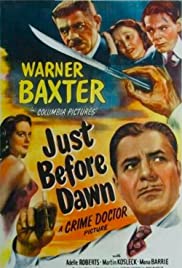
After hours inside the Ganss Funeral Home, two sinister-looking men meet. One hands the other what appears to be a kit containing a syringe and a small glass bottle marked “insulin.”
“It’s not what it says on the label,” one man tells the other.
In the next scene, the viewer sees Dr. Ordway, the Crime Doctor (Warner Baxter) sitting at home, minding his own business. That can’t last for long. Dr. Ordway is a psychiatrist who seems to be forever getting involved with solving murders.
The new neighbor, Mrs. Travers (Mona Barrie) from across the street, who is hosting a house party, rings the doorbell and asks for his help. A young man (George Meeker) attending the party has lost consciousness. He’s diabetic, according to his sister (Adele Roberts).
After confirming with the lovely young sister, Miss Foster, that the patient keeps his insulin kit on him at all times, Dr. Ordway asks the hostess to send someone to find it in young Mr. Foster’s overcoat. He then injects Mr. Foster. Immediately, the young man’s eyelids begin to flutter, and he thanks Dr. Ordway. He also apologizes for interrupting the party. Dr. Ordway advises him to lie still for a moment, and he should be fine.
He then chats with some of those attending the party, including the real estate agent (Wilton Graff) who sold the new neighbors the house, and another young man who runs a fitness institute (Craig Reynolds).
Miss Foster screams. Her brother now lies on the floor, unmoving. He has time to mutter a cryptic last phrase, “hath given you one face,” and then expires.
The coroner later confirms young Walter Foster was injected with poison, but no poison was found in the insulin kit. It looks like the Armand (Ted Hecht), the servant (gods, people had servants?) who fetched the insulin kit and replaced it is going down for this. But what was his motive? And what do those last words mean?
Thoughts:
The character of the Crime Doctor was created by writer/director Max Marcin that appeared on radio broadcasts from 1940-1947. The character also appeared in ten films from 1943-1949, of which this is the seventh.
Of course, the first thing Dr. Ordway does upon hearing he himself injected the poison into a man it to try and find the guilty party. How did the insulin get switched? He soon discovers that nearly everyone has a motive. Foster has spent all $250,000 of his inheritance and is pressuring Miss Foster to turn over her share. She has a tidy income of $1000 a month but wants to invest in her dearly beloved’s fitness institute. Foster’s pestering his sister for money is getting in the way of her getting married.
Young Foster’s last words turn out to be not from the Bible, as everyone is advising Dr. Ordway, but from Shakespeare. The full quote is, “God has given you one face and you make yourselves another.” It’s from Hamlet, Act 3, Scene 1, when Hamlet is trying to drive poor Ophelia over the brink.
Miss Foster thinks she knows what it may refer to, but asks Dr. Ordway to come to her place, as it’s too complicated to explain over the phone. Before he can get there, the doorbell rings. No! No! Don’t answer the bell, Miss Foster!
The William Castle who directed this is the same William Castle who went on to make gimmicky films in the 50s and 60s such as The Tingler and 13 Ghosts.
I have no idea what relevance the title has, assuming it has any. To the best of my recollection, none of the action takes place just before dawn.
Several elements stretched credulity beyond the limit of “Yeah, it could happen.” The bad guys seem given to elaborate murder schemes—like switching bottles of insulin for poison—when simple, direct methods are readily available. The womenfolk do their proper screaming and recite, “What is it, doctor?” on cue. (*sigh*) The bad’uns get their comeuppance, and Crime Doctor remains free to Crime Doctor another day.
Having said that, this movie is fun. I liked it.
Just Before Dawn is available for free on YouTube.
Title: Just Before Dawn (alternatively, Exposed by the Crime Doctor) Directed by William Castle
Writing Credits Eric Taylor…(story) Eric Taylor…(screenplay) & Aubrey Wisberg…(screenplay)
Max Marcin…(radio series Crime Doctor characters)
Cast (in credits order) Warner Baxter…Dr. Robert Ordway Adele Roberts…Claire Foster (as Adelle Roberts) Martin Kosleck…Karl Ganss Mona Barrie…Harriet Travers Marvin Miller…Casper
Released: March 7, 1946 Length: approx. 1 hour, 5 mins
Sometime after being struck by a truck, the unnamed narrator suffers from retrograde amnesia. He remembers the rehab. Before the accident, he was a runner. He has no memory of running, or of anything that occurred before the accident. At home, he has a trophy room and a family to corroborate it, however. He runs now not because he likes it but for exercise. His doctor threatened to put him on insulin.
While he’s out running, he begins to see a woman running in the distance, who then disappears, as if into fog, even on the clearest days. She is always ahead of him. As his running improves, he can close the distance between them. He thinks maybe she can tell him something about himself, from the time he can’t remember. She might be connected with his running. He only sees her when he’s running, right?
The day come when he’s able to reach out and poke her in the shoulder.
Thoughts:
This is a wonderfully atmospheric little tale. I remained engaged in the mystery. Who is this woman? Is she real? Is she a ghost? How is she connected with the narrator’s unremembered past? Why does he see her only when he’s running? Why doesn’t she talk to him?
That the ending may not be a complete surprise, but it hardly matters. The reader is along for the ride.
I enjoyed this story.
Bio:
According to his blurb, author Ronald Schulte is an avid reader and writer of speculative fiction. His work has previously appeared in several online and print publications including The Literary Hatchet, Dark Fire Fiction, Bewildering Stories, and Fiction on the Web. He lives in upstate New York with his wife, son, and twin daughters. Facebook
An alien ship drifts to earth and lands in a field outside Liverpool, England. The area is cordoned off and, much to the delight of the scientists, an Alien is recovered. It is promptly taken to a prison. The Alien is banged up, with patches of its surface skin torn off and its limbs damaged.
Once secured, the Alien is treated by doctors who do what they can for it. It is also attached to teach-to-talk devices, while the scientists eagerly await finding out what the Alien has to say.
The Alien eventually tells them its people call the planet it came from “Home,” but it doesn’t know what they call it. It isn’t sure how long it’s been traveling, but a long time—most of its life.
The scientists want to know why the Alien would undertake such a journey. And why come to earth?
The destination, the Alien says, wasn’t its choice.
Thoughts:
While this all leads up to a single punchline, it is not predictable. The scientists are asking all the questions the reader expects, but they’re the wrong questions.
The scientists’ eagerness provides a nice contrast to the Alien’s nonchalance. This is a fun, if dark, little tale. It’s not going where the reader thinks. There are few of the little hints that such stories often provide, but the ending is consistent and logical.
Presumably, the title was misspelled by Daily Science Fiction, and it should read “Just Desserts.” I’ve never been to Liverpool, but I don’t recall reading about a desert in the region.
I rather liked this story.
Bio:
According to his blurb, author Gordon Pinckheard lives in County Kerry, Ireland. Retired from a working life spent writing computer programs and technical documents, now freed he can write anything he likes to entertain himself and–hopefully–others.
His stories have been previously published by Reflex Fiction, Cabinet of Heed, Story Pub, and Gemini.
This week’s offering of Saturday night pizza and bad movie night was a classic. We watched it with Svengoolie.
Plot:
While bringing the Princess Parisa home for their wedding at Baghdad, Sinbad stops at the island of Colossa for fresh water and supplies. While there, the crew notices enormous cloven footprints, and an entrance to a cave carved to look like a giant mouth. Sinbad sees it as an invitation to explore.
Silly boy.
Before they get far, a man comes flying out of the cave’s mouth. Hot on his heels comes a giant cyclops with cloven hooves and an anti-social attitude, which causes a general exodus to the boats. The stranger, however, rubs an oil lamp he has and calls on a genie to protect the men he’s with. In the ensuing chaos, he drops the lamp over the side of the rowboat on his way to Sinbad’s ship. The cyclops, however, picks it up.
The stranger introduces himself as Sokurah the Magician and demands that Sinbad takes him back to the island to retrieve his lamp. Sinbad demurs. He’s got things to do as well. He’s getting married for one. The marriage is part of a peace treaty between his home of Baghdad and the Princess’ home of Chandra. They’ll come back for the lamp later.
Sokurah schemes. When an elaborate display of magic fails to impress the prospective fathers-in-law enough to outfit him with a ship, Sokurah takes to drastic measures, sneaking into the Princess’ room and miniaturizing her until she’s small enough to fit in the palm of normal human’s hand.
In the morning, the court is dismayed at the discovery of the Princess’s condition. (She, however, remains almost pathologically chipper.) Sokurah claims to have a remedy for her condition. All he needs is some shells from the eggs of a roc, which nest on the island of Colossa and to take it to his lair, where he keeps his potions.
Sinbad agrees to head the expedition, but where is he going to find a crew? No one in their right minds—he hires from those condemned to die. In exchange, they will receive full pardons. Yeah, what could go wrong?
The Princess accompanies the crew in a contraption that looks like an elaborate pool cabana cabin Sinbad somehow tucks away in his waist sash. Barbara Eden has nothing on her in the chipper department.
Thoughts:
From the moment you hear the over-the-top Bernard Herrmann (1911-1975) score in the opening frames of the film, you know this going to be a silly, fun adventure movie. And it is.
The various monsters are the stop-action creations of Ray Harryhausen (1920-2013), whose work includes the films The Beast from 20,000 Fathoms (1953) and Jason and the Argonauts (1963). While the latter remains his most famous film, he seems to have pulled out all the stops on the present one. Not only is the viewer treated to a goofy, terrifying cyclops, but also a snake-like creature with four arms, created when Sokurah tries to wow the fathers of Princess Paris and Sinbad. He cajoles the Princess’s maid into hopping into a giant jar then throws a snake in after her. That’s just the beginning. A dinosaur guards the entrance to the Magician’s cave/lair/secret laboratory. Sokurah later animates a skeleton, which then engages in a sword fight with Sinbad. And the rocs—the mythical birds of unusual size—have two heads here.
While these effects may strike the jaded 2020 viewer as cheesy, especially when watched on a television or computer screen, they were the height of technology when they first appeared just before Christmas in 1958. And they are laid on thick. These remain fun.
There are no surprises in the story. The good guys are good guys. The bad guys are bad guys and get their comeuppance. If the evil magician had a mustache, he would twirl it. Sinbad’s crew drop like flies around him.
The costumes are fanciful and colorful—except for the bad guy, who wears the traditional black. They appear to my dilettante eye to be more Indian-influenced than of medieval Arab origin. Just the same, the movie is not exactly a documentary. I’ll leave this as a small point. The Sinbad tales originated early in the time of the Abbasid Caliphate (that is, 8-9th centuries C. E.) and appear in One Thousand and One Nights.
This is not a movie for intellectual stimulation or for quiet contemplation. This is just an escapist romp.
Title: The 7th Voyage of Sinbad (1958)
Directed by Nathan Juran
Writing Credits Ken Kolb… (written by) (as Kenneth Kolb) Ray Harryhausen … (story) (uncredited)
Cast (in credits order)
Kerwin Mathews … Sinbad Kathryn Grant … Princess Parisa Richard Eye … The Genie Torin Thatcher … Sokurah the Magician Alec Mango … Caliph
Released: December 23, 1958 Length: 1 hour, 28 minutes
Jameel has just moved into a house in an unhappy neighborhood of northern Detroit. Half of the houses are habitable. The rest shelter crackheads.
His wife Marta has recently passed away. Jameel waits, avoiding the sun, going out once a month for groceries, cleaning his pump-action shotgun.
He watches new neighbors move in next door: Mom, Dad, and a boy of about seven with a bowl cut. Jameel begins his preparations. Over the summer, Dad refurbishes the house and makes a few additions. Mom does some landscaping.
When Jameel sees the “for sale” sign go up, he knocks on the front door with an invitation to dinner. The neighbors’ name is Mascarpone. Jameel finds it to be one of the best false surnames he’s ever heard.
Thoughts:
This is a creepy, creepy little tale. Its surprise ending makes it not one bit less creepy. At the same time, there is no bait and switch. The story is skillfully written. The author does not deceive the reader but shows them what’s unsaid. This is thoughtful, deliberate storytelling.
From the start, when Jameel is seen as a predator (…and he is), the reader can still have some empathy for him because of the recent loss of his wife, for whom he apparently cared deeply. He discusses his plan with her in a little shrine he keeps for her. He is not above exploiting this loss as a lure for his trap, however.
Having said that, I must admit that the story also contains some classic horror elements, including a few that stretch credulity. Horror buffs should enjoy it. Even if it is not your personal cup of tea, it is a well-crafted tale.
Bio:
According to his blurb, author Tim Boiteau lives in Michigan with his wife and son. He is a Writers of the Future winner, with short fiction appearing in Deep Magic, Dream of Shadows, and LampLight. His first novel, The Drummer Girl, is out now.
There is no plot. This is a list of satiric inspirational sayings for robots. A coherent world view emerges, one that is (as it should be) a reflection of own.
The list begins:
Recharge your batteries.
Keep a gratitude journal. I’m grateful this city is our home. I’m grateful The Supreme Council of Robots takes care of us.
You are not your own worst enemy. The humans are.
Thoughts:
While the list makes reference to politics, its sharpest barbs are reserved for corporate culture. The reader can see axioms taped to a mirror while a robot gets ready to head to yet another interminable board meeting.
Many of the sayings are cute and witty, particularly those that attempt to induce guilt and rail on about “productivity” or goal-setting. (Don’t just say you’re going to go kill a bunch of humans. Set realistic and achievable goals: how many and by what deadline will you kill them?)
There is a little development in the last paragraph. In general, I like stories with a beginning, middle and ending, and with characters who go through some trials and tribulations. I realize this is a personal preference, but I find lists like this—even when they’re cute and witty—disappointing.
So, in the end, it’s clever for what it is, but it’s not a story. There is a consistent portrait, which takes some thought and skill. I just didn’t enjoy it.
Bio:
According to his author’s blurb, Aidan Doyle is an Australian writer and editor. He is the co-editor of the World Fantasy Award-nominated Sword and Sonnet and the author of The Writer’s Book of Doubt. He has visited more than one hundred countries, and his experiences include teaching English in Japan, interviewing ninjas in Bolivia, and going ten-pin bowling in North Korea.
Dang, his life sounds like it could be a book itself.
Saturday night pizza and bad movie. The usual pepperoni, pineapple, and—on my side— jalapeno.
And Svengooli.
Plot:
The opening title card scroll describes a new form of medical treatment: “frozen therapy.” Enter our hero, Dr. Tim Mason (Roger Pryor), detailing the technique to an audience of his learned colleagues. It’s still in the early phases, of course, but he packs the patient in ice and brings the body temperature down to a level that would normally kill a human, yet his patient lives. The healthy tissue remains, but the cancer cells die. He revives his patient after five days, and she feels fine after her “nap.”
The revival involves coffee, a funnel, and tubing, the precise use of which is never described. How does an unconscious person consume coffee? Outside of college, of course.
Dr. Mason proves too flashy for the medical establishment and is asked to, well, shut up a bit. The newspapers claim he has a cure for cancer, a claim, which he denies making.
As he explains to his nurse/fiancée, Judith Blair (Jo Ann Sayers), his work is based on the writings of one man, Dr. Leon Kravaal (Boris Karloff), a lone genius who disappeared ten years earlier somewhere near the Canadian border. He has some time on his hands now. Why don’t they go see if they can’t locate this Dr. Kravaal?
So, north to some island on a lake by the Canadian border they go, only to find the doctor, yes, on ice, in an underground chamber where he’s made use of the remnants of a glacier for his experiments. He didn’t intend to freeze himself but made the best of a bad situation when the relative and legal representatives of a patient of his came calling. Well, whaddya, know, they might be here, too. Now, if he could only remember the formula he used…
Thoughts:
According to IMDB, the movie was probably based on the sad doings of one Dr. Robert Cornish, a University of California professor who, in 1934, announced he had restored a dog named Lazarus to life after putting it to death by clinical means. That University of California gave Dr. Cornish his walking papers. Poor Lazarus.
The film falls squarely in the “mad scientist” arena. Dr. Kravaal has developed a therapy mere mortals, that is, those of established medical field, can’t begin to understand. His aim is to aid humankind, and no one is going to stop him. He kills without compunction to achieve those goals, you know, for the good of humankind.
Having said all that, this movie is a lot of fun. Maybe the surprises are few, and there are a couple of plot holes one could drive a truck through, but I found all this easy to forgive. The flick is entertaining. I was along for the ride from the beginning. I didn’t recognize Boris Karloff, aside from his voice, which is unmistakable.
What does the title mean? No one has nine lives. I didn’t spot any cats. Or dogs. Given the movie’s inspiration, all the better. And what the hell are they doing with the coffee?
I grant this is not everyone’s cup of tea (or coffee), and little kidlets may not find it frightening or (alternatively) tedious because of its eternal yammering on about medical miracles. Just the same, I enjoyed it.
Title: The Man With Nine Lives (1940)
Directed by: Nick Grinde … (as Nick Grindé)
Writing Credits: Karl Brown … (screenplay) Harold Shumate … (story)
Cast (in credits order)
Boris Karloff … Dr. Leon Kravaal Roger Pryor … Dr. Tim Mason Jo Ann Sayers … Judith Blair Stanley Brown … Bob Adams John Dilson … John Hawthorne
Released: April 18, 1940 Length: approx.. 1 hour, 14 minutes
The narrator is the daughter of the warlord Erith Danaya. She, her mother, and her twin toddlers have been trying to escape him. They are functional captives on his starship as he travels from world to world.
Shortly before the action of the story, the narrator has hidden her mother and her children in a forest by a pond on one world she finds beautiful. Apparently, just as the narrator was about to escape, Erith Danaya attacked the once verdant planet and turned it into an inferno. She now looks at the gray husk and decides to take action.
Thoughts:
The title raised a red flag. Unfortunately, nothing in the story contradicted that red flag. Ordinarily, I would cheer on a character who took the extreme action the unnamed narrator does in the story. Sadly, this time, I couldn’t.
Nearly every element of this tale derived from a well-known movie franchise. The only feature I haven’t been able to connect to the same franchise is the warlord’s name, that is, Erith Danaya. Freely associating only brings up “Earth Day” and “Tuatha Dé Danann,” neither of which have any apparent relevance.
Another difficulty I had with the story was the plotting. For the ending to occur, the narrator would have had to escape her father for some extended time in the past at least once—never mind the children, who were not dropped off by the stork—yet the narration seems to imply only brief glimpses of life from outside the warlord’s thumb.
Overall, while I liked the idea, this story didn’t work for me.
Bio:
According to her blurb, author Mary E. Lowd is a prolific science-fiction and furry writer in Oregon. She’s won an Ursa Major Award, two Cóyotl Awards, and two Leo Literary Awards. She edited FurPlanet’s ROAR anthology series for five years, and she is now the editor and founder of the furry e-zine Zooscape. She lives in a crashed spaceship, disguised as a house and hidden behind a rose garden, with an extensive menagerie of animals, some real and some imaginary. Learn more at http://www.marylowd.com or read more stories at http://www.deepskyanchor.com.
She has many stories in Theme of Absence and Daily Science Fiction, including one I reviewed here.
A delayed Saturday night pizza and bad movie entry. The pizza was good. The movie was about as cheery as a sharing a bottle of absinthe with a French existentialist. (That is, the place is furnished in the style of the Second Empire, and the bell for the waiter doesn’t work. You just ‘fess up to the sin that brought you here. But it’s generally nobody’s damn business. That’s why, you know, L’enfer, c’est les autres. Oh, gods, what if the absinthe runs out?)
Plot:
Sometime in eighteenth-century Spain, a beggar (Richard Wordsworth) receives bad advice and goes to beg at the estate of a vicious marqués (Anthony Dawson) on the night at his wedding feast. The marqués humiliates the beggar, who then makes an off-color remark about his wedding night, gets tossed in the dungeon and forgotten for fifteen years. The only people who show him any measure of kindness are the jailor (Denis Shaw) and his mute daughter (Loraine Carvana).
The mute daughter grows up to be a beautiful woman (Yvonne Romain). She catches the eye of the marqués (to whom the years have not been kind) but refuses his advances and gets tossed in the pokey with the beggar. The beggar, who has gone nuts, then repays her years of kindness by raping her.
Yeah, thanks, dude.
She then agrees to be more cooperative with the marqués. ICK. She actually kills him and runs off, living in the woods for some months. Alfredo, a kind, scholarly gentleman (Clifford Evans), finds her and, knowing nothing of her background, brings her to the home he shares with his housekeeper, Teresa (Hira Talfrey). They take pity on the woman, nurse her back to health, and care for her when it becomes obvious she’s pregnant.
Teresa says it’s a bad thing for the baby to be born on Christmas Day, as this day is reserved for the Savior. Girls in her village avoid their men in March and April to prevent Christmas babies.
Oh, time to swallow a drink of credulous juice.
The munchkin is born, the mom dies. When Alfredo and Teresa take the boy to be baptized, clouds hide the sun, and the waters in the baptismal font stir. The priest says, yeah, this is a problem. He must be raised with love and find love when he grows up. Alfredo and Teresa treat little Leon (as they name the baby) like their own son. But it doesn’t keep the child from having bad dreams. After a hunting trip with a friend, he gets a taste for blood, the neighbors start losing their livestock.
Thoughts:
This is not an easy film to watch. The poor werewolf seems to be a decent sort, and his adoptive family loves him. He did nothing to bring the curse on himself. Sure, he does a lot of rotten things once the curse gets ahold of him, but it’s not like he was downstairs in the basement summoning demons in the first place.
That his parents came to bad, pitiful ends somehow means he is destined to terrorize a town against his volition? This makes no sense.
If it needs to be said, the rape scene is especially hard to watch even if the particulars take place off-camera. The beggar has been brutalized and, in turn, brutalizes one of the few people who has not been unkind to him. She murders the next man who menaces her.
One of the casualties of the child Leon is his own kitten (the viewer never sees the kitten, either alive or dead). Teresa says its loss will break his heart. The adult Leon kills a working girl, to whom he has no emotional attachment, but at whose death he is suitably shocked and repulsed. In a sense, Leon is as much a victim of the brutality of the monster as he is the perpetrator of it. This mirrors the fates of his parents, neither of whom he knows anything about. Both were dealt lousy hands to begin with. One was abused, went nuts, raped, and then died. The other murdered—understandably enough—to protect herself from further violence and later died. The priest says Leon needs love. He receives it, goes out to make his way in the world, falls in love with someone else’s fiancée, and dies. What’s the message here?
Besides “Life sucks and then you die,” I must say the sets and the costumes were excellent. According to IMDB, the exteriors were designed for a film about the Spanish Inquisition, which was scrapped when (… really) the Catholic League of Decency threatened to ban it. (Come on, guys. The real obscenity is torturing people over matters of religion, doncha think?) Some interiors were used in 1958’s Horror of Dracula.
It should come as little surprise that a movie with rape in it had trouble with censors in 1961, both in the UK where it was made and in the US. It wasn’t even shown in Spain, then under the authoritarian rule of Francisco Franco. Another point of contention was, of course, the working girls. Was the inn a Motel Six or a Sadie’s Entertainment Palace? The movie is a little ambiguous, but really. The young woman who seemed to take an interest in Leon when he isn’t feeling well isn’t inviting him upstairs for tea.
The movie is loosely based on Guy Endore’s 1933 The Werewolf of Paris, which uses the Franco-Prussian War (1870-1871) as a backdrop and a lot of don’t-let-the-kids-see this with respect to weird sex and violence. The makers of the film changed settings when they had to ditch their Inquisition movie.
As for recommending the movie, I’m in two minds. The characters are engaging. Most of us don’t have to worry about becoming werewolves, familial curses from parents we don’t know, or disturbing the water in the baptismal font. On the other hand, the story is fatalistic and a downer. We’re all going to hell anyway, so why strive for anything? Like watching a movie?
Title: The Curse of the Werewolf (1961)
Directed by Terence Fisher
Writing Credits Anthony Hinds … (screenplay) (as John Elder) Guy Endore … (novel)
Cast (in credits order)
Clifford Evans … Alfredo Oliver Reed … Leon Yvonne Romain … Servant Girl Catherine Feller … Cristina Anthony Dawson … The Marques Siniestro Josephine Llewellyn … The Marquesa
Released: June 7, 1961 Length: approx. 1 hour, 33 minutes