Hmmm…. Well, the narrator, who isn’t always sure he (?) speaks the words he hears, seems to be waking from a deep sleep. Or maybe’s coming into being. He’s with Debbie. He seems to know Debbie. There’s a scratching from outside, but neither he nor Debbie knows what it is.
Thoughts:
This reads like a writer’s exercise. The author’s notes confirm that that is precisely what it is. It at least has a beginning, middle, and an end, but it’s written for writers, not readers.
This is something, I think, that would be passed around among writers at a coffee shop or maybe a workshop. There is a definite, “Yeah, I get it” moment, but for the average reader, who is not a writer, it may not be as cute.
As cute as I found the story, I cannot recommend it.
Bio:
According to his blurb, author William Mangieri is a blogger, karaoke junkie, former theater student, and recovered wargamer, who spends a lot of time wondering “what if….” He writes from Texas, where he lives with his wife and the ghost of a nine-pound westie as he tries to find ways to flesh out his own existence. His fiction–including his first novel Swordsmaster–can be found on Smashwords, Amazon, and other online sellers. William Mangieri’s Writing Page is at williammangieri.wordpress.com
Mick can travel in time, but he doesn’t tell anyone. It’s the sort of thing that suggests mental illness. He doesn’t want to be studied, nor does he want to be locked up while others decide how his ability should be used. He keeps his secret and uses it when he decides to put it to good use.
Mick works at a rest stop along the Mississippi River on the Minnesota/Wisconsin border. One day, George from tourism, who’s a little hard of hearing, comes in to ask him to speak to a woman who has lost her wallet in the parking lot.
In the lobby, Mick finds two women and a boy of about eight. The woman who is missing her wallet is visibly upset. She had about three hundred dollars in it. They were on their way to Wisconsin Dells, the indoor water park. He asks her how long ago she lost her wallet, then goes back to the office and check the security footage. There it is.
Thoughts:
The time-traveling Mick has already indicated that he uses his ability the way he wants to. This seems to be the perfect chance to step back in time and retrieve a lost wallet. He knows where it fell. Thanks to the time stamp on the security cameras, he knows when it fell. He also knows who helped themselves to it. This seems to be a preventable mishap.
It’s only ten minutes or so in the past. Not much could have changed in that time.
Of course, if it were that simple, there would be no story.
And Mick is a person with a conscience. Without it, the story would be much simpler. Having a conscience complicates the world. How far is Mick willing to go?
No reference is made to other times Mick has used time travel options, but presumably, those have worked out for him, perhaps without as many complications as the one the reader knows about.
There is nothing too deep here, but it is an entertaining little tale.
Bio:
According to his blurb, Mike Sharlow lives in La Crosse, Wisconsin, a small city on the banks of the Mississippi River. He works in Special Education, and is an Employment Trainer for adults with disabilities, although he’s done everything from structural design to working in a cemetery.
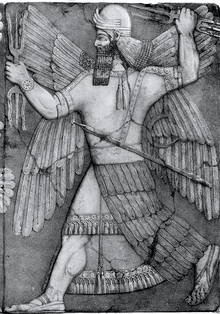
Assyrian stone relief from the temple of Ninurta, god of war (among other thing) at Kalhu, showing the god with his thunderbolts pursuing Anzû, who has stolen the Tablet of Destinies from Enlil’s sanctuary (Austen Henry Layard Monuments of Nineveh, 2nd Series, 1853) from Wikipedia
Plot:
There is no plot to this story. There is merely an overview—in the form of a course outline— of a centuries-old conflict of uncertain origin. (“[W]e remain certain that our cause is just.”) The enemy “lacks common sense, courage, religion, and access to a decent dry cleaning service.” To make matters worse, the enemy has green skin.
The outline contains a section of war profiteering, comments on the effectiveness of torture, and, of course, “our goal.”
Thoughts:
This is (surprise) an absurdist anti-war statement. While it contains some cute elements, I personally found it, sad to say, tedious overall. I liked the anti-racist touch. Perhaps that’s in part because I dislike the device of using a form like a class outline instead of telling a story. The anti-war sentiment and the feeling of absurdity about war are ones I share.
I realize this is all incredibly subjective, and the piece may leave another reader in hysterics. I wish I could recommend this because there are bright spots (e.g., Conshohocken, Pennsylvania), but I cannot.
Bio:
According to his blurb, author Robert Douglas Friedman’s fiction and humor have appeared in Story Quarterly, The Satirist, Cosmos, Humor Times, The Writing Disorder, The New York Review of Science Fiction, (something I don’t imagine is easy to do) and many other publications. He lives and works in New Jersey.
In turn-of-the-century New England, a mute woman named Helen (Dorothy McGuire) attends a (silent) film shown at a local inn. While she’s there, an unnamed woman (Myrna Dell) who limps (“a cripple”), an inn resident, is strangled by a man who’d hidden in her closet. This follows the murder of another woman, a “simple-minded creature.”
The new doctor in town, young Dr. Perry (Kent Smith), on his way back from a house call, stops by to see if he can be of any assistance with the investigation of the deceased. The old town doctor (Erville Alderson) assures him there’s nothing he can do unless he’d good enough to bring the dead back.
On his way back, Dr. Perry comes across Helen walking home from the movie. He offers her a ride, knowing there’s a dangerous man about killing disabled women. The good doctor also tells Helen he knows of a place in Boston where help is available for people in her situation. Helen’s muteness is not organic but a result of trauma when her parents died in a house fire. It’s not the last time the good doctor will be sticking his nose in her business.
Helen lives as a companion/nurse’s assistant to the elderly and ill Mrs. Warren (Ethel Barrymore), leaving her free to disregard the ministrations of Nurse Barker (Sara Allgood). The household also contains Mrs. Warren’s stepson, Professor Warren (George Brent), who has looked after her all these years, and her ne’er-do-well younger son, Stephen (Gordon Oliver), who has recently returned from Europe. Just to make things interesting (…and confusing), Stephen is having an affair with his stepbrother’s secretary and old flame, Blanche (Rhonda Fleming).
Mrs. Warren is not happy to see Stephen. In fact, she tells him he might as well go back to Europe. The bad things always happen when he’s around.
Thoughts:
I frankly felt uneasy with the premise: a serial killer picking off women with disabilities. In a world of sick SOBs, this is sick SOB. Even the good doctor, whom Helen at one point fantasizes about marrying in an elaborate sequence, is convinced he can conquer the mute woman’s inability to speak by pushing her over the edge. Helen is menaced throughout the movie: a figure watches her enter the house the night Dr. Perry drops her off from the movie at the inn. Mrs. Warren tells her she is in danger and that she must leave the house. Of course, this all occurs during an unrelenting thunderstorm.
In one scene, the villain has poor Helen trapped on a staircase landing in front of a full-length mirror. The bad’un taunts her for her muteness and for being “weak.” She turns to examine herself in the mirror. I almost screamed, why not just push the sicko down the stairs? Her life is at stake. It’s okay to forego ladylike manners and introspection for a little while. Appearances only mean so much when someone wants to strangle you.
While there are a couple of see ‘em comings, this was a nicely suspenseful film, full of red herrings. This is a deadly serious film. There are no (intentional) absurdist moments, albeit there is comic relief, such as when the maid steals a bottle of brandy under Professor Warren’s nose. Mostly, though, the feel of the movie is gothic, heavy, and the viewer knows Helen is in danger. Even the people who are being kind to her—for her own good—do so with a heavy hand.
Ethel Barrymore was nominated for her role as Mrs. Warren for Best Supporting Actress in 1947.
The screenplay is based on a book titled Some Must Watch by Ethel Lina White (1876-1944). The original book does not involve a spiral staircase, a prop the movie borrowed from The Circular Staircase by Mary Roberts Rinehart, which has been adapted for stage and screen several times, including 1930’s The Bat Whispers. Although forgotten now, White was a famous British crime novelist in her day. Another of her books, The Wheel Spins, became Alfred Hitchcock’s The Lady Vanishes (1938).
Title: The Spiral Staircase (1946) Director: Robert Siodmak
Writers: Mel Dinelli (screenplay), Ethel Lina White (novel)
Cast: Dorothy McGuire … Helen George Brent … Professor Warren Ethel Barrymore … Mrs. Warren Kent Smith … Dr. Parry Rhonda Fleming … Blanche
For Holly’s twelfth birthday, her mother had taken her to the unicorn pen. Her mother went into the butcher shop to get Holly a delicacy. Bored with adult talk, Holly goes to look at the unicorn on display in a glass case outside the shop. For years, she’d been begging her parents for a pet unicorn, a unicorn who “would be her bestest friend and confidante. She would braid flowers through her unicorn’s silky mane, ride on its back, and they would play games together in the garden all day.”
Thoughts:
This is a statement primarily on vegetarianism, but also, at a more profound level, I think it’s a portrayal of selfishness. Holly is not concerned about the welfare of the unicorn. She thinks of the animal’s beauty and of playing with the animal, but not whether it would derive any benefit from her or her actions. The purpose of the animal in her thought—as far as her thoughts go—is to serve her every whim. It has no existence outside of that.
In a small child, this thinking comes naturally. But by Holly’s age, it should be gone except in flashes. The scary thing is that the adults encourage this selfishness in Holly. Indulgence would be annoying, but this sense of entitlement is chilling.
I can’t say this was among my favorite stories, nor that it was particularly profound. Nevertheless, it did capture a glimpse of a little girl’s delight in animals.
Bio:
According to the blurb, author Avra Margariti s a Social Work undergrad from Greece. She enjoys storytelling in all its forms and writes about diverse identities and experiences. Her work has appeared or is forthcoming in Daily Science Fiction, The Forge Literary, The Arcanist, and other venues. You can find her on twitter @avramargariti.
Rachel Shommer and her fiancé, Jeremy Nybor, eagerly await the release of U-Phone XV’s instant posting feature. It will allow the user to post thoughts without the hassle of typing. All anyone has to do is merely think, and their thoughts are posted.
“My first insta-post will be one saying how much I love you,” Jeremy tells Rachel. Rachel—but not the reader—is surprised when his first post is actually:
JEREMY NYBOR THINKS THAT SUSAN FROM ACCOUNTING IS WAY HOTTER THAN RACHEL.
The post sends him to a flower shop for roses only to find the shop out of roses. Seems a lot of guys have found themselves apologizing for thoughts they’ve posted.
Thoughts:
Whose idea was it that unfiltered thoughts posted on a public forum would be a good idea? There are reasons we learn early on not to say the first thing that comes to mind, instinctively realizing it’s one way we keep this life of man (and woman) from being unnecessarily solitary, poor, nasty, brutish, and short.
Scenes of the apocalypse play out, and not merely between Rachel and Jeremy. Does the world come to an end?
This is a silly little tale, enjoyable for what it is, but I would not read it a second time.
Bio:
James Rumpel is a retired high school math teacher who has greatly enjoyed using his newfound additional free time to rekindle his love for science fiction and the written word. In an author interview with Theme of Absence, Rumpel says that he’s been writing for about a year since he retired. He’s been thinking up stories and ideas for his entire life but didn’t start writing them down until recently.
The unnamed narrator describes the stranger who strikes up a conversation with him: “the friendly type, grey at the temples, with the stocky blue-collar build of a man who never lifted a barbell in his life, but could still bench-press me over his head.”
They talk about this and that, discuss what brought them to town, and swap pictures of their grandchildren. The stranger, a butcher, is looking for a new location for a processing plant. Routine stuff. So why does the narrator feel uneasy?
Thoughts:
There are no surprises here. The ending is telegraphed from miles away, like a joke everyone but the narrator is in on. What makes the story, though, is the telling of it. It is cute. It’s the sort of conversation that might happen in any number of bars between middle-aged guys in just about any place in the world—up to a point, course. And that’s where it gets weird.
What might be worth a second glance is the idea of a shift in perspective, however. Like the garrulous stranger in the bar, many of us take for granted that others are there for our benefit. We can be polite to them or, like the stranger’s daughter, rude to them, but they still exist for us. Hmmm….
Bio:
According his blurb, author Danny Macks lives in southern Indiana surrounded by kids, cats, and dogs. He also has some fantasy book for sale through his site, but little additional info about him.
Saturday night pizza and bad movie night. The pizza was good.
Plot:
Four people on vacation in outer space are getting on each other’s nerves. It’s established early that none of them is in the running for Nobel prizes. While refueling the spaceship—which looks suspiciously like a battered rental RV— Bernard (Mel Smith), the only one whose dimmer switch is anywhere above the “off” position, goes outside for a round of spaceball. The others play with the ship’s controls (which, again, look suspiciously like those of a battered rental RV). Of course, they shoot out of the station uncontrollably and head for parts unknown, that is, a certain blue planet. Their only recourse is to send out a distress signal. Their ship crash lands on the M1 Motorway outside London, running several cars off the road in horrific explosions.
Bernard gets experience hitchhiking in space and lands in a “National Park” in Arizona, which doesn’t look at all like any place in Arizona I’ve ever seen. While Bernard tries to establish contact with trash cans, his three former friends are interrogated by British and American military about the secrets of the universe. Yeah, once more into the breach.
Thoughts:
This is a little slow in the beginning and really, really, appallingly silly. There is a lot of cute satire and homages to other movies, including (surprise) Star Wars, Close Encounters of the Third Kind, One Flew over the Cuckoo’s Nest, but also The Caine Mutiny, Blade Runner, Hitchhiker’s Guide to the Galaxy, and probably others that I missed.
I don’t mean to imply that this is packed with intellectual power—hardly. It’s just goofy. But it also pokes fun at the idea of celebrity. These three idiots become overnight sensations not because they’re anything special, but simply because they’re novel. They don’t look novel, however. They even speak English. And they are the epitome of vapid empty-headedness. The military scientists diagnose them as “brainless.” During a television interview, one of the aliens, Sandra Brock (Joanne Pearce), is asked what she read “at university.” Her one-word answer is “Shoes.” The audience eats it up. Pearce is a good enough actress to show surprise and odd delight at the audience’s reaction.
The best part of the movie, however, is the end. It is logical.
I understand that it’s not everyone’s kind of movie, but if you’re looking for a movie for Saturday pizza and bad movie night, this will fit the bill and provide a couple of chuckles.
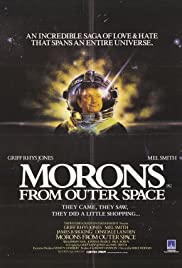
Title: Morons from Outer Space (1985)
Directed by Mike Hodges
Writing Credits (in alphabetical order) Griff Rhys Jones Mel Smith
Cast (in credits order)
Joanne Pearce … Sandra Brock Jimmy Nail … Desmond Brock Paul Bown … Julian Tope James Sikking … Col. Raymond Laribee, CIA (as James B. Sikking) Dinsdale Landen … Commander Grenville Matteson
The narrator tells the reader Danny Trank hanged himself in the garage three days earlier. People say you could hear his mother’s screams from across the neighborhood. It wasn’t a surprise, and after all, it wasn’t like the narrator and Danny were friends. Danny was just another sad sack.
He and his buddy Jay receive an invitation to Isabel’s party. Her parents are away vacationing in Fiji. As expected, they arrive at the party to find everyone drinking and dancing. What they don’t expect are the loud, intermittent bangs that seem to be coming from the basement.
Thoughts:
This was hard to get a read on at first. The feel is nihilistic/hedonistic, almost like a Bret Easton Ellis novel. When the narrator sees the hostess Isabel in a “short pink flowery dress,” he notes, “she beamed at us with those glistening pearly whites.” After some further description of her, he concludes, “I would’ve fucked her right then and there with everybody watching.”
Who says romance is dead?
But he isn’t so wrapped up in her that he fails to notice she deadbolts the door behind them.
Nevertheless, he isn’t completely listless and acts to help an innocent person.
However, some of the imagery is so over-the-top, I couldn’t buy it. It crossed my mind that perhaps the narrator’s experiences could be chalked up to (…dating myself…) bad acid. What makes this story even odder, is that the ending came as no surprise.
While the story is not bad, it was more of a puzzle that turns out to be just what you expected.
Bio:
According to his blurb, author K.N. George is a lifelong lover of the arts. He attended the Art Institute of Washington for animation but found his creative writing classes more rewarding. His passion for storytelling stems from his time as an award-winning actor during his youth.
The narrator used to love the rain, but then the boy attacked, beat, and robbed her in the rain. Ten years later, she’s at a bus stop, watching bus after bus pass by. She doesn’t want to risk getting caught in the rain, even for a little while. She sees a little girl waiting in the corner of the bus stop.
Thoughts:
Distilling the plot into everyday language makes it sound absurd. It is anything but. The poetry of the language is rich and deep. Yes, it’s rain, but perhaps it’s something more. Something that once brought joy to someone can drain the same person after trauma. It can be something as commonplace as rain.
The strength of the story is in its use of language and metaphor. While there isn’t a lot of action, there is transformation. The narrator comes to a realization about herself and the world.
I can’t say I enjoyed this sad little story, but I certainly admired it.
Bio:
Accord to the blurb, author M.K. Hutchins regularly draws on her background in archaeology when writing fiction. She’s the author of the YA fantasy novels The Redwood Palace and Drift, and she’s written over thirty short stories, appearing in Podcastle, Analog, and elsewhere. She lives in Utah with her husband and four children. Find her at mkhutchins.com.









 Reviews of Old and New Stories. Mostly Old